

Unquestionably Skeptical (like Donald Howard Menzel)
When you hear people say the UFO cover-up is a deep state, NSA & CIA-led, decades’ old psyop, Donald Menzel is who they’re talking about.

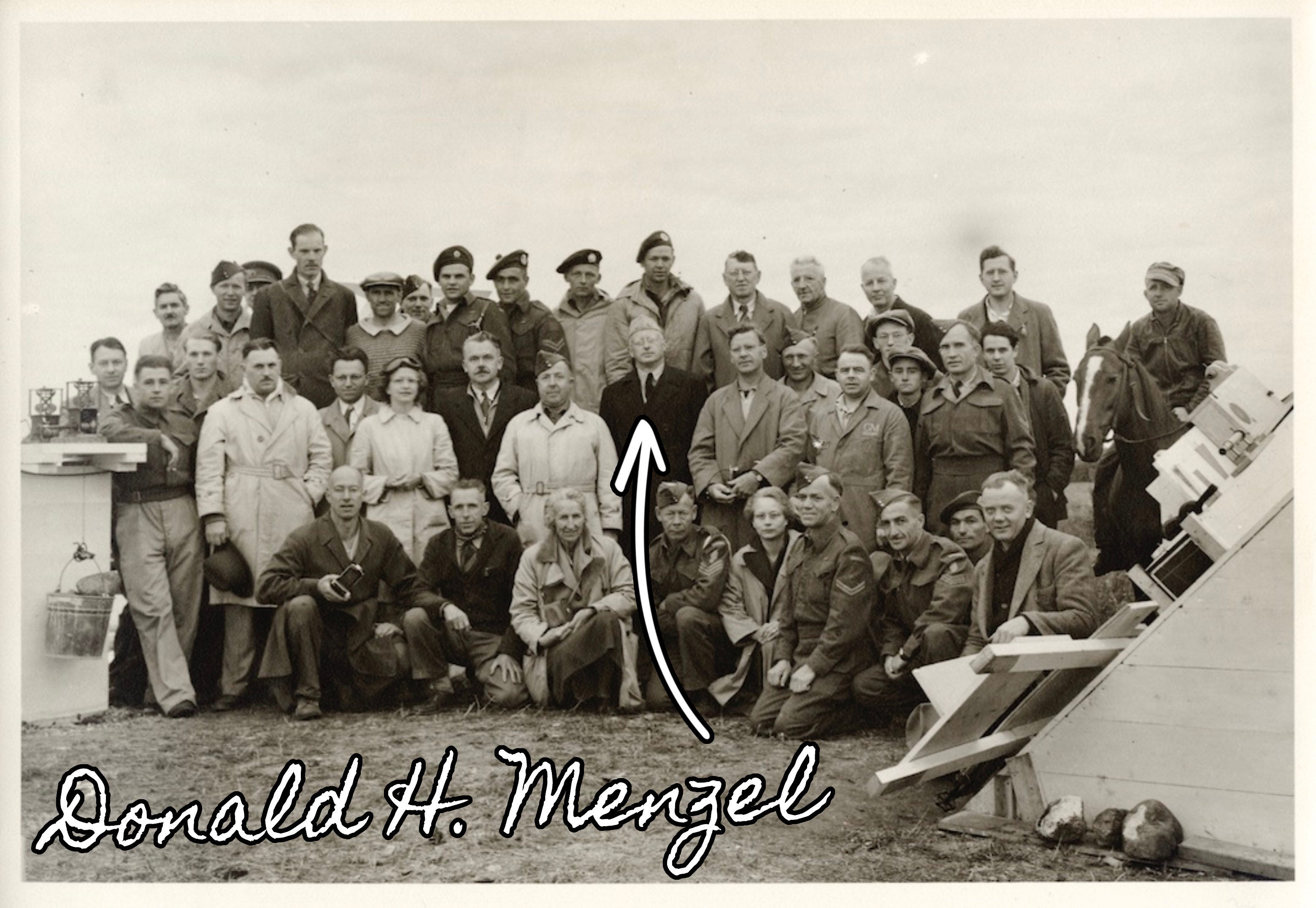
Donald Menzel was a genius
It is unequivocal that Donald Menzel was a genius. There are many stories that capture this1, but perhaps one of the best is from I. Bernard Cohen as he and Henry Tropp interviewed Howard Aiken for the Computer Oral History Collection. On Menzel, Cohen recalled, “The first person who said scientifically that there has to be a positive electron, and this we can document, was Donald Menzel, but he gets no credit for it, because it was just his thinking as he was studying problems in electrodynamics and quantum theory.”2
The genius consideration may be a bitter pill for researchers digging into the cover-up of UAP/NHI–and a surprise for dogmatic-skeptics–but it is medicine worth taking to have a better frame of reference for uncovering the facts that Menzel was so successfully able to hide.3 Of course he had help, but many of the bounds Menzel tied around the data indicating an earthly presence of NHI remained secure, and secret, for decades.
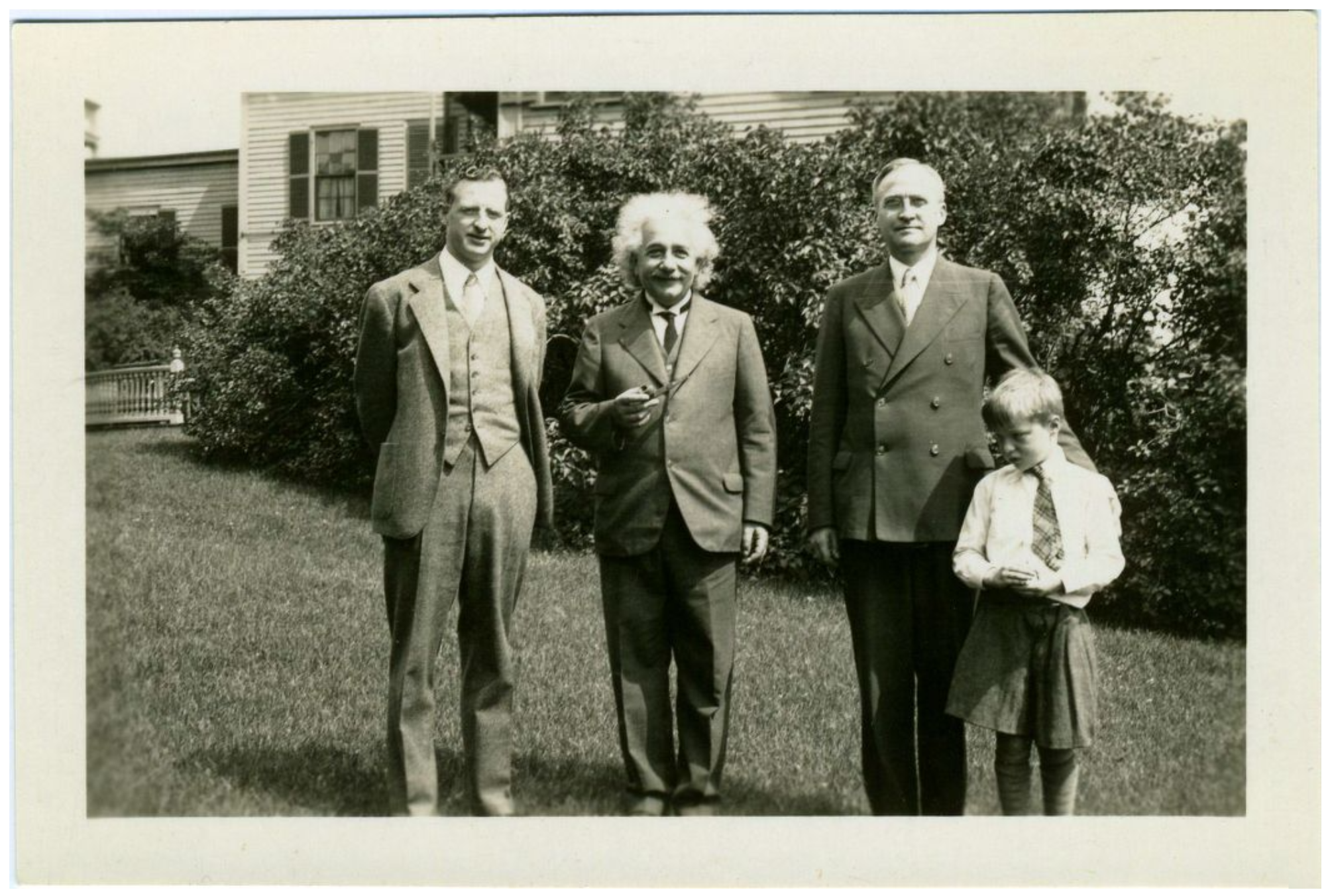
This type of success in secrecy–across generations–is not accidental, it is intentionally and expertly applied.4 It is the outcome of controlled access, compartmentation, and institutional authority. It is also indicative of secrecy tightly held. Wilbert H. Smith offers a peek into the climate of secrecy in which Menzel operated when he discreetly uncovered through Canadian Embassy staff in Washington D.C. the “...operation of the saucers…” and relayed in his Top Secret memo5 from November 21, 1950:
“The matter is the most highly classified subject in the United States Government, rating higher even than the H-bomb.”
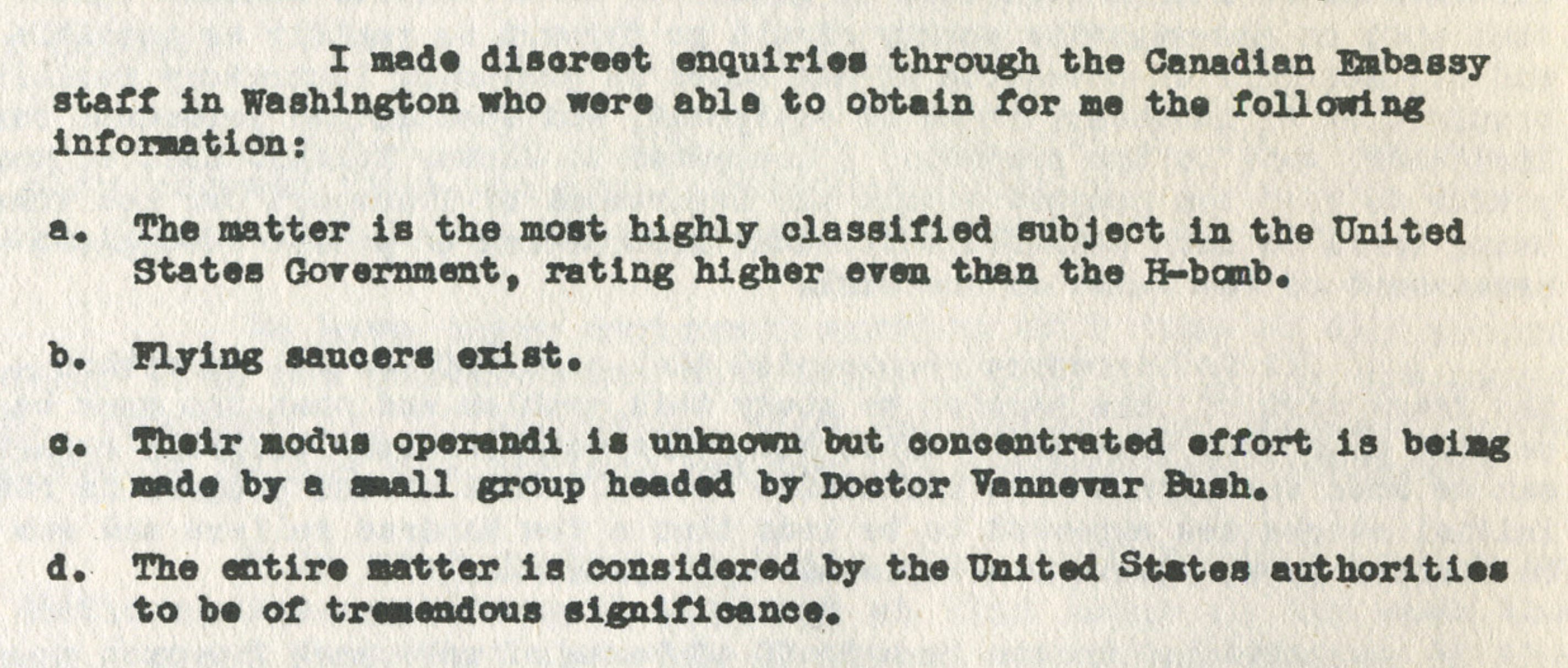
Perhaps no other researcher uncovered as much about Menzel as Stanton T. Friedman, who said, “I have developed great respect for Donald Menzel. He may have been egotistical (a word I heard often from his associates, and it comes through in some of his writing about his background); however, I have to respect his discretion in maintaining an active life on behalf of his country and I admire his patriotism.”6
Thus, believing Menzel to be a boor or simple skeptic is a disservice. The question isn’t whether Menzel was intelligent. He was. The question is what he did with that intelligence as he entered the classified communications world–and why his public role as an arch-skeptic functioned so effectively. Better to abandon as much bias as possible and earnestly seek answers to:
How did Donald Menzel apply his genius to the cover-up?
What strategy and tactics endured, some even into our present day?
How did his background, training and relationships contribute to his efforts?
How did he father modern dogmatic skeptics?
Menzel’s Youthful Mind
Born on the picturesque eastern edge of Colorado’s Front Range7 and growing up in the Rocky Mountains,8 Menzel filled his days developing secret ciphers for his boyhood clubs, inventing offshoots of Pig Latin, learning Morse code, securing a Boy Scout merit badge in signaling, building his own radio transmitter, doodling, reading voraciously, and writing in abundance.9 Later in his boyhood years, he gained the amateur radio call sign W1JEX which he kept until his death. Not one for staying pent up indoors, he also enjoyed fishing, rock collecting, camping and trekking through the Rockies while a Boy Scout.
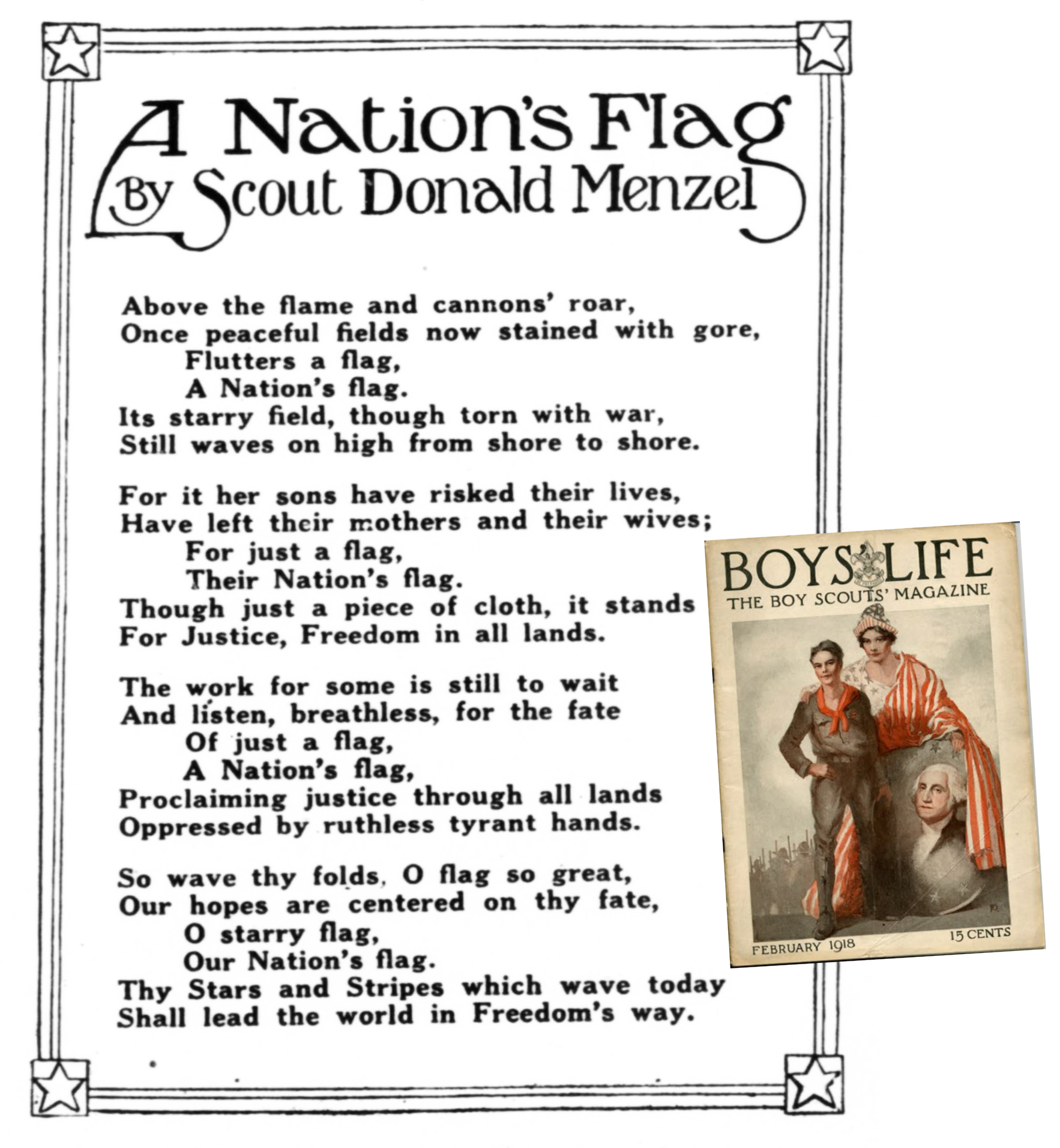
Throughout his life he retained a prodigious intellect, was strategically-minded, had a lasting and precise memory, was inventive, and was a prolific author.10 His acceleration from undergraduate to Ph.D. is summarized well by Craig Bauer and John Ulrich in their excellent, “The Cryptologic Contributions of Dr. Donald Menzel.”
As an undergraduate at the University of Denver, class of 1920, he planned on a career in chemistry. Indeed, he received his A.B. in chemistry, standing second in a class of several hundred students. In 1921, he earned A.M.s in chemistry and mathematics, also from the University of Denver. However, while working as an industrial chemist, his plans were changed by an explosion which left him seriously affected by the fumes. His doctor’s orders were to keep away from chemicals. Thus prompted to change fields, he pursued astronomy. At Princeton University, he earned an A.M. in astronomy in 1923, and a Ph.D. in astrophysics in 1924. According to Menzel, there had only been one other Ph.D. in astrophysics awarded in the U.S. at that time. His age made it even more impressive; he was born on April 11, 1901 (in Florence, Colorado).11
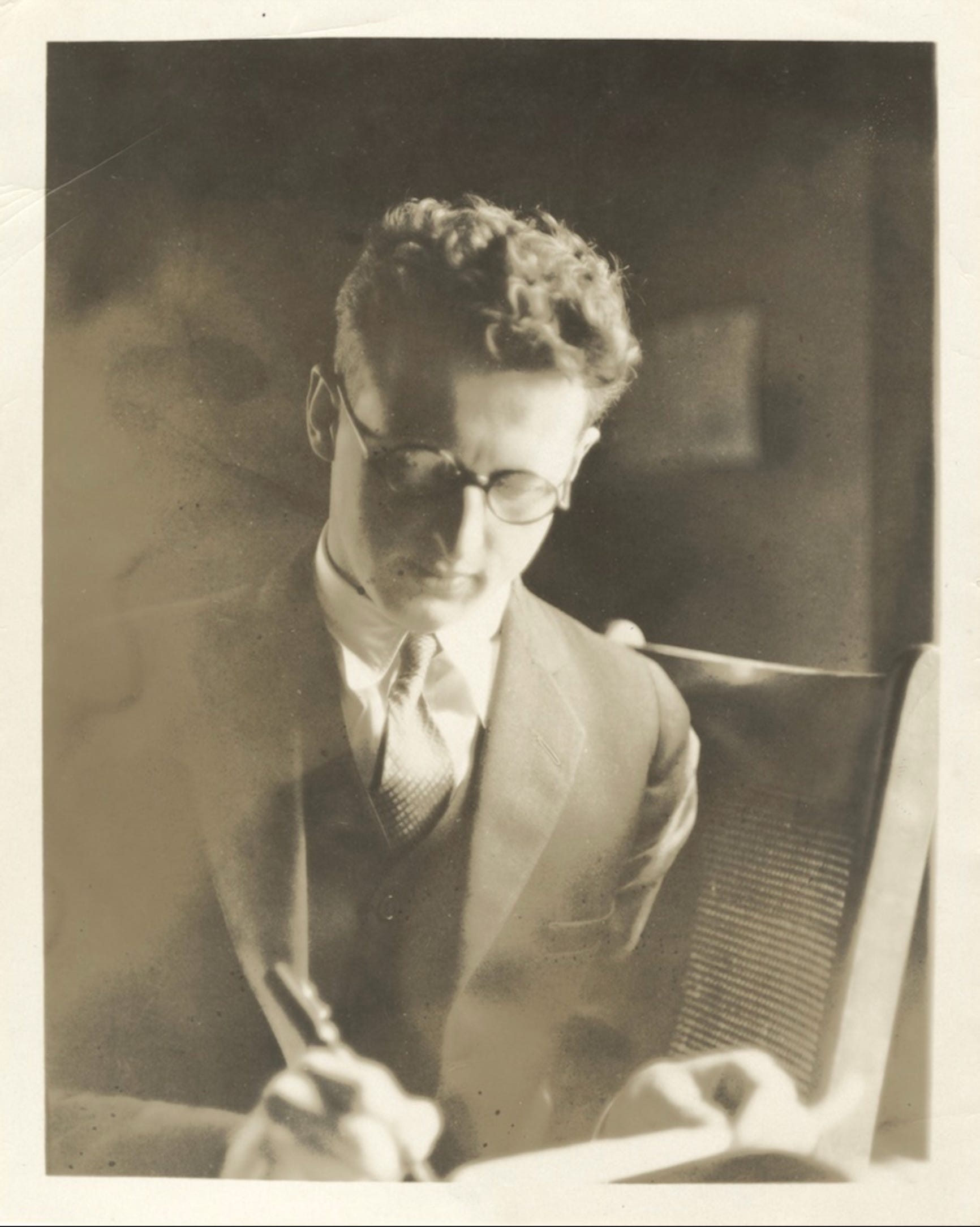
Prior to beginning his Ph.D. and when still considering astronomy, Menzel wrote to the American Association of Variable Star Observers (AAVSO) President Leon Campbell to learn how variable star observers worked.
“In May 1920…Campbell responded to a letter from Donald H. Menzel of Denver, Colorado, explaining in general terms how variable star observers worked. He referred the boy to the work of Henry Norris Russell, Harlow Shapley, Theodore Phillips, and Herbert Turner, who did visual or photometric work that young Menzel could ‘take up to advantage.’ Menzel’s reply indicated his desire to begin work immediately, without waiting for charts. By August, Menzel reported he had observed some eclipses of binary stars with the 6-inch Grubb refractor of the University of Denver. Within a year, Menzel won an appointment to graduate study in astronomy at Princeton University. He attended his first AAVSO meeting, the 1922 Spring Meeting hosted by the Olcotts in Norwich, and then traveled on to Cambridge for research in the HCO plate stacks. During his stay in Cambridge, Menzel roomed with the Campbell family.”12
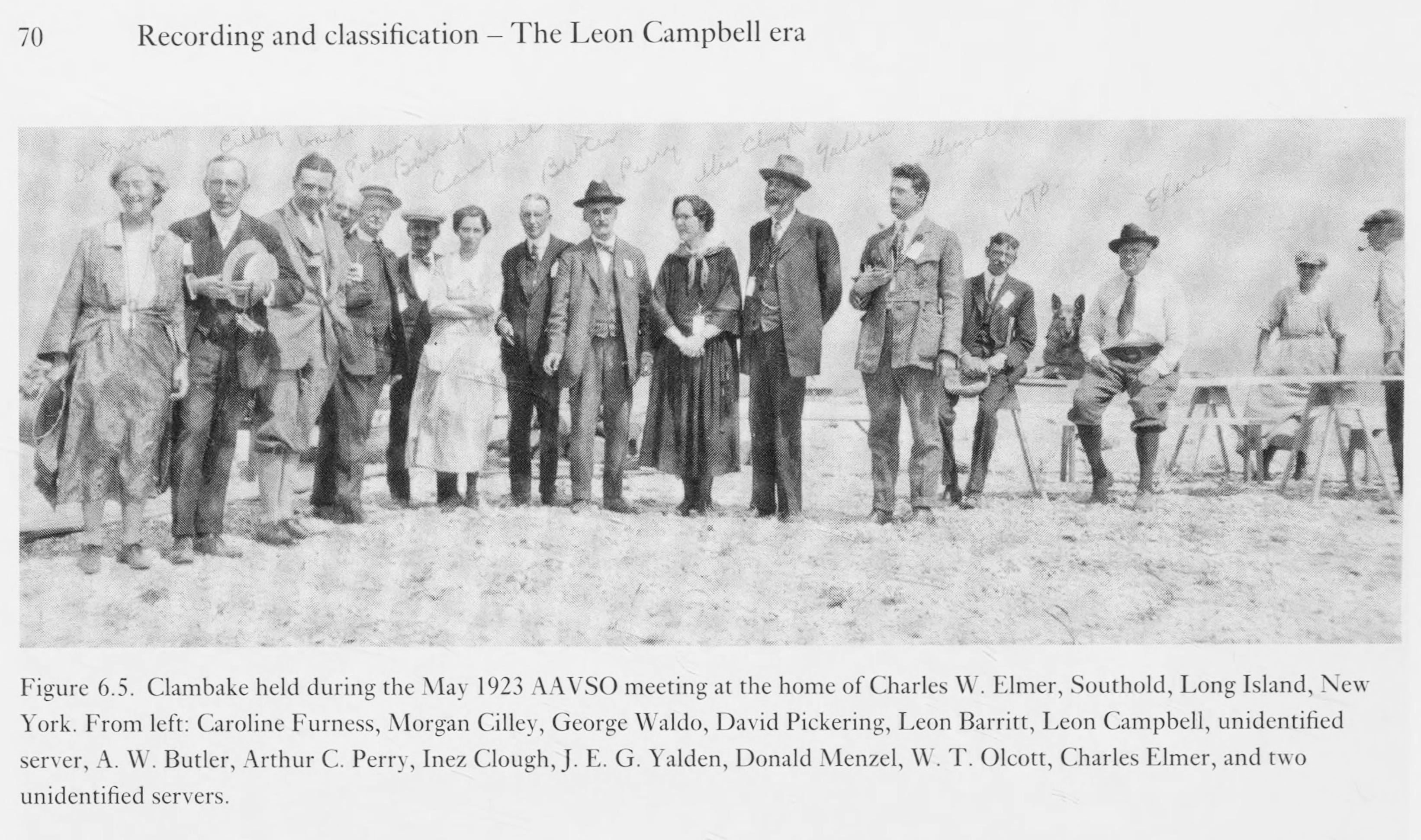
While studying for his Ph.D. in astrophysics, “Harlow Shapley employed him at Harvard as a research assistant during the summers of 1922, 1923, and 1924.”13 These years were Menzel’s introduction to the famed plate vaults of the Harvard College Observatory. Marianne J. Dyson records: “[Henry Norris] Russell sent his graduate student Donald Menzel to Harlow Shapley at Harvard to use the plate vaults for his thesis on the ionization potential for titanium...Menzel completed his thesis ‘A Study of Line Intensities in Stellar Spectra’ in 1924.”14
Menzel went on to teach for two years, first at Iowa State and in the second at Ohio State, where in 1926 he met and married Florence Kreager. Next, with the recommendation and backing of Russell, he took a role at Lick Observatory. Here he demonstrated his expertise with photographic plates–skills honed in Harvard’s vaults–when a colleague, “...had not calibrated the photographic plates to establish the relationship between blackness of the image and intensity, a limitation Donald ingeniously managed to overcome.”15
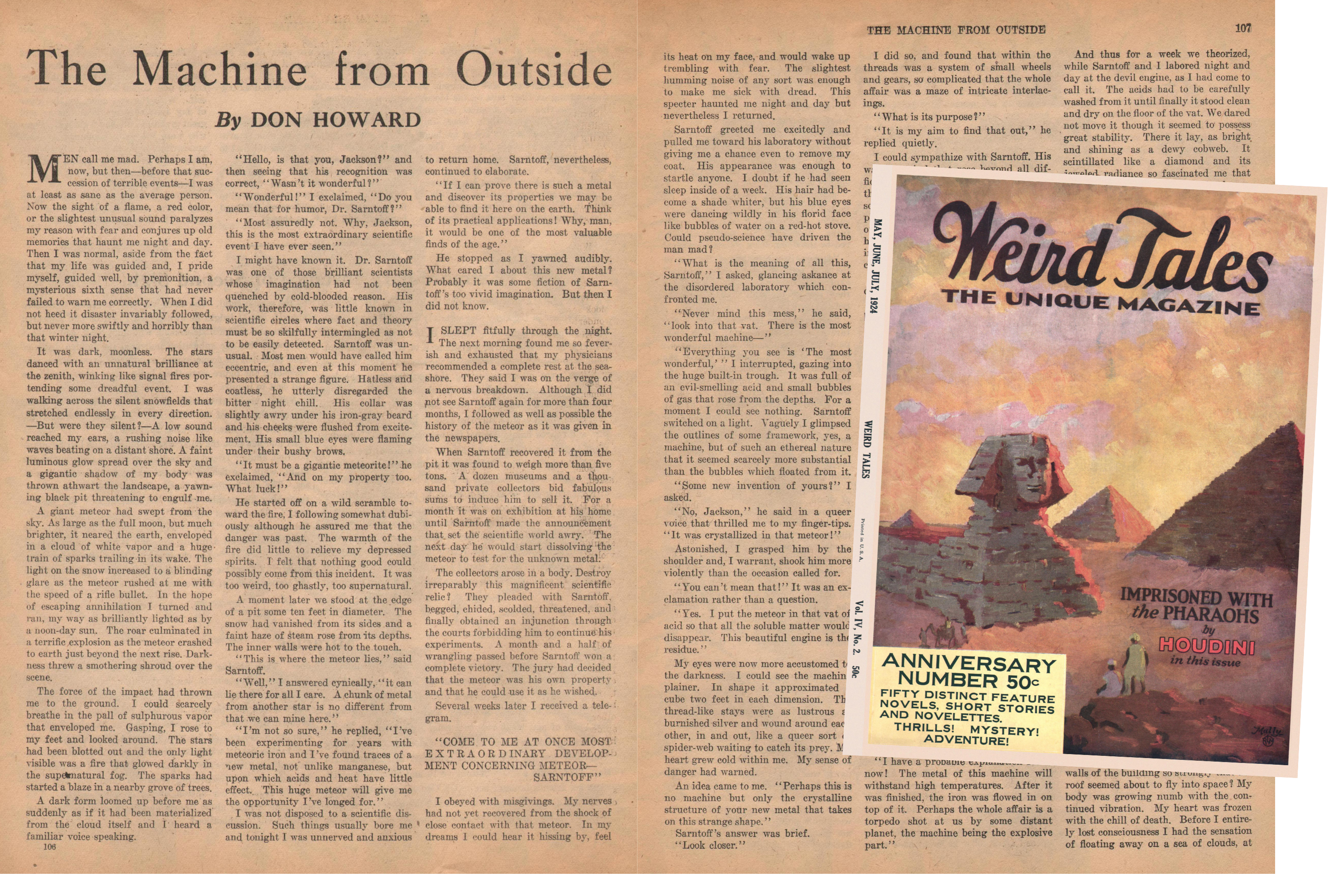
While Menzel was earning his degrees and working at Lick Observatory, he also pseudonymously wrote science fiction as Don Howard.16 He wrote popular science in his own name and with pen names including ”Joseph N. Howard, George W. Zint, Charles T. Howard, Gene Deachem, Don Home, Haldon Menley, and Charles T. Dahama (this last name consisted of his initials with the letter ‘a’ interspersed between).”17
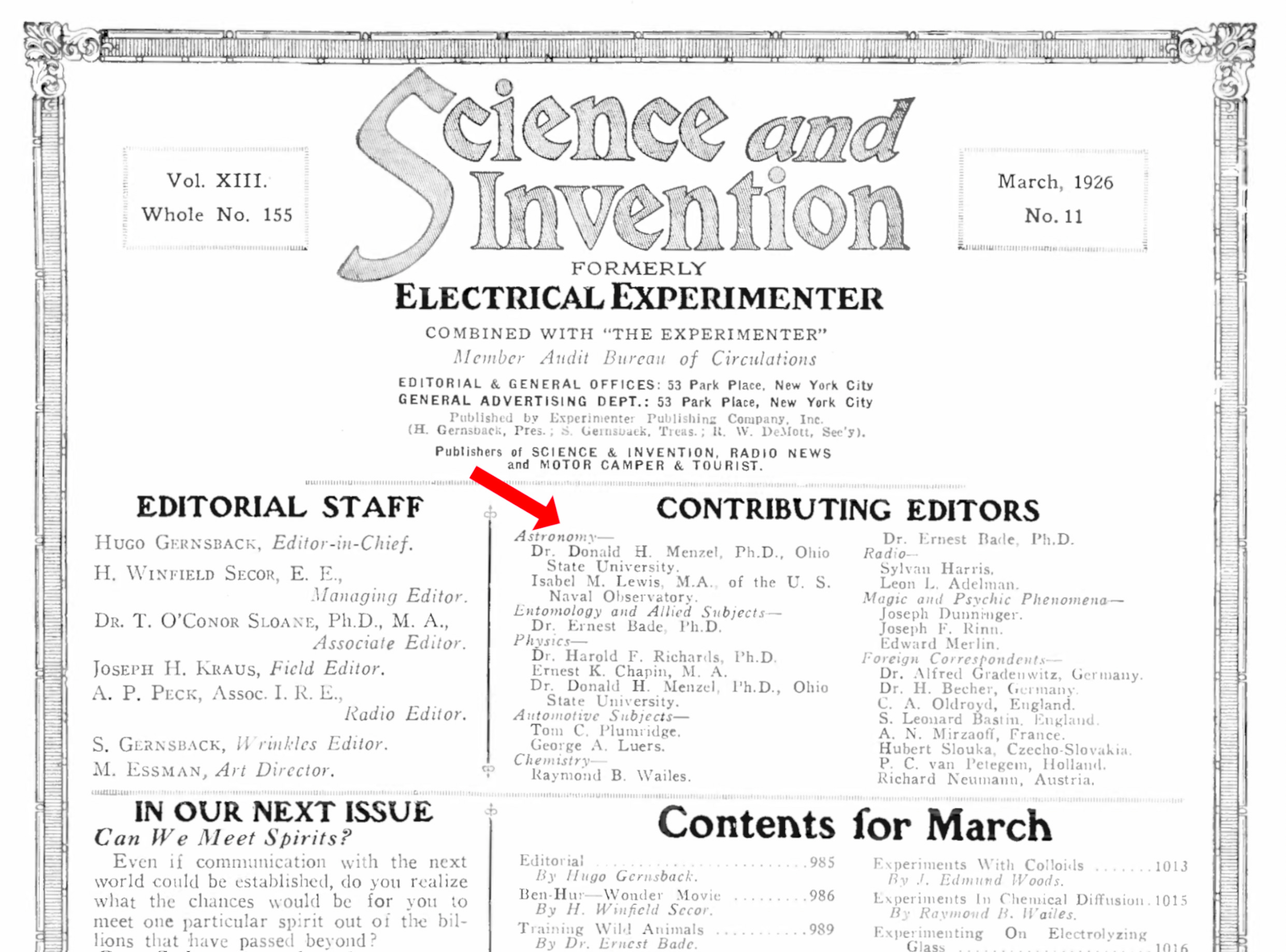
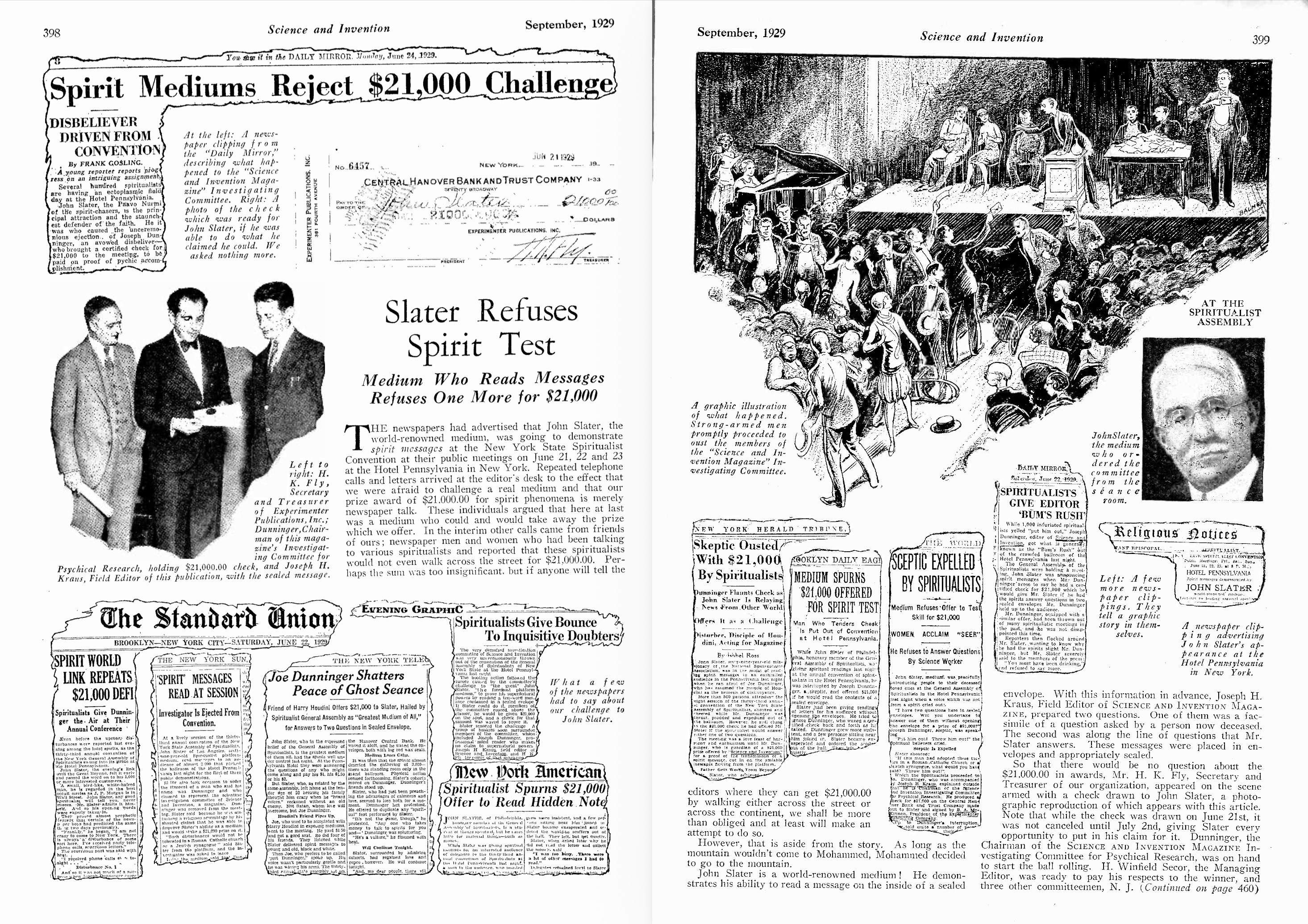
During the latter half of the 1920s, Menzel’s popular science writing frequently appeared in Science and Invention magazine, where he served several years as a contributing editor.18
In the years following his Ph.D., an enduring pattern solidified for Menzel. He could handle a variety of studies, groups, and projects while excelling in each, consistently demonstrating success on parallel tracks: scientific work, public writing, and pseudonymous fiction. In 1932, at age 31, Menzel was hired at Harvard College Observatory and became a permanent fixture there until his retirement and death in 1976. Menzel’s restless mind19 persisted throughout his life as he held patents in his own name,20 was an unheralded war hero,21 and kept entire swathes of his accomplishments hidden for decades.22 Of his classified work with the NSA, CIA–and other nascent intelligence organizations that preceded them–his wife of 50 years, Florence Elizabeth Menzel, never knew.23
Menzel, the Harvard Man
In the 1930s, Menzel earned a reputation for being diligent and diplomatic. “At Harvard, where theoretical activity was encouraged, the next nine years were to be scientifically the most productive of Menzel’s career. He promptly became acquainted with Harvard and Massachusetts Institute of Technology (MIT) physicists and persuaded them to work with him on problems of astrophysical interest.”24 He met and stayed connected with luminaries in both theory and applied sciences. These include Albert Einstein, Robert Oppenheimer, George Birkhoff, James G. Baker, Howard Aiken, Wallace Eckert, Philip Morse, Vannevar Bush, Edward Condon,25 among many others.26 Each figure named here is documented in this article with a specific connection to Menzel.
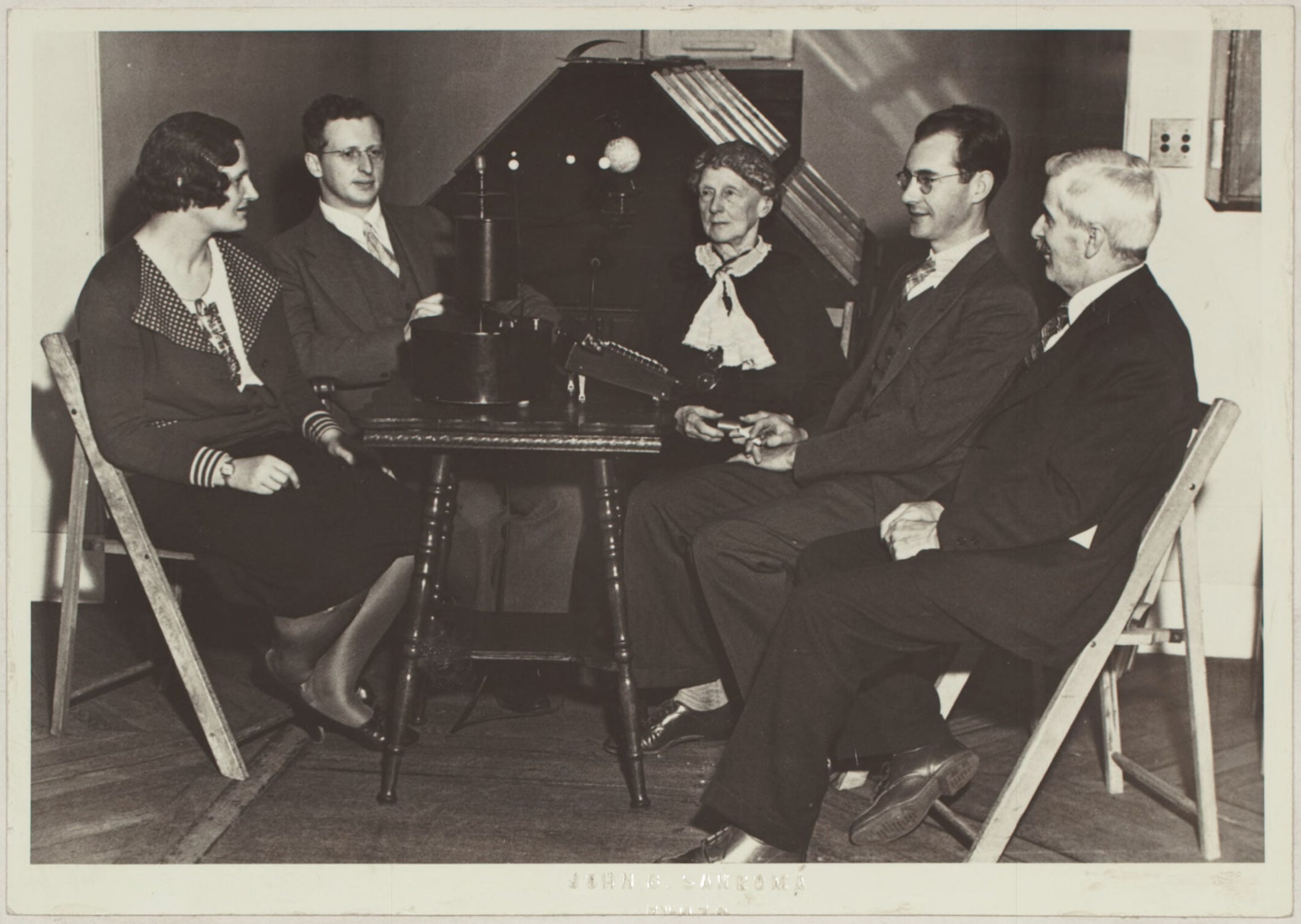
Menzel recounts working on early analog computers with Vannevar Bush in 1936:
By this time, Vannevar Bush at MIT was very active with the differential analyzer. And I went down to him and told him about my problem and between us we worked out a special machine. It was a very simple sort of gadget in which you would transform, just simply follow a line tracing and with pencil would draw out the linear that would rectify this. And so this was another step in the development [of computers].27
Also in the 1930s, Menzel recounts early computer developments with Aiken and Eckert:
I heard during this discussion about 1935, that there was likely to be a computing facility here at Harvard. And I believe Howard Aiken at that time was planning such a facility and he probably went around to the Heads of the different departments including the Astronomy Department and he asked Dr. Shapley what the needs would be of the astronomer. And of course, Dr. Shapley asked me to do that, and this was what this came out of. This was not something that I dashed off by any means. I made quite a study of it. I myself am not a celestial mechanician. I had obtained advice on this from two people. One of them was himself a pioneer in computation, Wallace Eckert. He was a very close friend of mine. His wife used to work for me.
Wallace Eckert’s wife, Dorothy Eckert, worked in the field of computerized measurement of star positions on photographic plates:
The measurement of stellar positions on photographic plates was an important program under the supervision of Dirk Brouwer, head of the astronomy department at Yale University. Its purpose was to register the data on the plates that were taken at the Yale-Columbia Southern Station. Numerous people were involved, particularly Ida Barney and Dorrit Hoffleit at Yale, and for the numerical processing and automatic scanning, Rebecca Jones and Dorothy Eckert, wife of Wallace Eckert, at the IBM Watson Laboratory.28
Even before the war, Menzel is documented forming working relationships across universities with people of a similar, pioneering bent. He was actively applying new technology to astronomy and paying attention to the development of computers. Returning to Menzel for more background on his long term friendship with the Eckerts, again from his interview with Henry Tropp:
Menzel: Well she [Dorothy “Doll” Eckert] worked at Lick Observatory when I was at Lick Observatory and then later on during World War II, when I was in the Navy, and faced with additional problems in computation, and so on, I – I hired “Doll” as they called her, to work for me in the Navy Department. And she worked for me for a couple of years. And we, well, as I say, I’ve known her since 19 .. 1928 I guess, in this work.
Henry Tropp: Of course Wallace Eckert has always been interested in this problem and the need for computation.
Menzel: Well, it was Wallace that was my primary contact in this because of the fact that I knew him so well.29
As for other scientists mentioned above, on Robert Oppenheimer, Menzel states, “...I knew him very well and he was very kind and gave me a great deal of help and encouragement.”30 Regarding Edward Condon, “It must have been in 1930 that I first became associated with the Bureau [of Standards] because I knew Ed Condon very well. And Ed used to rely on me for advice a good deal.”31 On Morse, “I got most of my [mathematical] encouragement from MIT, Philip Morse.”32 For mathematics help at Harvard, “There was only one person that I really obtained help and encouragement from and that was George Birkhoff. He was the bravest of them all and I went to him with some of my mathematical problems and he considered me a very good practical mathematician. And that was high praise coming from him.”33 And finally for Baker, “Menzel was the first to recognize [James G. Baker’s] talents for building new instruments and put him under the guidance of instrumentalists such as Joseph Boyce and George Harrison at MIT.”34
Closing the decade and by the start of the 1940s, Menzel was well-established in academia and the fields of study that would put him firmly in the establishment of an America preparing for war.35
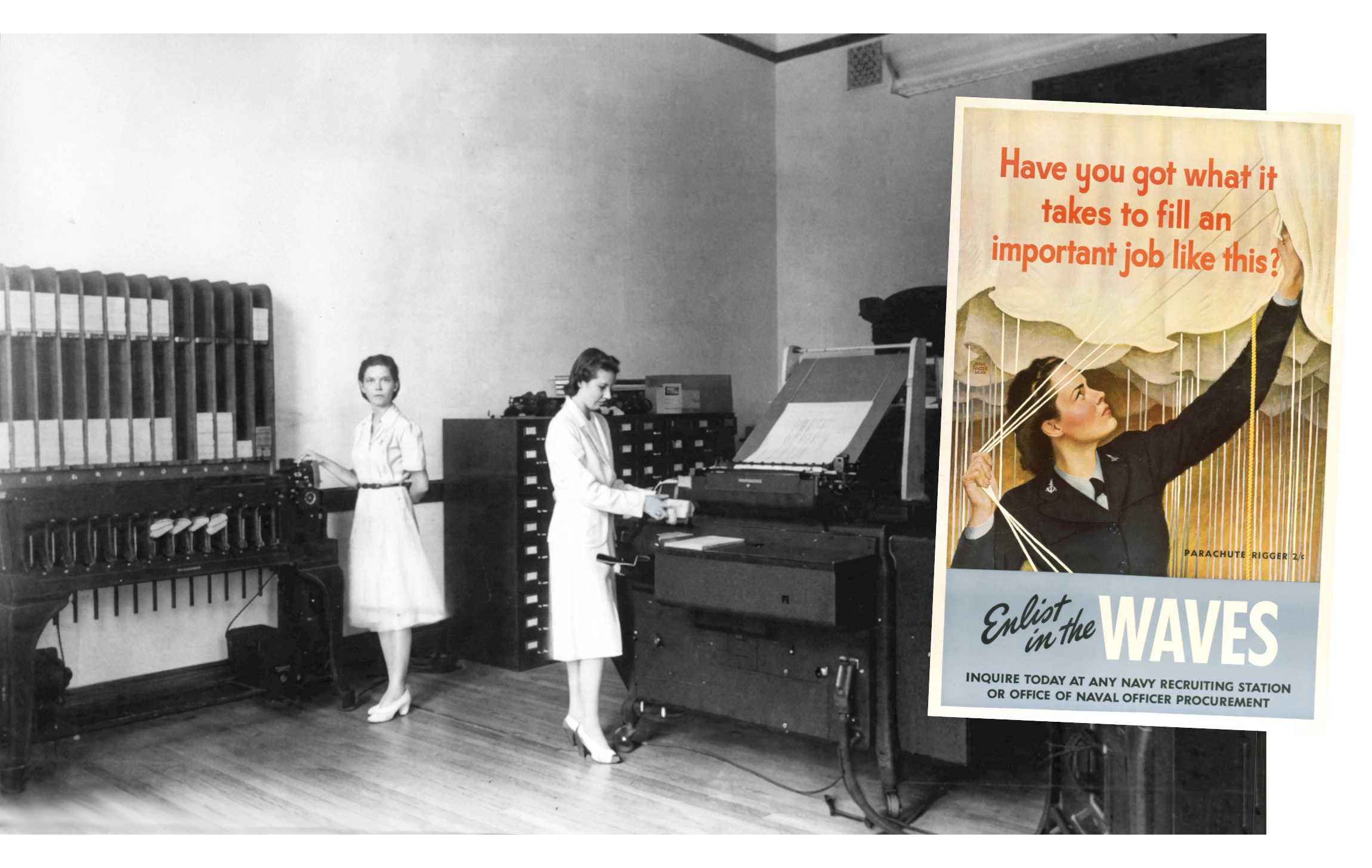
Menzel crosses into a cleared, indoctrinated and classified world
The Second World War brought profound changes for Donald Menzel. First, he became a lieutenant commander in the Navy, holding a Top Secret Ultra Clearance. Ultra intelligence came from the program concerned with codebreaking German, and other, sourced codes. In his book “Top Secret Ultra” Bletchley Park intelligence analyst Peter Calvocoressi gives the history on nomenclature:
Enigma was the name given by the Germans to their machine. Ultra was the name given by us to the intelligence we got from breaking Enigma. Top Secret Ultra, to give it its full name, was a grade or category of intelligence. It applied to documents and to what was in them. Some things were Secret, others were Most Secret. But Most Secret did not mean what it said. For some things were more secret than Most Secret. These were Most Secret Ultra - changed to the dubiously grammatical Top Secret Ultra when the Americans came into the war.36
Menzel’s boyhood ciphers were no longer a hobby. Code breaking and code making became a key aspect of his wartime activities–featuring teaching secret classes of “Code Girl”37 WAVES38 for use in the total war effort. His other activities included analysis of the ionosphere to determine optimal times for radio propagation,39 direction and location finding of enemy submarines,40 transponder signals, and communications intelligence.
Also during the war, his parents, mother Ina Grace (née Zint) Menzel and father Charles Theodore Menzel, died less than a year apart on November 6, 194241 and August 17, 1943,42 respectively. The sense of loneliness and reevaluation that accompanies the loss of both parents didn’t alter Menzel’s path; rather, the passings cemented his identity and network of, “...many contacts in the military industrial complex.”43
The boy genius was now in his 40s, a father to two daughters and an instructing mentor to many more young women–eagerly seeking to serve in the Office of Naval Intelligence. The mix of these traits would define his closest friends and confidants moving forward: intelligence, clearances, scientific discovery, industriousness, inventiveness, and subterfuge.
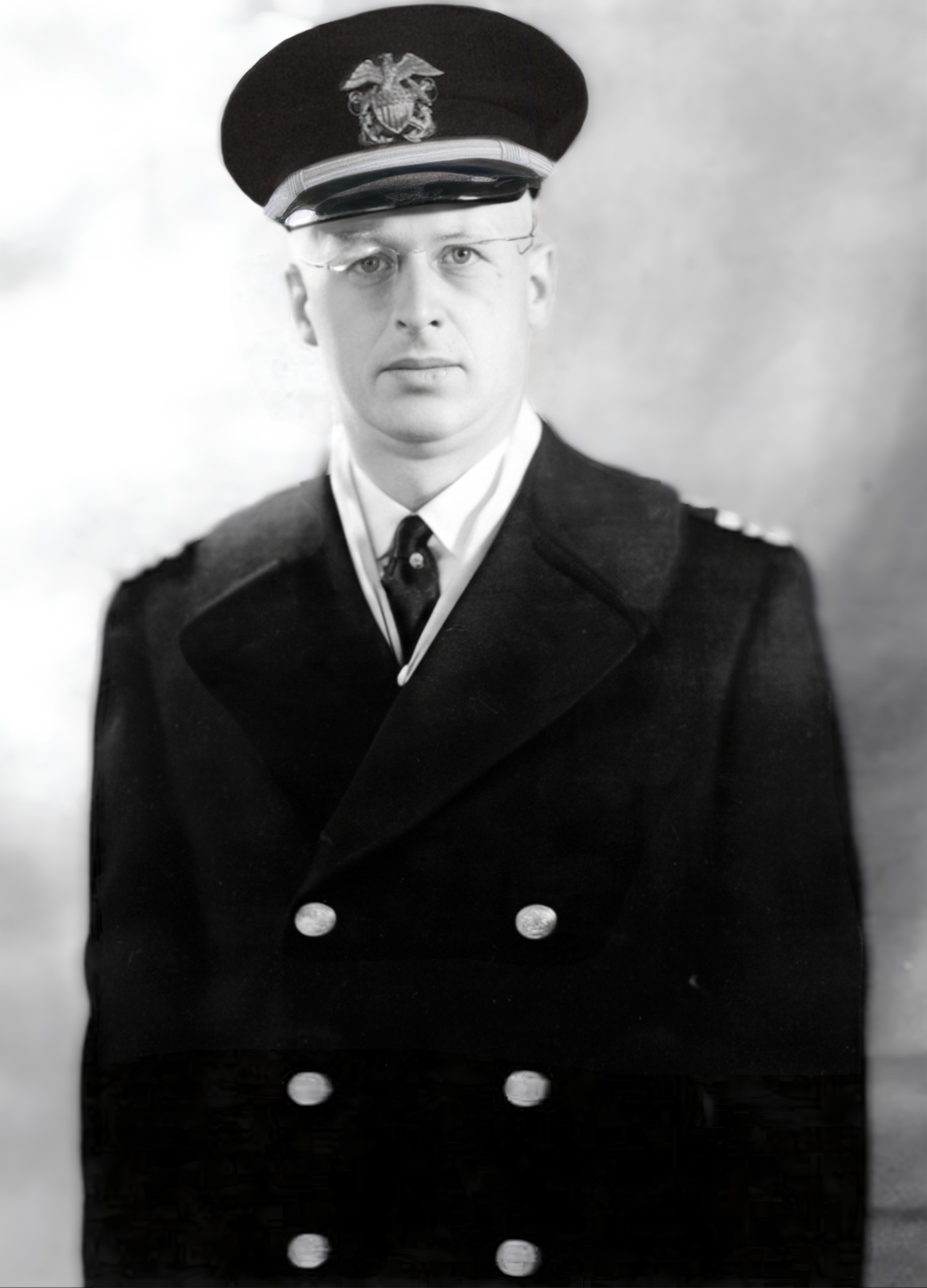
In 1942, this work mix brought Menzel into the blandly named, “Navy Communications Annex” and that unit–when later combined with the Army Signal Intelligence Service–would become the National Security Agency (NSA).44 Earlier, Menzel worked with the Office of Scientific Research and Development under Vannevar Bush with one of his developments there being, “...a gun sight that could be used when the plane that was flying in from the direction of the sun.”45 (Patent US761649A) In 1942 though, now fully housed within the Navy, he found out that he was to be in charge of mathematical and physical research for Naval Communications, combining his knowledge in astronomy, radio ham operations, and the effects of solar activity on radio propagation.46
This station also means Menzel would have U. S. Navy manual DNC 5, “Communications Instructions” [referenced earlier in Unquestionably Skeptical (About UFOs)] as one of the textbooks for the courses he continued to teach to WAVES. With DNC 5 as a textbook, his courses would be certain to cover cryptography, cryptanalysis, deception, manipulative transmissions, and misleading material.47 He was also keenly aware of radio countermeasures. Even further, developing a type of computing machine for the Navy that gave probability and the likely fix for enemy submarines when they transmitted, Menzel was able to provide coordinates that, “...sank dozens of submarines, especially in the Caribbean.”48
Menzel’s successes in cryptanalysis, direction finding, and novel computing methods–on top of his core curriculums in astrophysics and communications led to his becoming an NSA and CIA consultant for more than two decades following the war. This later consulting role is documented in primary records and Menzel’s own statements, presented in later sections.
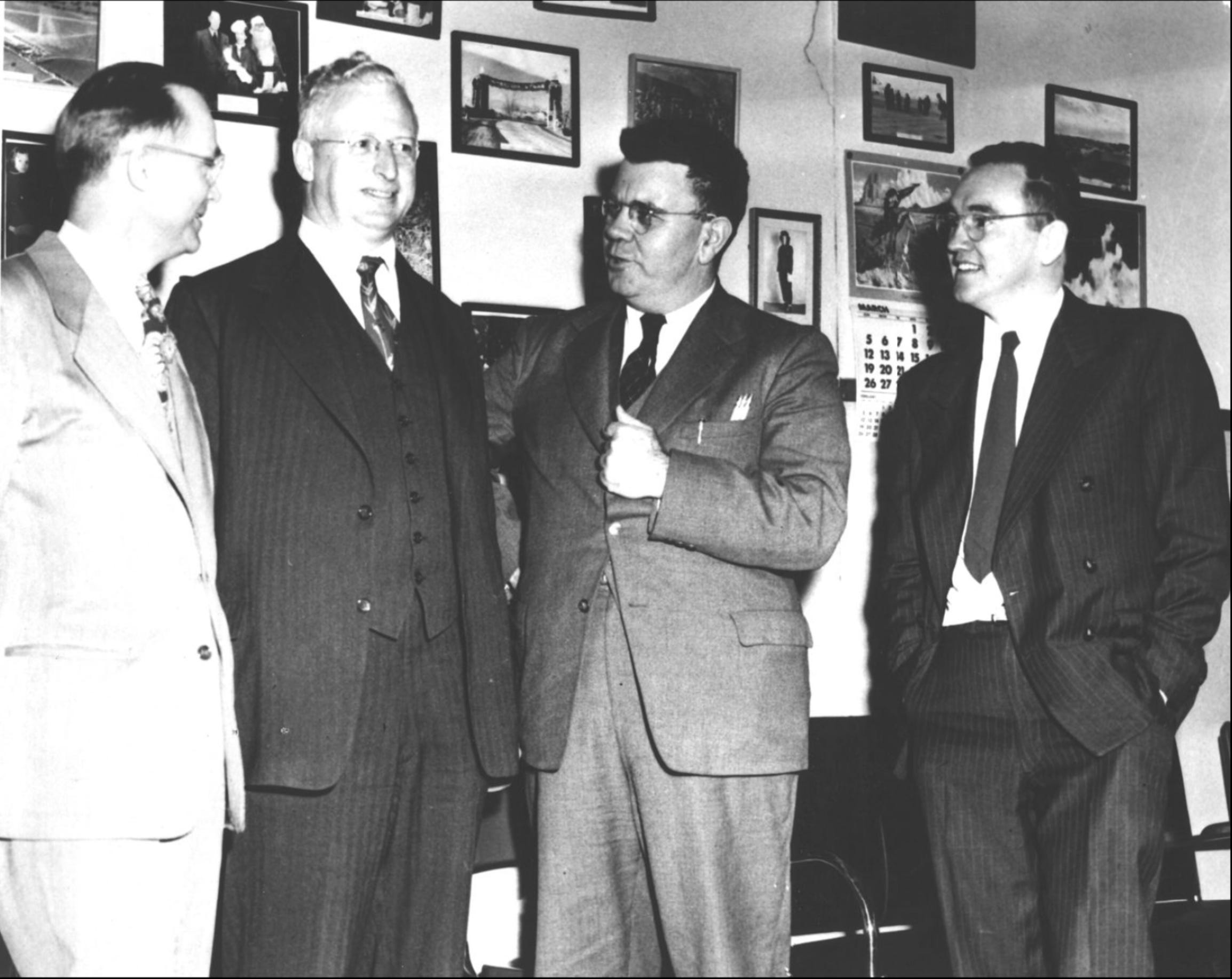
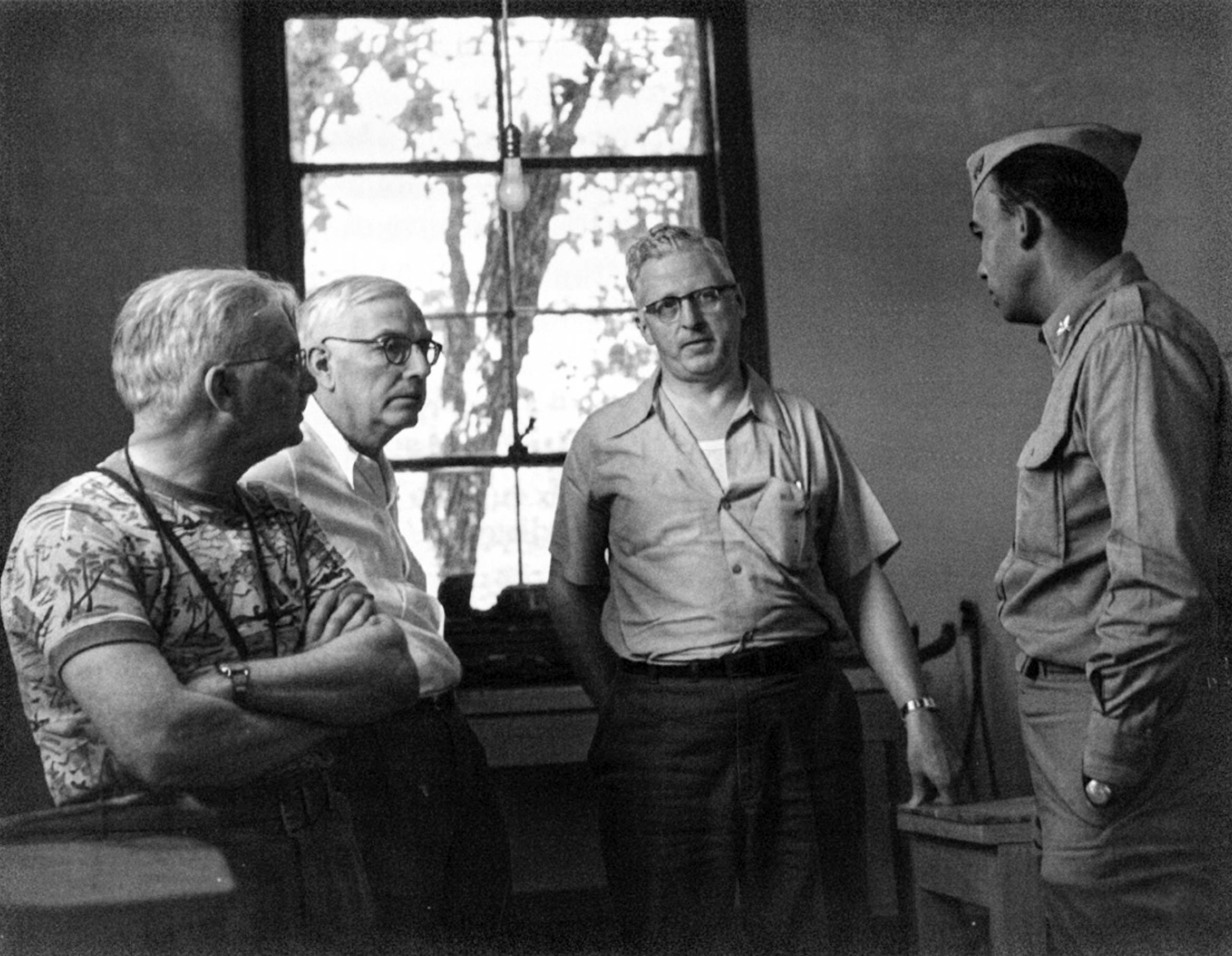
Returning to our photo from the opening of this article, Menzel, center of frame, is surrounded by astronomers and combined forces from the US and Canada. The date is on or near July 9th, 1945, when the cloud-obscured solar eclipse overhead would hit totality. Victory in Europe was secured two months earlier on May 8th. The first nuclear bomb would be detonated a week later on July 16th at Trinity as part of the Manhattan Project. Three weeks later, on August 6th, the atomic bomb was dropped on Hiroshima, then on Nagasaki on August 9th. Within two months on either side of this photograph, World War II was over.
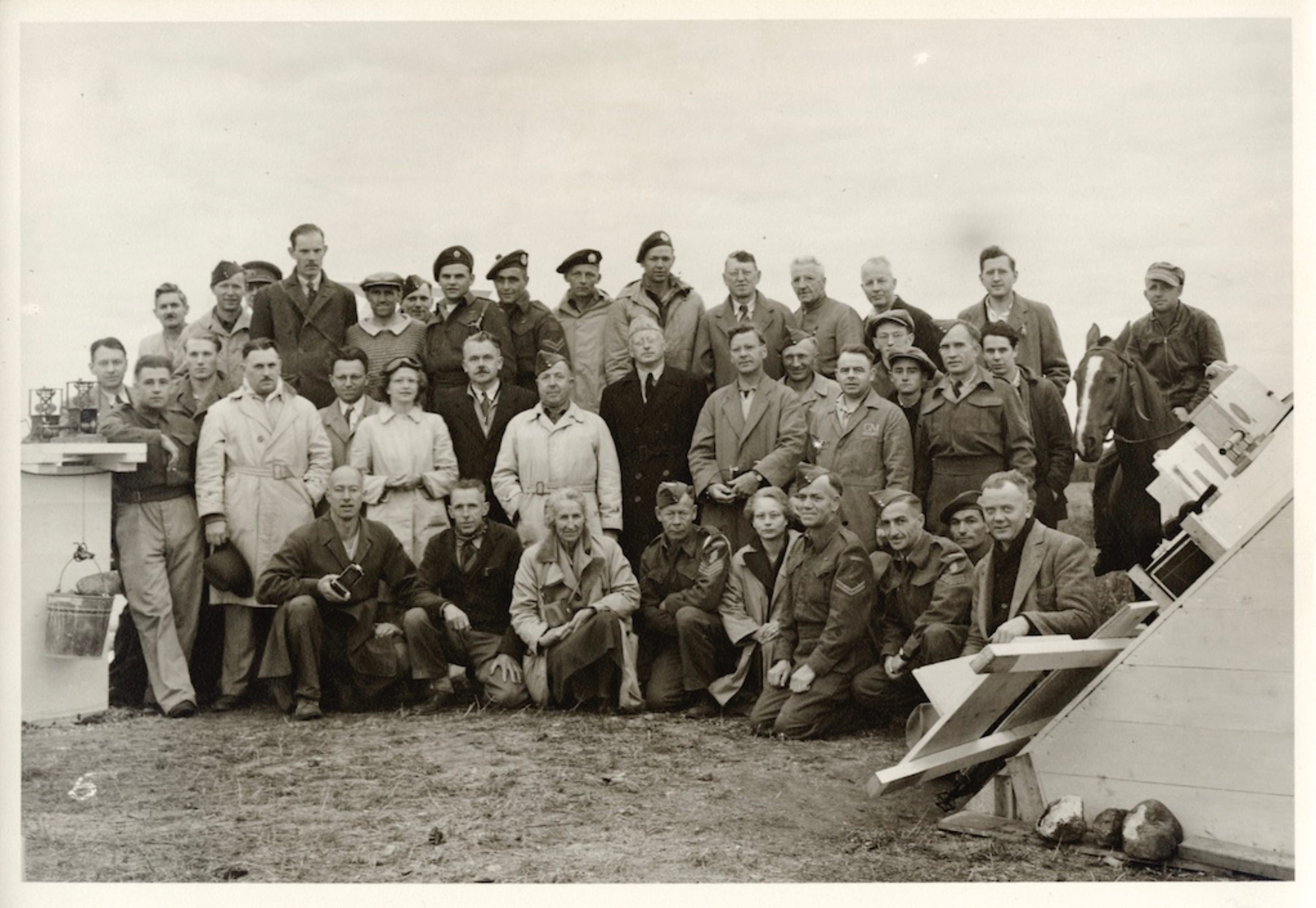
Menzel’s Majestic matriculation
For many, the end of World War II meant an end to their military service.49 For Menzel it only looked that way. He returned as the first chair of the Harvard Astronomy Department,50 but he would remain the Commanding Officer at the Naval Reserve Unit in Boston continuing cryptographic work.51 Additionally, he was a scientist on the receiving end of Operation Paperclip, “...to the advantage of coronal studies.”52 Menzel sought, “...to find out all that German scientists had been doing in coronagraphic studies during the war.”53 And, “...to get several of the newest German coronagraphs being produced at the Zeiss plant at Jena transferred to observatories in the Western Hemisphere.”54 Author Ruth Liebowitz puts it succinctly, “When the war ended, some of the scientists who had been in wartime employ now disengaged. Menzel was one of those who did not.”55
The Mark I computer would also remain in service at Harvard’s Cruft Lab, overseen by Professor and former US Navy Commander Howard H. Aiken.56 Entering service in 1944, the Mark I, followed by the Mark II and Mark III, continued to run communications intelligence (COMINT) calculations57 after earlier being put to use by John von Neumann in calculating the implosion of the atomic bomb.58
All these–Menzel, Aiken, Von Neumann59–would remain “COMINT indoctrinated personnel” long term with the United States Communications Intelligence Board (USCIB). As the postwar period slid into the Cold War the partnership with the London Signals Intelligence Board (LSIB) grew into the Five Eyes Alliance (FVEY) with the addition of Canada in 1949, then Australia and New Zealand in 1956.60 With the cooperation between GCHQ and NSA flourishing during the Cold War, Menzel remained equally as busy.
Back to the immediate aftermath of the war:
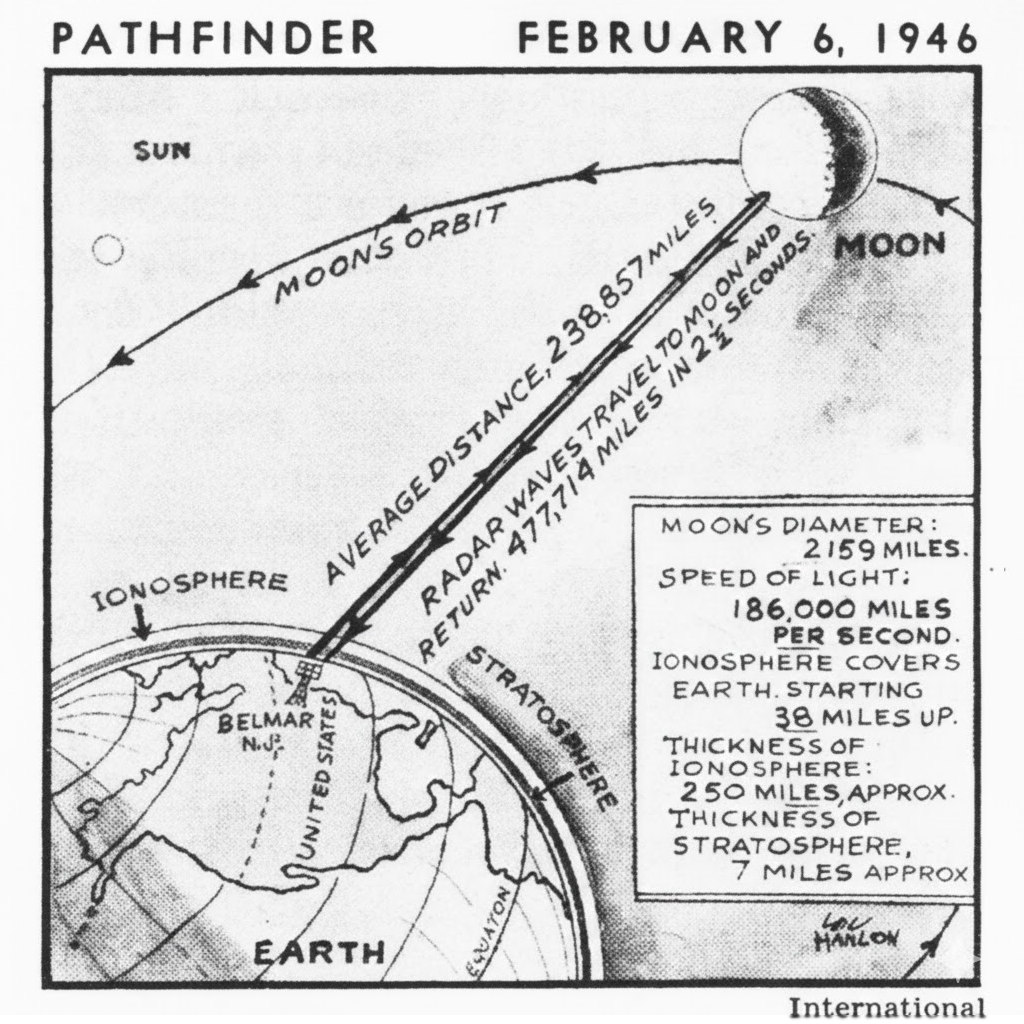
In 1946, after learning that Army Signal Corps’ researchers had detected radar signals that had reflected from the Moon,61 Donald Menzel of the Harvard College Observatory proposed to the Navy Department that the Moon could be deliberately used as a reflector for radio signals. Menzel had served as Naval Reserve commander during World War II and advised the Joint and Combined Chiefs of Staff as a member of their radio propagation committee. That proposal would find its way to James Trexler, who back in his college days at Southern Methodist University had tried reflecting high frequency radio waves from meteor trails as part of a radio propagation study. That put Trexler into the small club that was apt to have radio, communication, and cosmic objects in the same thought.62
As for “cosmic objects” UFOs were likewise active. During the war, a “UFO crash retrieval case occurred in 1941 in Cape Girardeau, Missouri. This crash kicked off early reverse-engineering work, but it did not create a unified intelligence effort to exploit possible technological gains apart from the Manhattan Project uses.”63 In leaked document records, this crash retrieval, a few more associated with the “Battle of Los Angeles,” which occurred on the night of February 24th and early morning hours of the 25th in 1942, and others prompted the development of the Interplanetary Phenomenon Unit.
On March 5, 1942, George C. Marshall writes a top-secret memo to the President, which states: “Regarding the air raid over Los Angeles it was learned by Army G2 that Rear Admiral Anderson recovered an unidentified airplane off the coast of California with no bearing on conventional explanation… This Headquarters has come to the determination that the mystery airplanes are in fact not earthly and according to secret intelligence sources they are in all probability of interplanetary origin.”64
This memorandum is a categorized copy under the header of INTERPLANETARY PHENOMENON UNIT, which in 1984 was acknowledged to have existed, but the records of which were no longer available to the Department of the Army as they were, “…transferred to the Air Force in the late 1950’s.”65
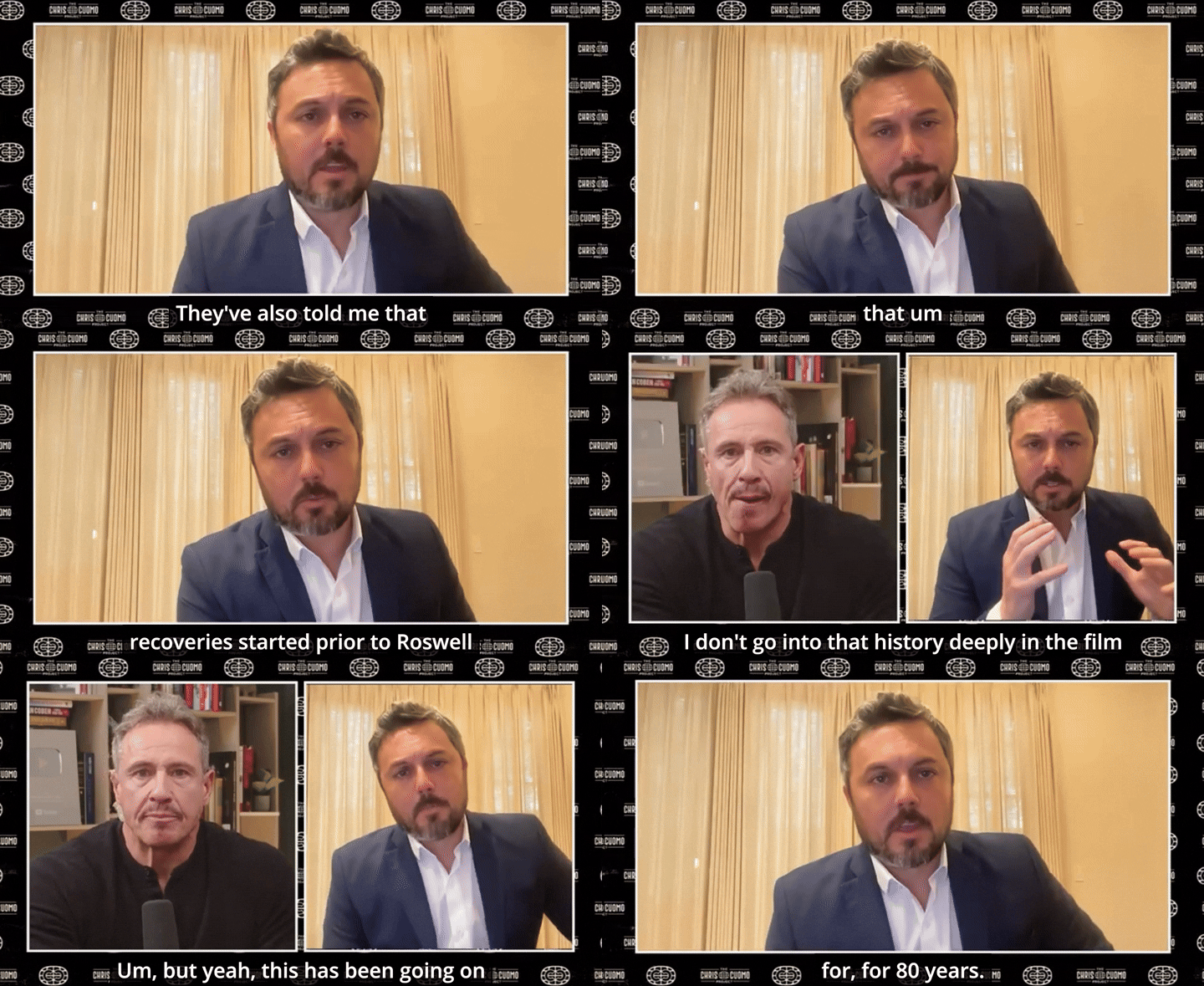
Bringing this into the present day, these crash recoveries are what Age Of Disclosure documentary film producer and director Dan Farah, in an interview with Chris Como, states as being, “...recoveries started prior to Roswell, during World War II in fact.”66
UFO investigations continued in step with contacts, notably with “foo fighters” during the war and “ghost rockets” in Scandinavia during the summer of 1946. The ghost rocket flap saw both US Secretary of the Navy James Forrestal and General Jimmy Doolittle travel to Sweden to investigate, urging, “…Intelligence to conduct research and collect information in an effort to identify the sightings.”67
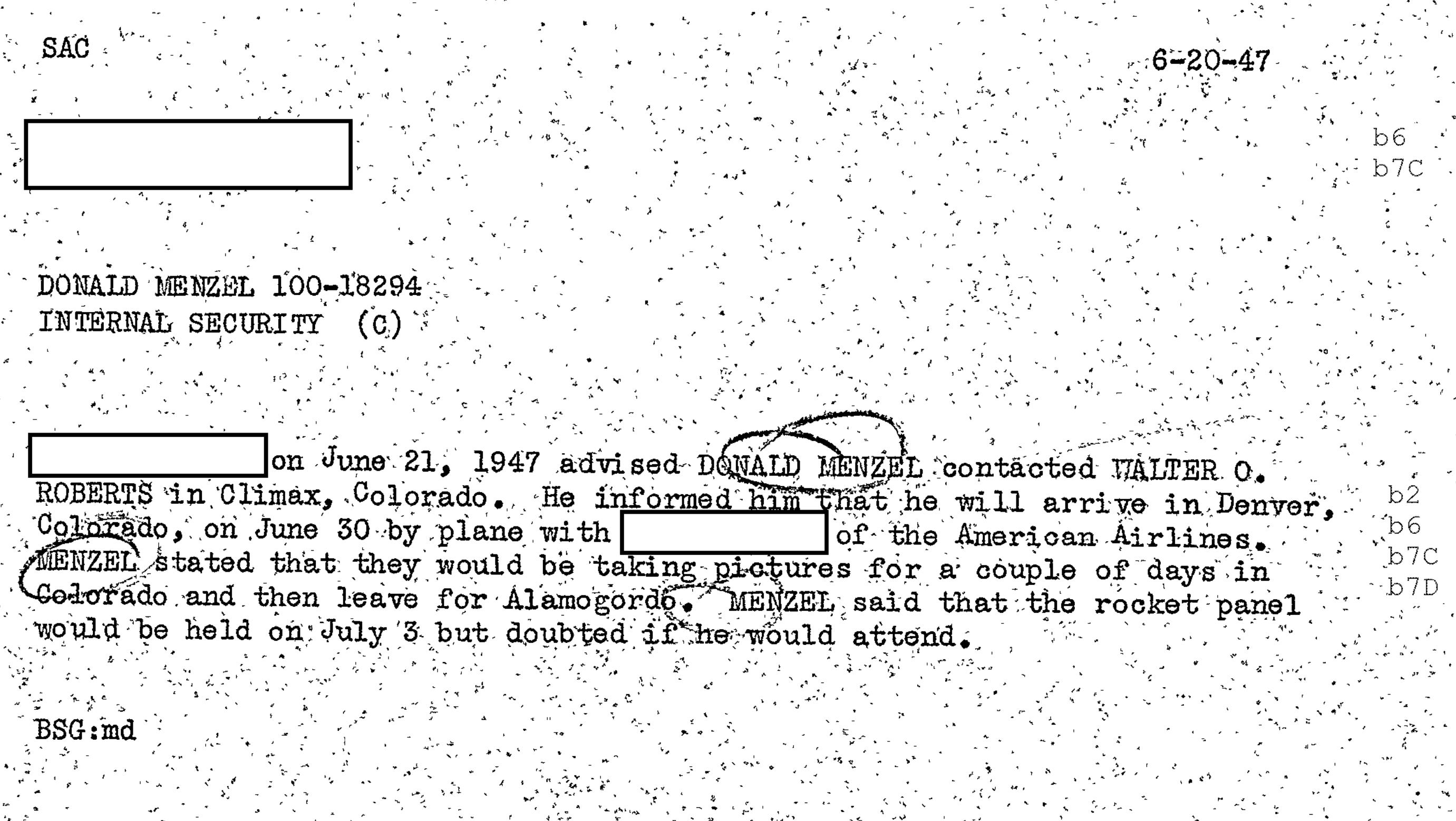
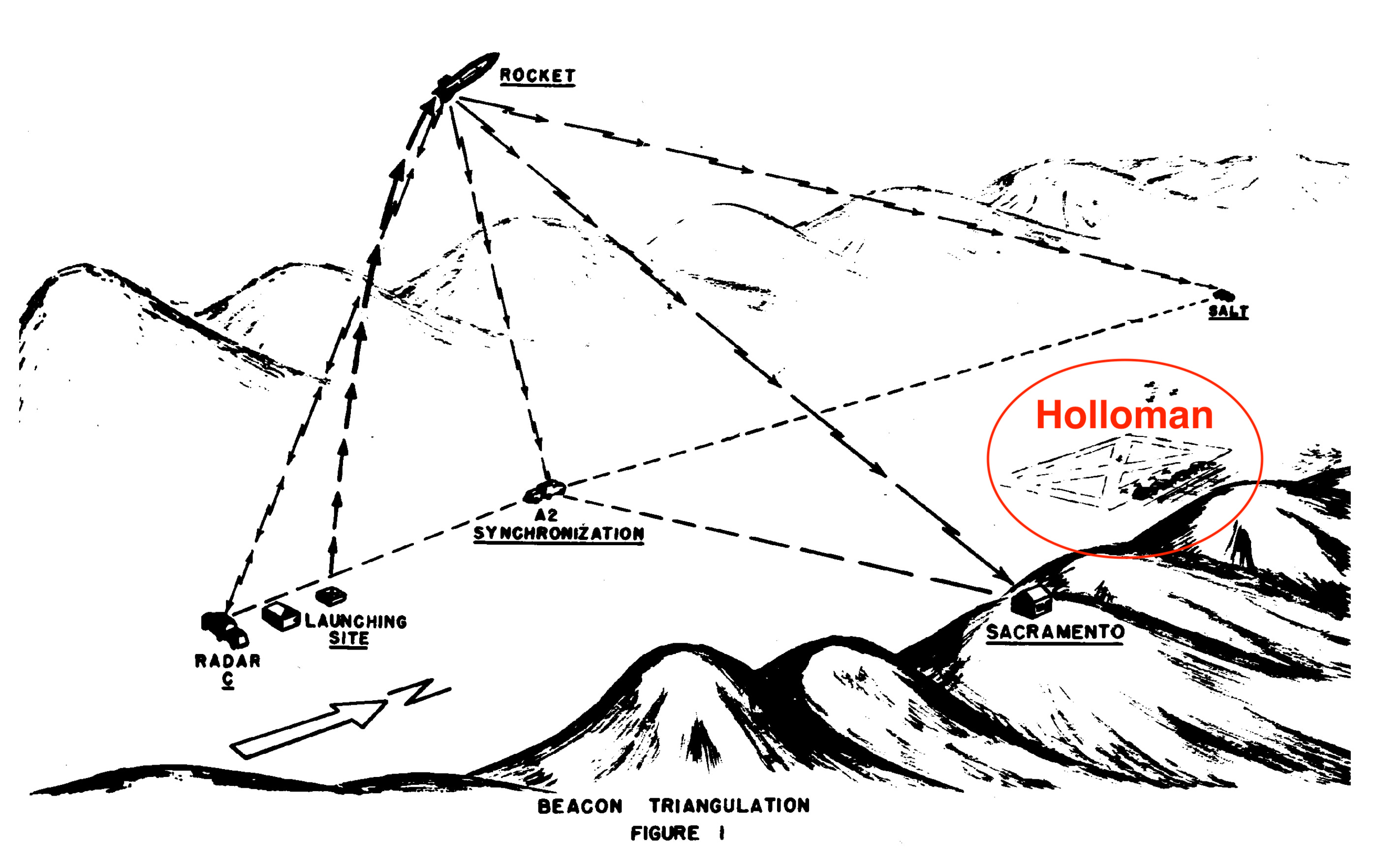
Returning to the other side of the world, Menzel was busy touring sites for a second solar observatory, to be situated on Sacramento Peak, in New Mexico amongst the mountains that overlook Alamogordo, White Sands Missile Range, Holloman Air Force Base to the west, and Roswell to the east. “For the first reconnoitring trip to the Sacramento range, Menzel enlisted his friend, Ralph S. Damon, the president of American Airlines (and later of TWA), who had an interest in solar astronomy. Damon provided one of his research planes for an initial aerial survey and came along himself. Menzel and O’Day then explored further on foot.”68 The dates of that trip? July 2, 1947 to July 7, 1947.
Historian Richard Dolan adds:
Around the time of the Roswell crash and the inundation of flying saucer reports in the American Western region. Dr. Menzel and Dr. Walter Orr Roberts travel to White Sands, New Mexico, on a special research airplane provided by American Airlines. The purpose of their trip is initially unclear, and the Denver Post reports on July 6 that there was a meeting in New Mexico between Los Alamos officials and Dr. Roberts, but attempts to locate Roberts or the officials were unsuccessful. Dr. Roberts, who is a regular contributor to the Denver Post, explains upon his return to Denver on July 7 that the trip was for the viewing of a V-2 launch on July 2, which had been suddenly canceled. However, there are doubts about this explanation, as there is no record of a V-2 launch on July 2, and the word “cancellation” seems evasive. It is also unclear why Roberts and Menzel remained at White Sands until July 7 if there were no launch results to collect and study. The nature of the meeting with Los Alamos officials and its connection to the V-2 launch remains uncertain.69
All of this serves to answer Stanton Friedman’s rhetorical question, “How could [Menzel] possibly have been a member of a group that was fully aware of the crash of a flying saucer outside Roswell, New Mexico, in July 1947?”
Because he was there.
In the leaked and disputed–but timely–IPU documents below, it’s possible Menzel may have even been the scientist listed as part of the Interplanetary Phenomenon Unit given orders to investigate the crash site since he was present and held Ultra clearance.
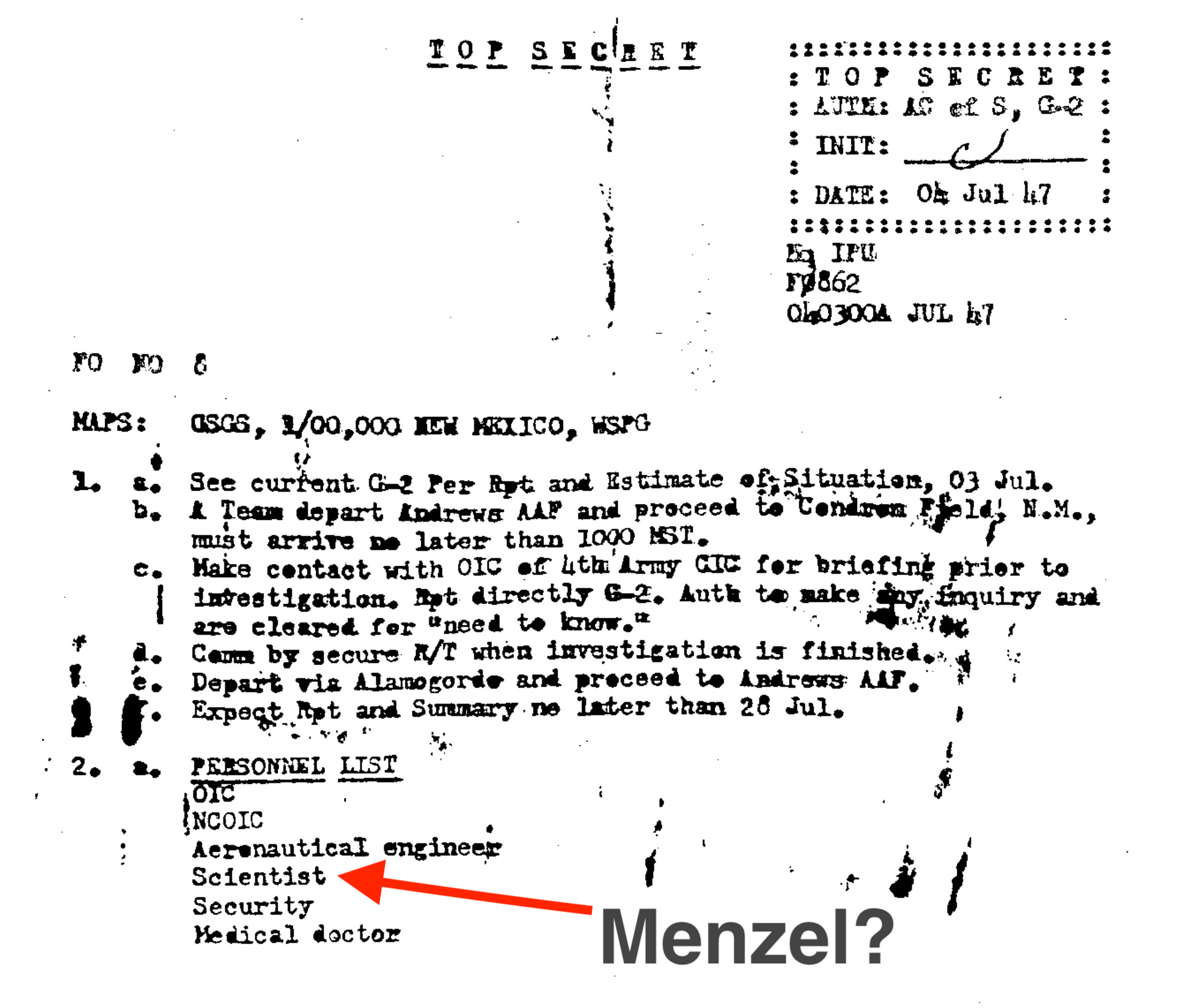
The Ultra level of clearance–which Menzel still held–was later used on the IPU Summary Report covering the incident.
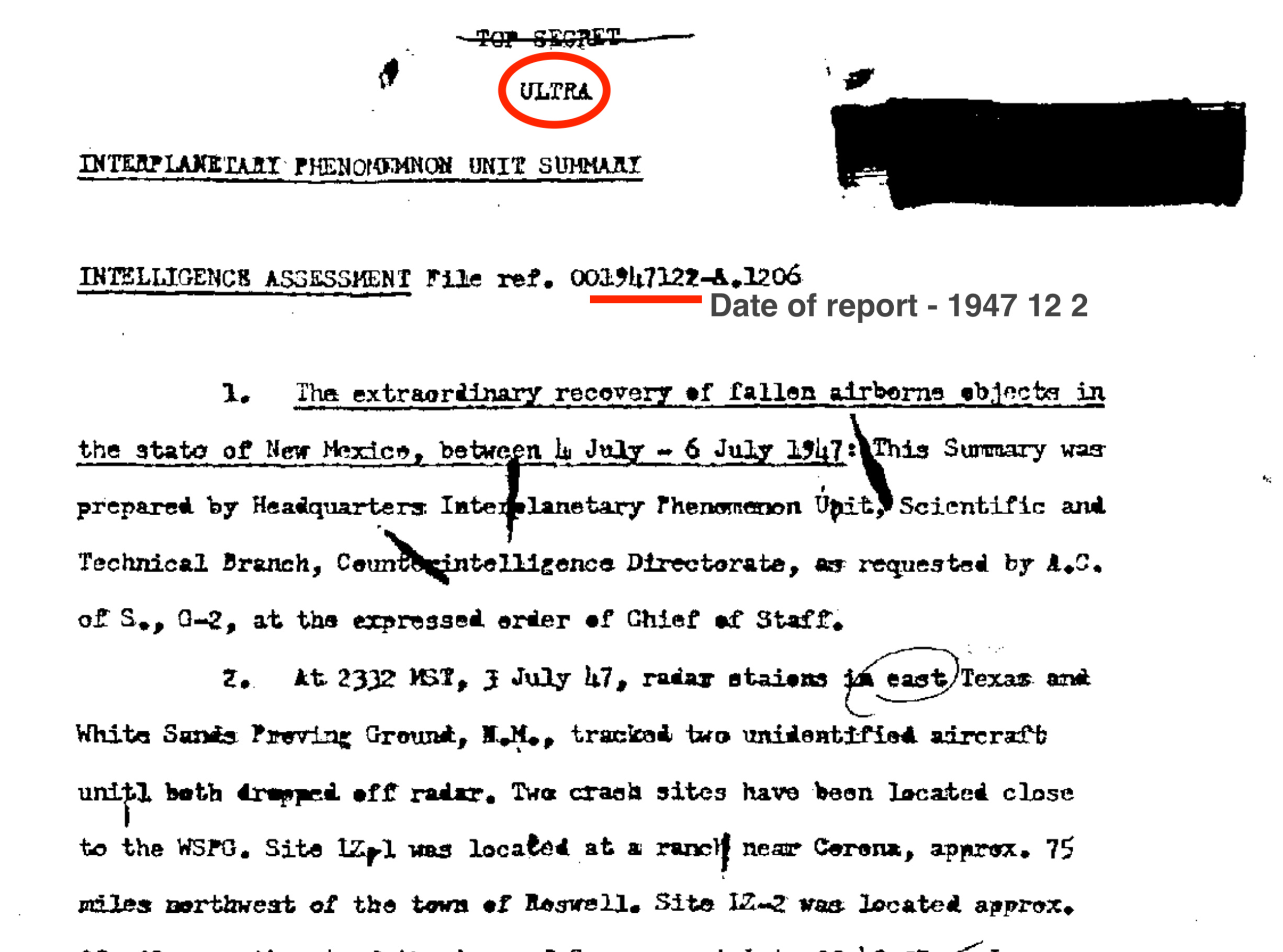
What’s even more remarkable is that Menzel’s involvement could have been related to early experiments of targeted shoot-downs of UAP, as stated in Luis Elizondo’s Imminent, “An electromagnetic pulse generated from one of the nearby test ranges had inadvertently intervened with the craft’s technology and caused it to crash.”70 While Elizondo makes the claim of an ‘electromagnetic pulse’–possibly radar–interfering with UAP in 2024, Guy Hottel, a Special Agent for the FBI notes the claim much earlier, in 1950, “...the saucers were found in New Mexico due to the fact that the Government has a very high-powered radar set-up in that area and it is believed the radar interferes with the controlling mechanism of the saucers.”71 Additionally, scientists Menzel and O’Day, working with Secret clearances from and for the Army Air Forces (about to become the United States Air Force [USAF] on September 18, 1947)72 were also considering Sacramento Peak as an overwatch for V-2 rocket missile tests, as this late 1940s image shows multiple radar stations running precise triangulation. Had Menzel’s success in targeting submarines graduated to UAP?
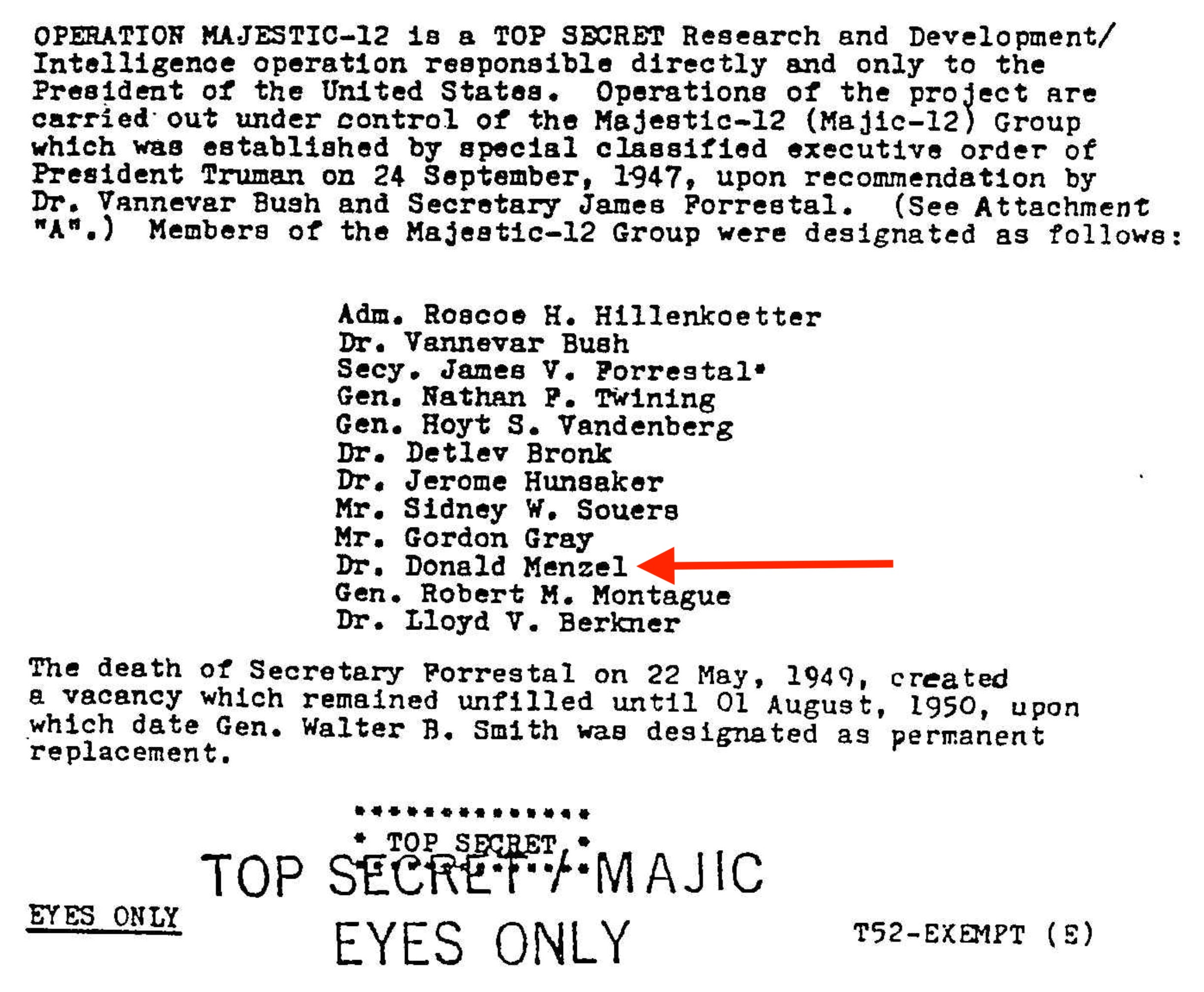
While Menzel’s level of know-how and direct involvement in this moment of history is still speculative, one documented result is known. In another leaked presidential memo, the timeline shows just a week after USAF became its own branch, Menzel is listed as part of a group established by the special classified executive order of President Truman on 24 September, 1947: Majestic-12 (Majic-12).73
Menzel enters the battlefield of persistent secrecy and managed public perception
By late September 1947, the available paper trail and later claims converge on Menzel as a UAP/NHI insider; the open question becomes how early that began. As taken, he certainly knew by then, and very well could have known much earlier. Prior to becoming known in public as the leading skeptic and debunker of UFOs, Menzel had a busy schedule in getting briefed. With the Sacramento Peak project taken on by the newly minted Air Force and the main contract running from May 1948 to May 1953, Menzel says he was, “shuttling back and forth between Cambridge and Air Force [Materiel Command] Headquarters at Wright Field, Dayton, Ohio, about once a week.”74 Menzel’s Wright Field activity was earlier than that though, as he was “anxious” to address the heavy discussion around the Alamogordo project with officials there.
![Donald Menzel 100-18294 Internal Security (C), FBI Office Memorandum, July 29, 1947: "Alamogordo project under heavy discussion. (Donald) Menzel attempting to get Colonel [Marcellus] Duffy, Wright Field, to appoint out site [sic] observers as Wright Field consultants."](https://substackcdn.com/image/fetch/$s_!pfk3!,f_auto,q_auto:good,fl_progressive:steep/https%3A%2F%2Fsubstack-post-media.s3.amazonaws.com%2Fpublic%2Fimages%2F7d517fc5-fe37-445b-a975-17004ec83a73_3028x1740.png "Donald Menzel 100-18294 Internal Security (C), FBI Office Memorandum, July 29, 1947: \"Alamogordo project under heavy discussion. (Donald) Menzel attempting to get Colonel [Marcellus] Duffy, Wright Field, to appoint out site [sic] observers as Wright Field consultants.\"")
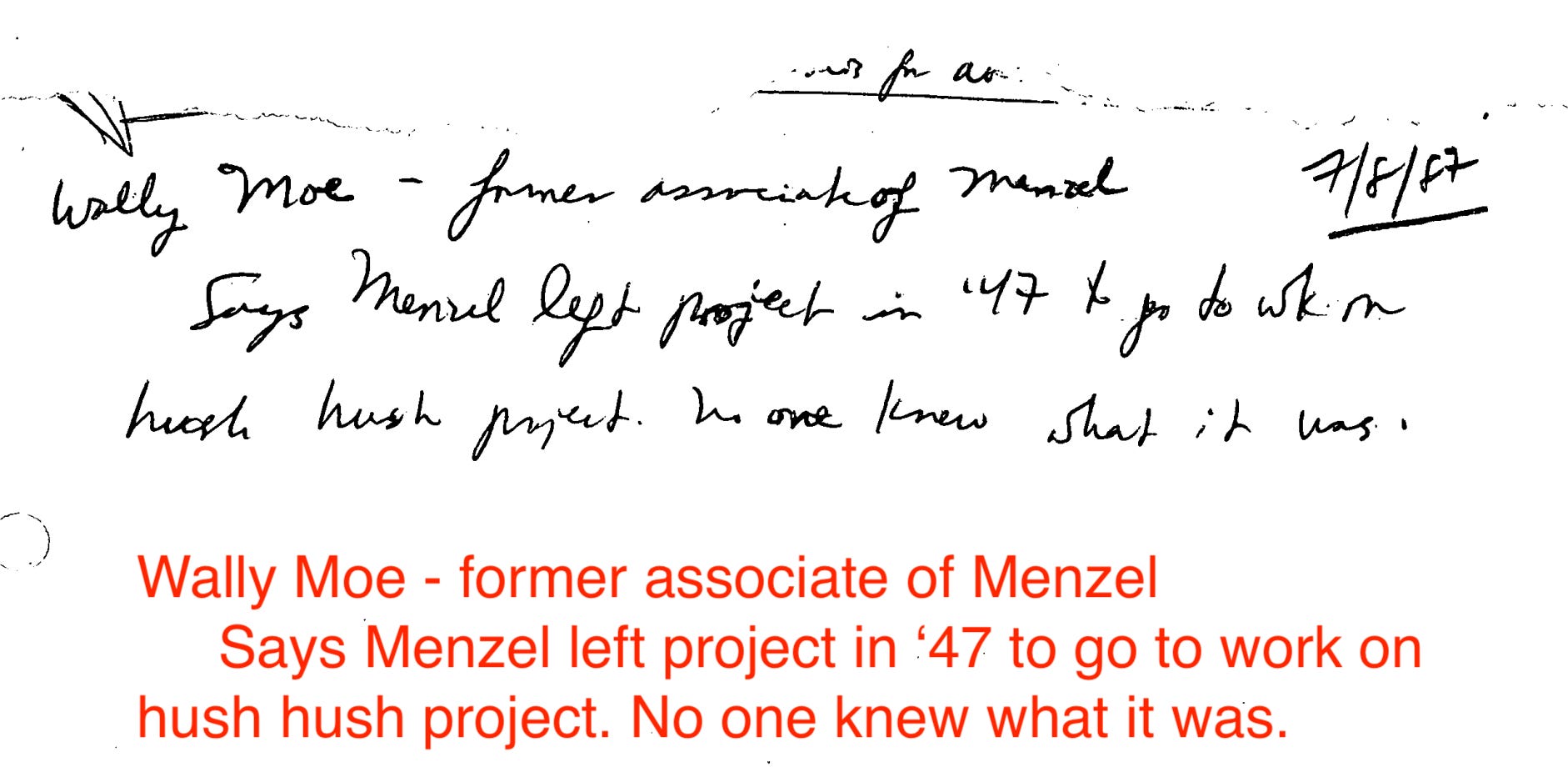
His trips back to New Mexico became no less frequent, and he was often heading to Washington D.C. as well. A founder at one of Menzel’s post-war consulting appointments–Walter J. “Wally” Moe of Engineering Research Associates (ERA)–noted that Menzel left their project in 1947 to go to work on a ‘hush hush’ project. “No one knew what it was.” As the Sacramento Peak Project was reported on by the press from the initial stages, it had to be something else. Later Moe recounts, “that Menzel was suddenly called to Washington in the summer of 1947 to work on some highly classified job. (He and I [Bill McNeff] believe this was probably the newly forming NSA and the MJ-12 group.)”75
Similarly, government activity following Roswell was also a flurry as the National Security Act of 1947 enacted on July 26, 1947 created several Executive Branch and military entities: National Security Council, Central Intelligence Agency, National Security Resources Board, Secretary of Defense, United States Air Force, and more.76 One of the first activities of the newly formed Air Force was Project Blue Book, which began the same year (1947) and ran till the end of 1969.77
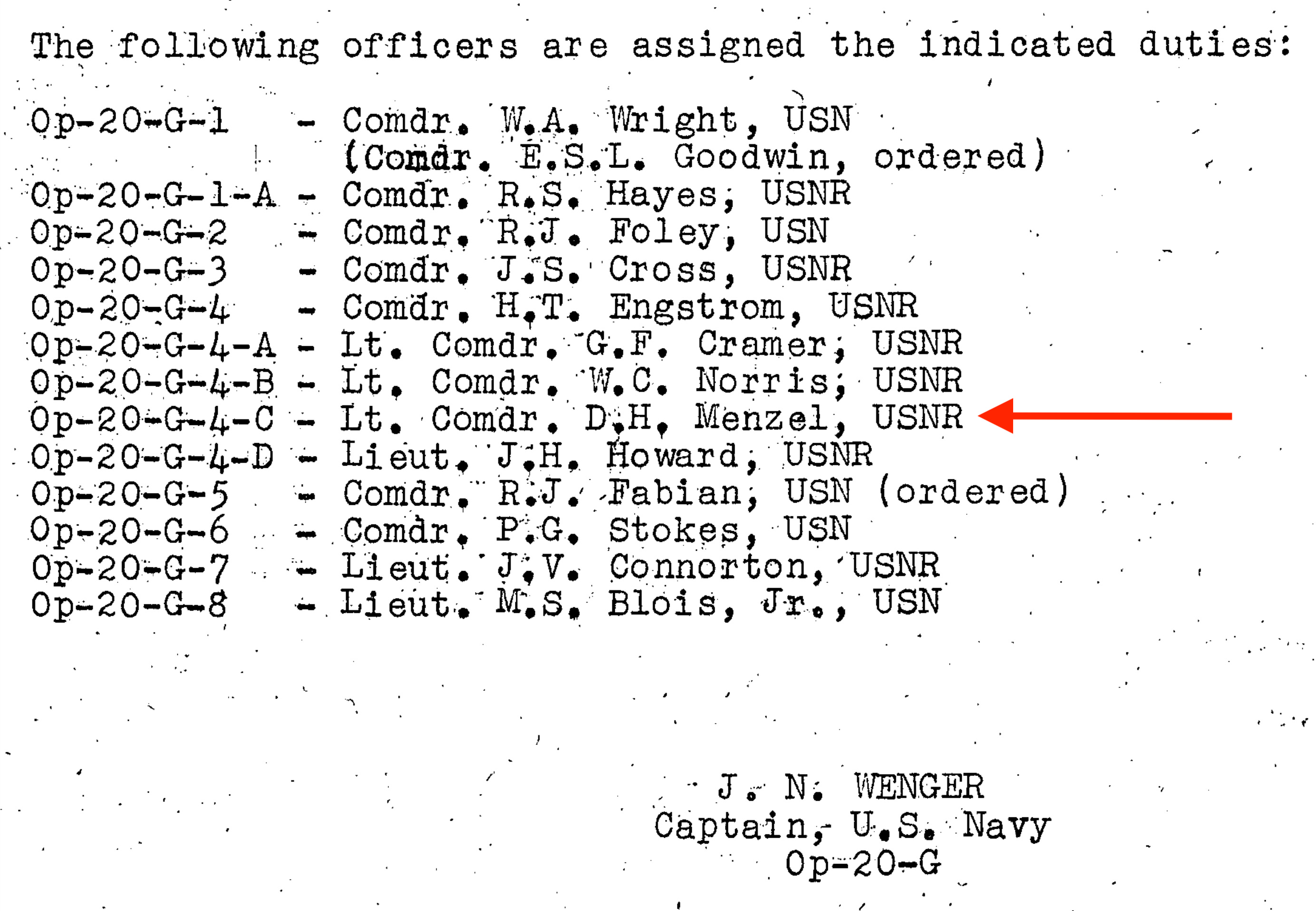
Following briefings, the likely role of Menzel’s involvement with the Majestic-12 Group would be counter-intelligence, a skill he developed–and taught, as mentioned earlier–during the war while in the Navy’s NSA predecessor: OP-20-G.78
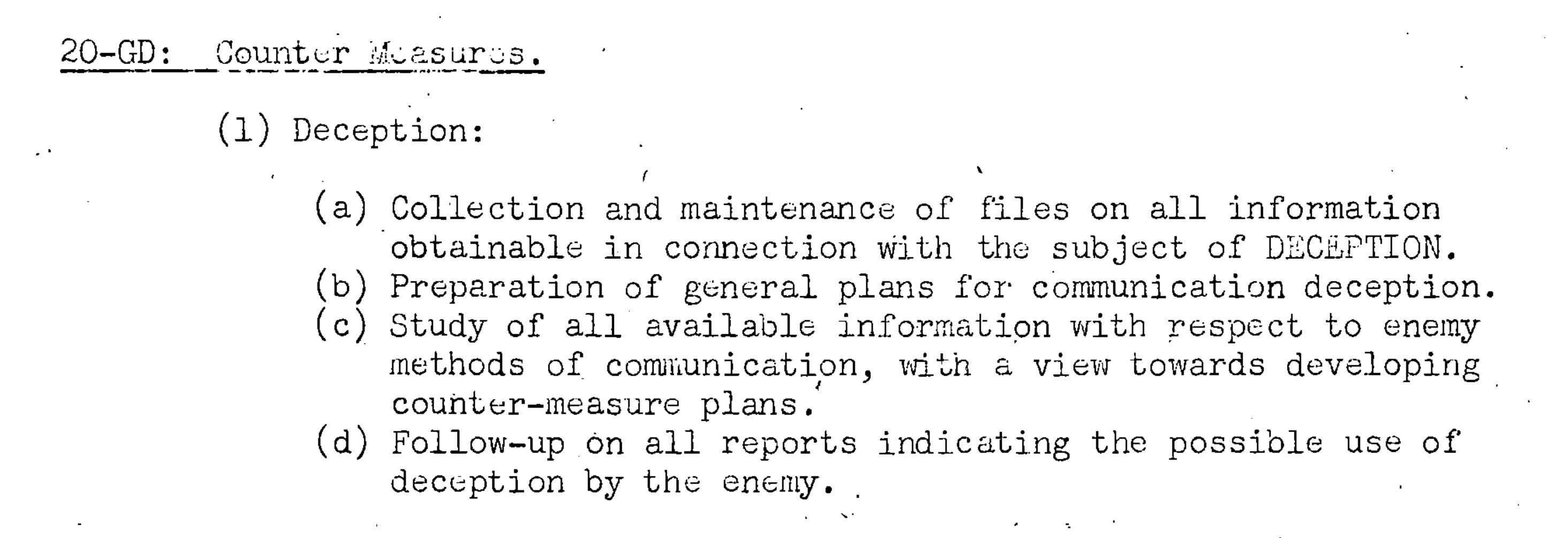
With a key element being “DECEPTION” and the “Study of all available information with respect to enemy methods of communication, with a view towards developing counter-measure plans.”79
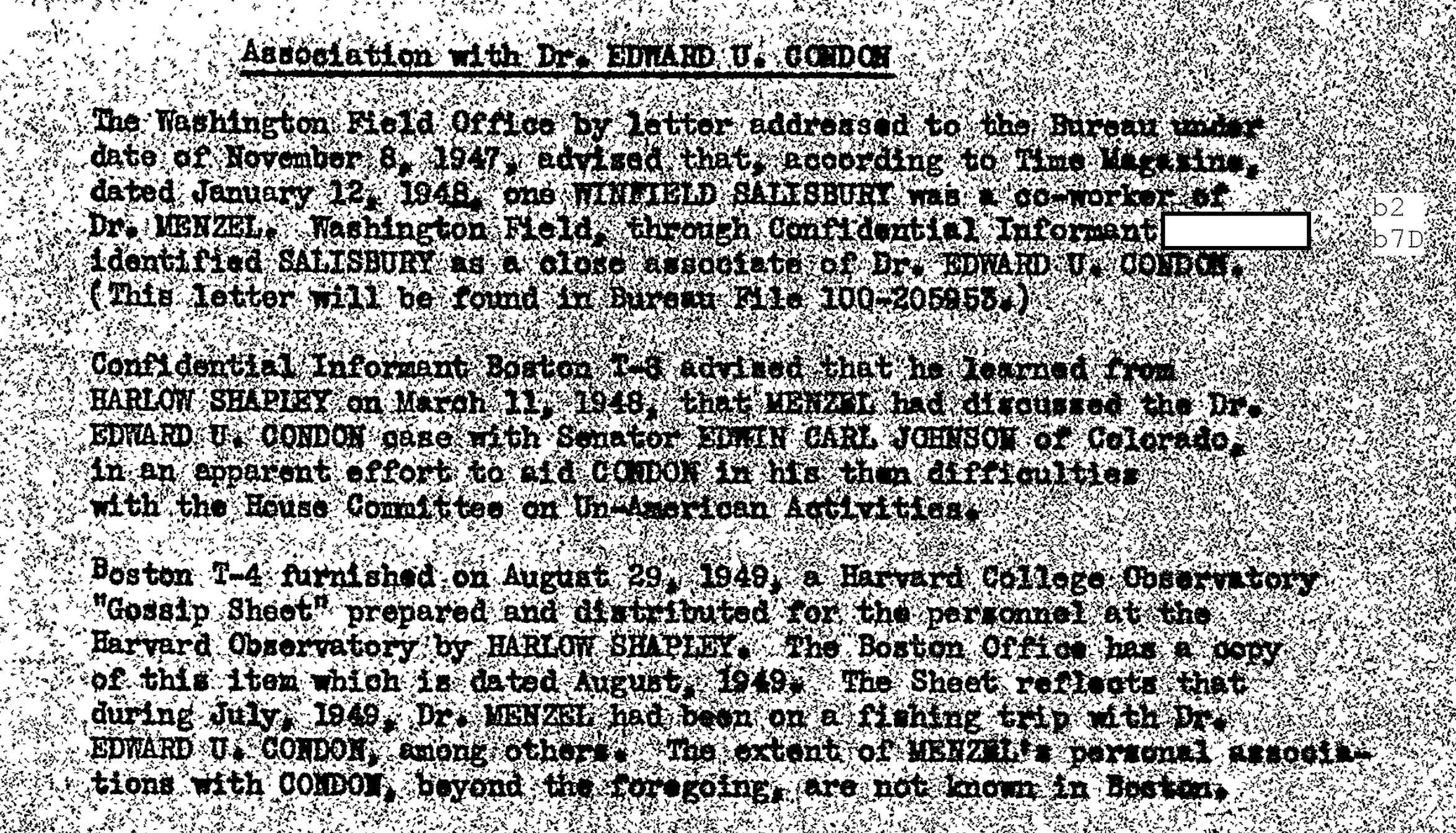
In 1949, Menzel is tracked by the FBI going on a fishing trip with the earlier mentioned Edward U. Condon. The report states, “Boston T-4 furnished on August 29, 1949, a Harvard College Observatory ‘Gossip Sheet’ prepared and distributed for the personnel at the Harvard Observatory by HARLOW SHAPLEY. The Boston Office has a copy of this item which is dated August, 1949. The Sheet reflects that during July, 1949, Dr. MENZEL had been on a fishing trip with Dr. EDWARD U. CONDON, among others. The extent of MENZEL’s personal associations with CONDON, beyond the foregoing, are not known in Boston.”
To add to the intrigue, the FBI Special Agent in Charge working on the Menzel file: Guy Hottel.
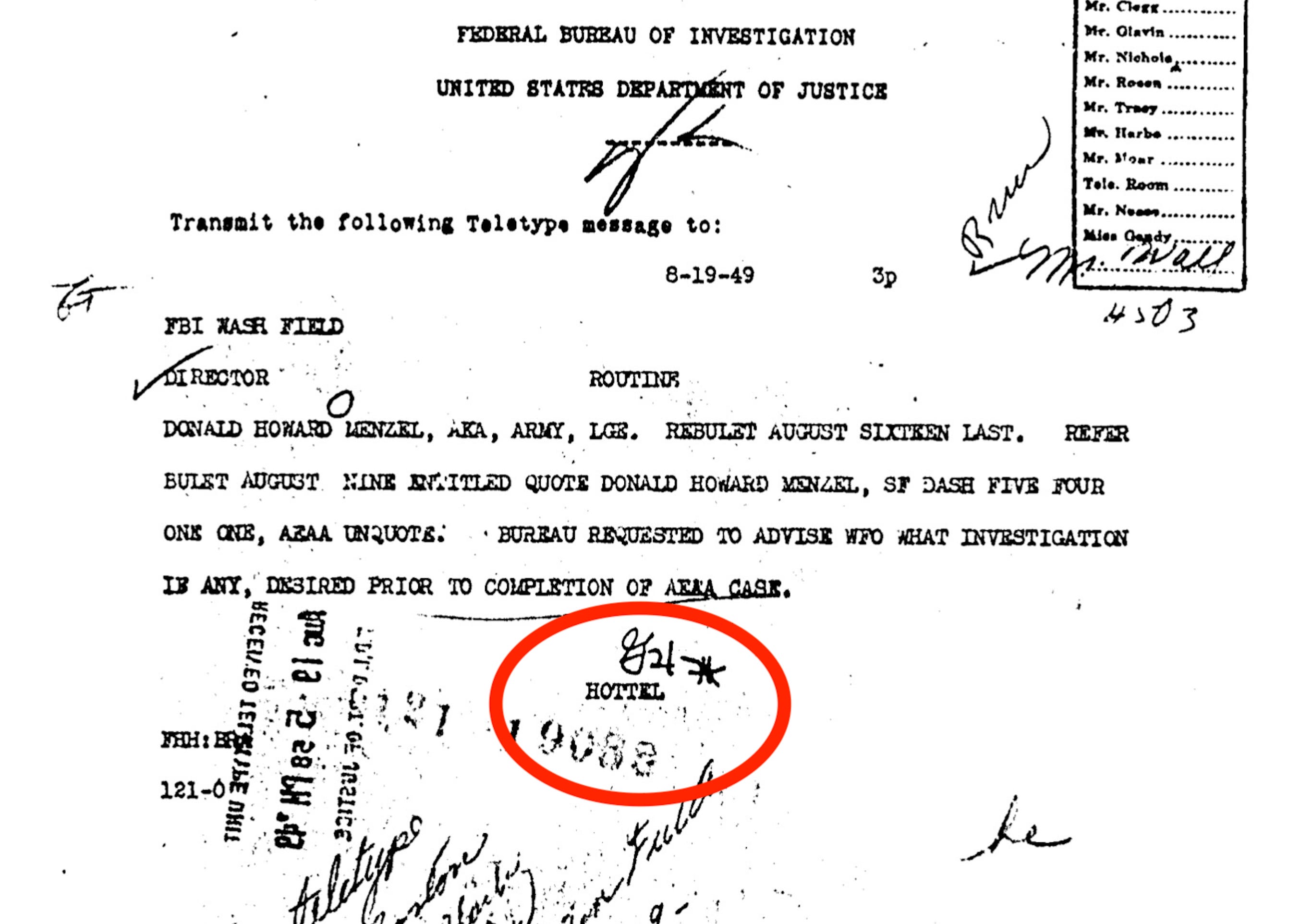
This is the same Special Agent out of the Washington Field Office (WFO) that was on the ‘flying saucer’ file with informants telling him about high powered radar targeting UFOs in New Mexico. Even earlier FBI documents connect the three, as SAC Guy Hottel documents Condon and Menzel in the same Internal Security - R (Bureau File #100-205955) chronicling activities in 1948 in relation to the House Un-American Activities Committee (HUAC) investigation into Condon for communist sympathies which began on March 1, 1948.80
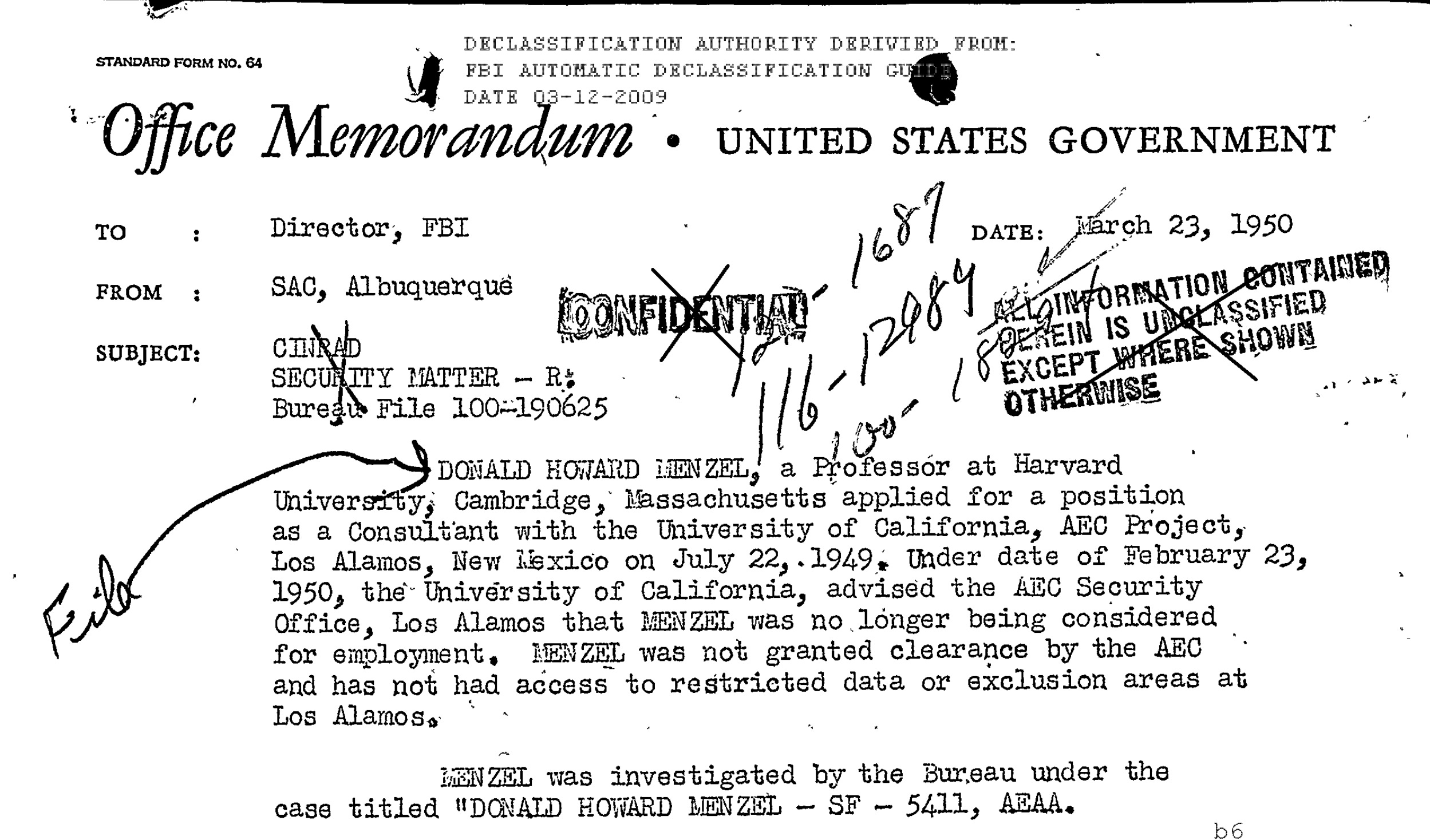
Another factor for the increased scrutiny of Menzel during this time was his pursuit of a Q-Clearance–a clearance which Condon already held after working on the Manhattan Project during the war–for a Consultant position with the University of California, Atomic Energy Commission Project in Los Alamos, New Mexico on July 22, 1949.
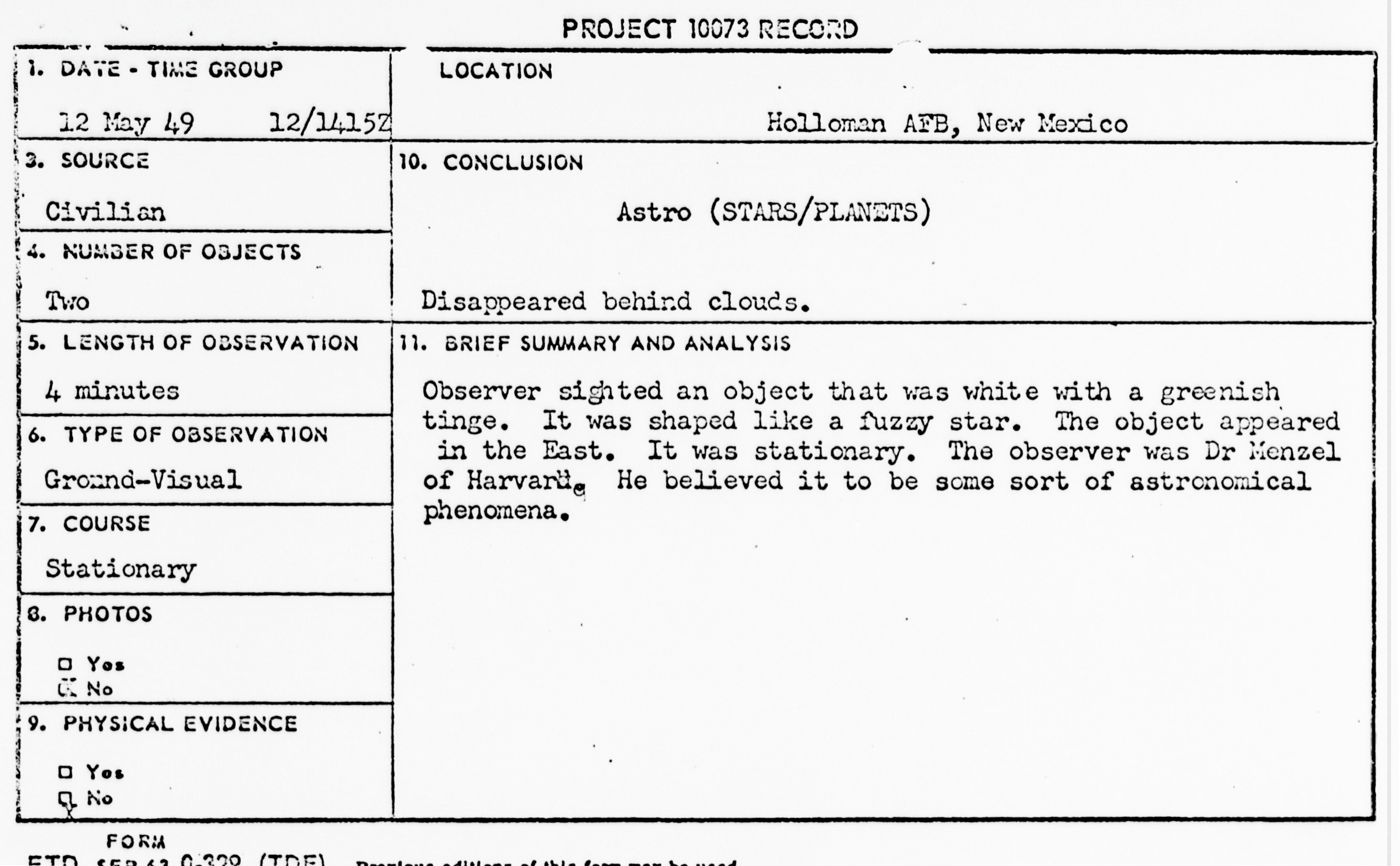
Also in 1949, Menzel would prod the Blue Book process by filing his own report of a daylight sighting while his driver ferried him from Holloman Air Force Base to Alamogordo between 09:15 and 09:30 on the 12th of May. Doing so connected him with their database and provided first hand experience with how Project Blue Book would handle cases.
Menzel would continue making inroads into Blue Book in the coming years, most notably working with Navy-Harvard-USCIB cleared colleague Howard Aiken in the summer of 1952 to collect UFO files from the Air Technical Intelligence Center (ATIC) in preparation for Menzel’s first book on the topic.81 Having these reports prevented Battelle Memorial Institute from using them in a statistical study of UFOs as a supplement to the Robertson Panel taking place in January 1953.82 Blue Book chief Edward Ruppelt relates the event in his personal papers:
[Menzel] said that he had decided to write a book and wanted to know when he could come to ATIC to study our files. Although this was against the policies, Col. Dunn suggested that we go ahead and try to set it up. I checked with AMC security people and they said that he had no clearance and that temporarily, he couldn’t get one. Since ATIC is a secure area he couldn’t be allowed to visit for any length of time. He was notified of this and didn’t like it. Col. Dunn sent him a letter, very much to the point, saying that he could get his data through channels, from the PIO, like anyone else.
Not long after this I had a visit from Dr. Aiken, of Harvard, a computer specialist. Aiken said that he thought that maybe he could make something of the UFO reports if we would be kind enough to loan them to him. He was working for ATIC at the time and had the proper clearances and storage facilities that allowed him to store documents borrowed from ATIC. We packed up three years of reports and sent them to him. He was to send them back to us in a month. One month passed, then two, and not a word from Aiken. I called him several times and he was ‘just getting ready to send them back’ each time. Finally I sent Bob Olsen [of BLUE BOOK] up to Boston to get the reports but when he arrived Aiken couldn’t produce time. We did get them back a few days later.83
With Menzel having the data and connections to Howard P. Robertson–a fellow USCIB indoctrinated person–Menzel was able to influence the Robertson Panel as well, but this is getting a bit too far ahead. Back in 1950, Menzel was about to experience his own counter-intelligence pressure.
These accumulated early Majestic-12 counter-intelligence efforts reached a tipping point for at least one security office, as the associations84 and behavior would trigger Loyalty Hearings of Menzel, beginning in 1950. The amount of operations Menzel was running at this time were immense, as he recounts, “I was putting in about an 80-hour week on the average and thoroughly enjoying my work.”85 He even made time to be interviewed by Edward R. Murrow for the April 7th, 1950 news radio report, “Case of the Flying Saucer.”86
Then, the hammer fell.
From Menzel’s own journaled review of the event:
April 13, 1950 marked the beginning of the unhappiest, most traumatic experience of my life. Although the War had been over for more than 4 years, l’d continued as Commanding Officer of Communications Unit 1-1 of the US Naval Reserve in Boston. I was a consultant with TOP SECRET ULTRA clearance to the National Security Agency which had replaced the Naval Communication Unit I had been associated with during the War. The National Bureau of Standards had requested my services as consultant in the field of radio propagation at that time. Was on the Visiting Committee to that Bureau, reporting directly to the Secretary of Commerce. US Air Force experienced various problems associated with radio communications, rockets used for Space research, etc. Had specifically requested my services as a consultant. The duties were not onerous, but interesting. Had designed several experiments to be sent up in rockets. One of these had plans to detect X-rays which then concluded from theoretical studies might be coming to the earth.”87
Two airmen presented the 8-page document to Menzel at his home in Cambridge that April evening. It would initiate a nearly year-long period–until January 1951–until Menzel was cleared of any disloyalty and his Air Force clearances were reinstated. It was an active period of investigations. Recall this is the same window of time when Wilbert H. Smith sent his Top Secret “...operation of the saucers…” memo–November 21, 1950. Even with these leaks, the extremely tight compartmentalization of MJ-12 appears to have held until all the original members were deceased. At no point in the hearing did Menzel mention any of his other clearances. Once again, the man could compartmentalize exceptionally well.
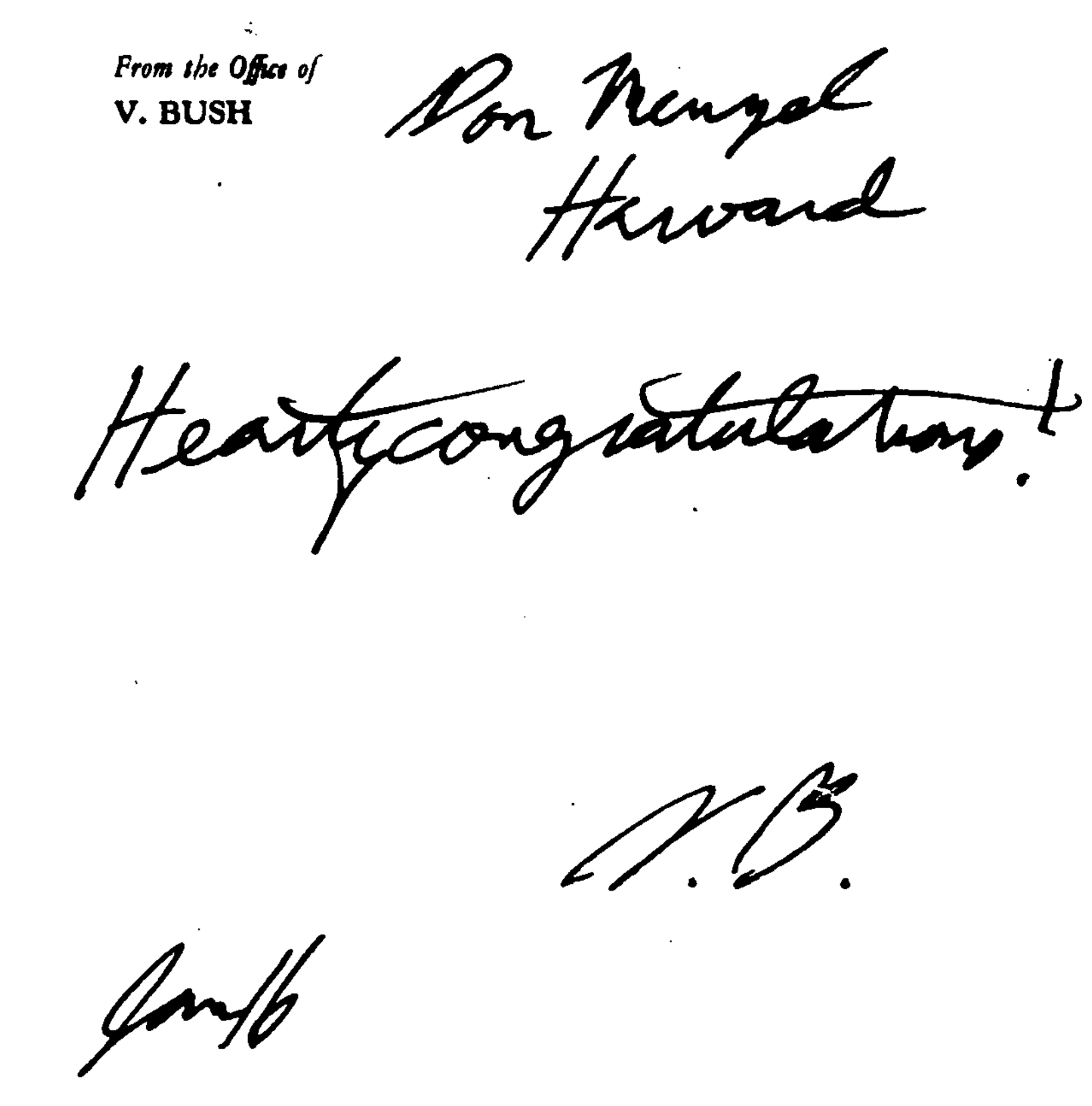
With the loyalty hearing over, Menzel’s cover intact, and his lesser clearances in good standing with the armed services and intelligence investigators, it was back to full steam ahead on Majestic-12 activities. Old friend, fellow computer wonk, and Majic-12 compatriot Vannevar Bush was quick to congratulate Menzel on the success.
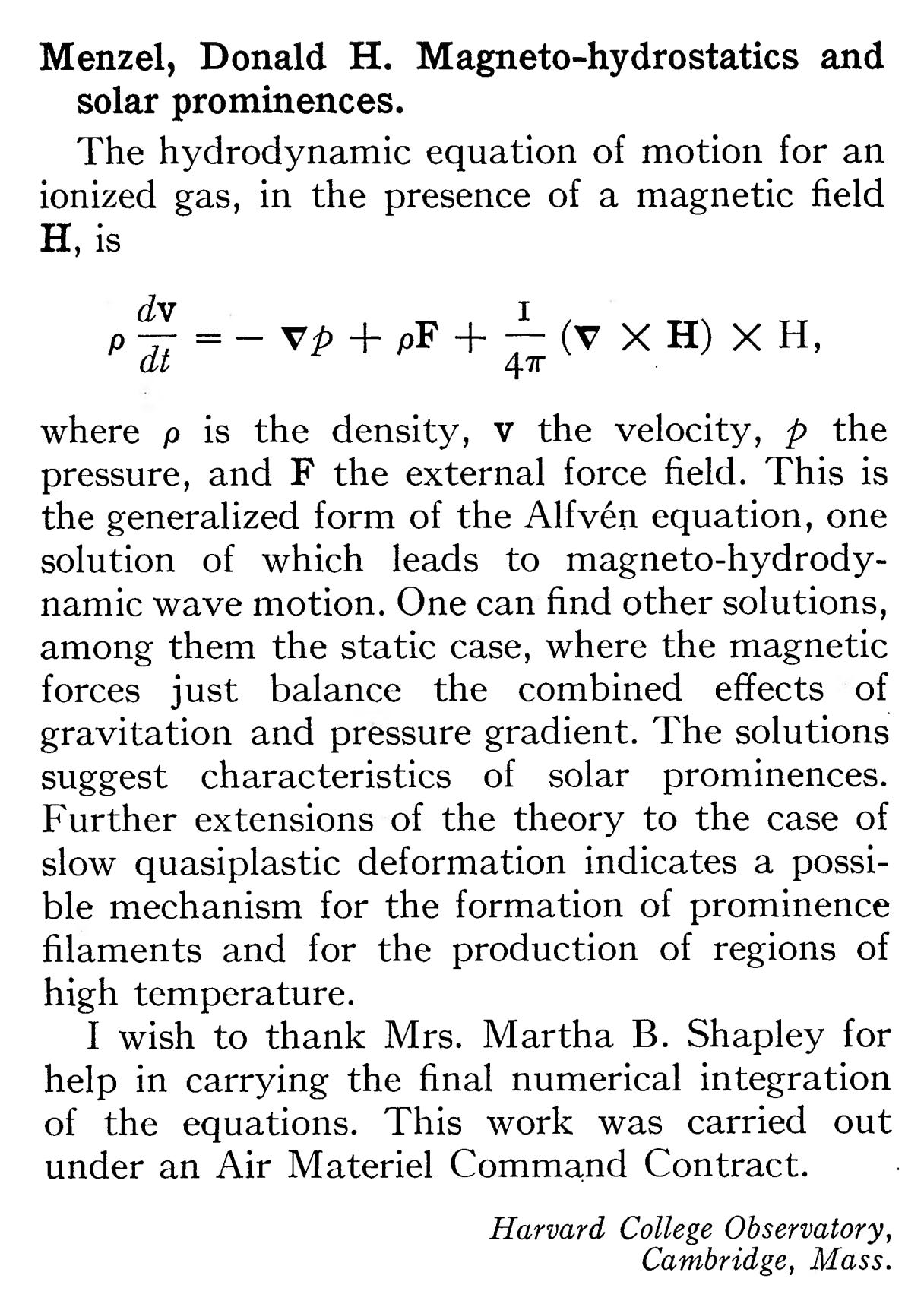
During 1951-1952, as with most years, Menzel published several papers, two of which–Menzel, D. H. & Sen, H. K., “Transfer of Radiation. III. Reflection Effect in Eclipsing Binaries.”, 1951 and Gaposchkin, C. H. P., Gaposchkin, S., & Menzel, D. H., “Variable stars in Milton field 54”, 1952–were close examinations of the HCO plate collection. A third paper, "Magneto-hydrostatics and solar prominences" published in Astronomical Journal, Vol. 56, p. 135 was commissioned by Air Material Command and covered how magnetism can steer plasma to overcome gravity–in the case of the paper, coronal mass being ejected from the sun.
Also in that year, "...President Truman established a Presidential Commission under the chairmanship of George A. Brownell to study the communications intelligence effort and to make recommendations concerning the management of the effort."88 The resulting report developed the foundational management of what became the National Security Agency in 1952.89 Menzel’s preparation, and a large ramp up in UFO activity, opened the main battlefield for counterintelligence and psychological warfare operations in the decades to come: public perception.
1952 - Menzel brings counter-intel to the layman: debunker, data-deleter and arch-skeptic
No year is more pivotal in Menzel’s Unquestionably Skeptical timeline than 1952.
Here are some highlights–with lasting consequences–that took place in that year:
In February, James Bryant Conant asks J. Robert Oppenheimer to assess HCO and the astronomy department
Oppenheimer was charged with finding the new HCO director (Menzel)90
The Summer of ‘52 UFO Sighting Wave occurs, culminating over Washington D.C.
Menzel publishes debunking articles in popular magazines and newspapers
Using Dr. Aiken’s access, Menzel acquires Air Force ATIC UFO records
Menzel’s first book, “Flying Saucers” is written. (Published February 5, 1953)
Menzel becomes acting Director of the Harvard College Observatory - September, 1952
The “Menzel Gap” begins
AAVSO is given eviction notice from Harvard
On November 4th, the NSA effectively forms under authority of a Presidential memorandum91
Menzel meddles with the CIA’s “Robertson Panel”
“Aviation Week & Space Technology” covers Menzel’s debunks with new reporter: Phil Klass
From the side of UAP activity, Dr. James E. MacDonald provides an excellent introduction to the year:
In 1952, a brief year’s energetic investigation (still not characterized by strong scientific expertise, but definitely characterized by vigorous Air Force checking and data-gathering in many striking cases) was the high-watermark of the official American UFO studies. The year 1952 saw about 1500 reports turned into Project Bluebook, some 300 of which were conceded to be Unidentifieds. When I visited Bluebook in 1966 for the first time, I was quite astonished at the number of feet of files on 1952 cases - and much more astonished to scan the contents of randomly sampled file-folders within that year’s shelfful. Case after case of, to me, entirely inexplicable cases, many coming from within Air Force channels (pilots, controllers, ground crewmen, etc.) told the story of the outstanding year in American UFO history.92
Archivist and historian Loren E. Gross begins his history of 1952 simply: “The BIG year.”93 Then, in his supplemental notes, goes on to detail archives from Barry Greenwood, Jan Aldrich, Robert Todd, Dr. James McDonald (who ‘discovered a lot of valuable data’), Robert Gribble, George Fawcett, Murray Bott, Les Treece-Sinclair, Paul Cerny, Leon Davidson, the files of APRO, NICAP, MUFON and CUFOS, and the Air Force’s own New York Romeike press clipping service preserved on microfilm.94
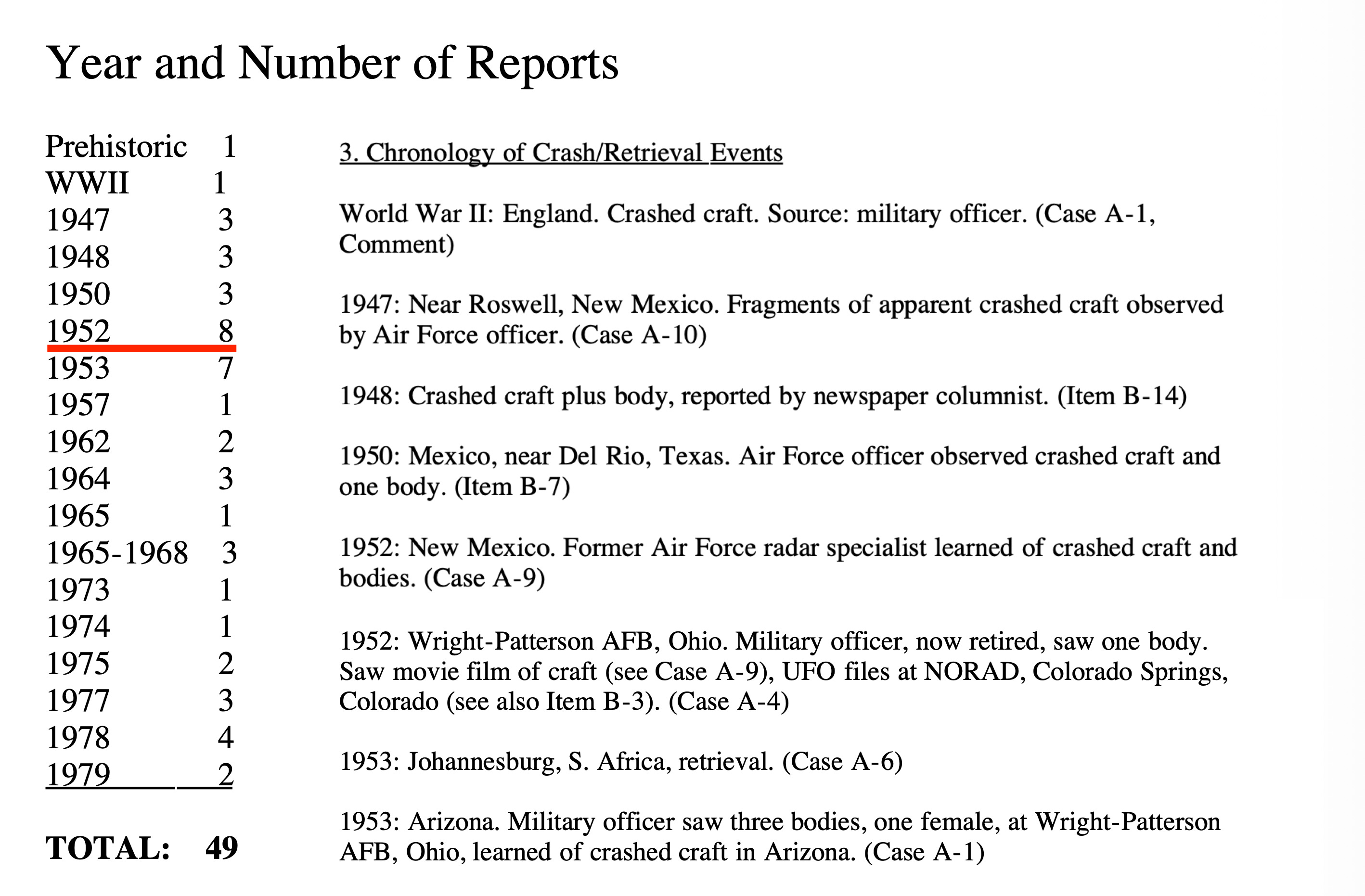
Investigator Leonard Stringfield also records his highest year of crash retrieval reports in 1952, detailing a supply chain of New Mexico crash and recovery, lo-boy transport, and subsequent storage of craft and occupants at Wright Patterson AFB95 while Stringfield was unaware at the time of the radar and EMP measures active in the West detailed earlier (Elizondo, Hottel, et al).
The maturing MJ-12 Committee–providing regular briefings for President Truman, and later preparing to brief incoming President Eisenhower during the year96–could have often been prodded by one of their military axioms, “The enemy gets a vote”97 when considering how to counteract the activity with their cover-up.
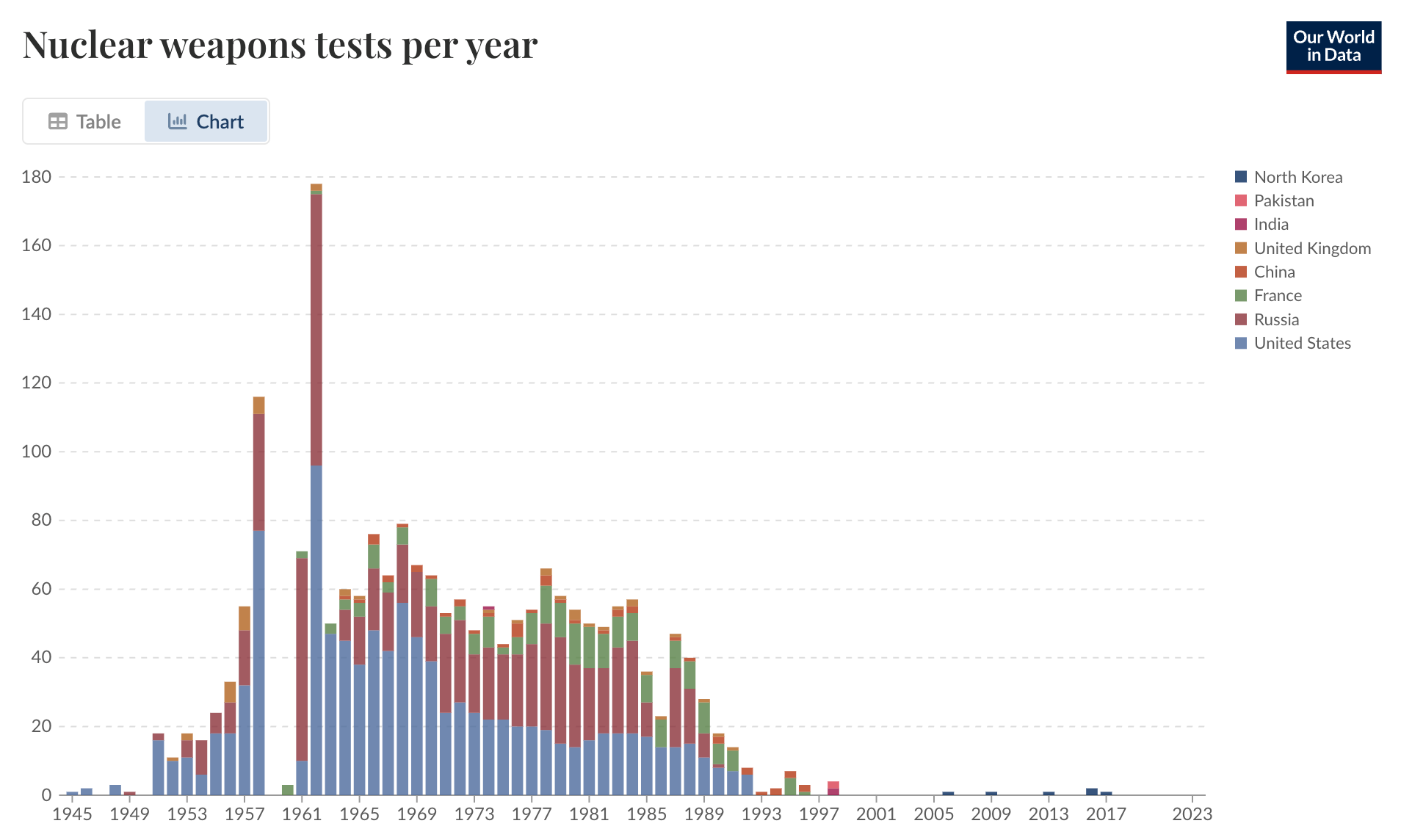
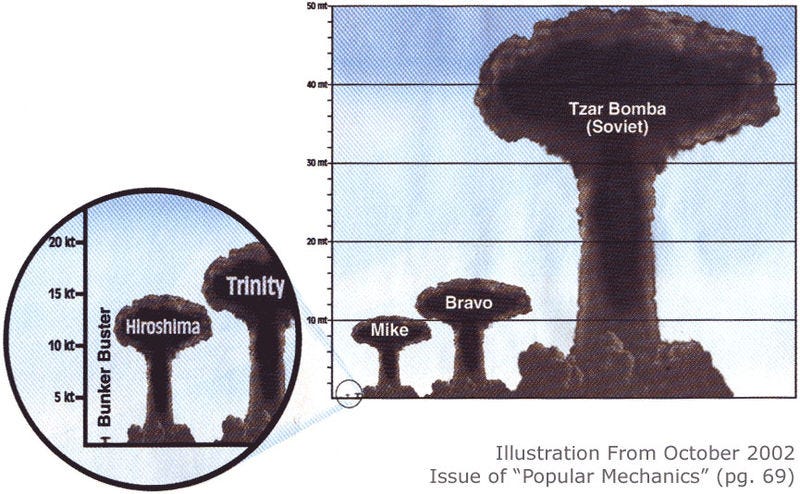
Even more speculatively, considering the attention of NHI and presence of UAP, there was curiosity–or concern–over the marked increase in nuclear detonations. First in volume, as the years 1951-1953 saw 47 detonations to the previous years’ 9 (1945-1950)–a 422% increase;98 and second, in scale as the first hydrogen bomb–Ivy Mike–was detonated, 31 October 1952, on Enewetak Atoll and had a 10.4 Megaton yield99–a 69,233% increase over the 15 kiloton Little Boy dropped on Hiroshima in 1945.
1952 was a big year.
And Donald Menzel had plenty to do.
The known retirement of Harlow Shapley–then HCO Director–was on Menzel’s calendar for September, 1952 years in advance since Shapley would then be at Harvard’s mandatory retirement age for the era.100 His preparation for that event was already in place through his own studies of the plate stacks and his working relationships with Wallace Eckert, Doll Eckert, and Howard Aiken. While plans were in motion on this front early in 1952, their execution would wait till after Shapley’s retirement.
Another vector in Menzel’s public-facing skeptical shift was literature. Several books had already been printed on the topic of UAP/NHI including Gerald Heard’s “Is Another World Watching? The Riddle of the Flying Saucers“ which was first published in 1950 had already gone through two editions and three reprints.101 Other titles available at this time were: “The Flying Saucers Are Real” by Donald Keyhoe (New York: Fawcett, 1950); “The Flying Saucer as I Saw It” by Kenneth Arnold (Boise, Idaho: Self-published, 1950); “Behind the Flying Saucers” by Frank Scully (New York: Henry Holt, 1950); “The Coming of the Saucers: A Documentary Report on Sky Objects That Have Mystified the World” by Kenneth A. Arnold & Raymond A. Palmer (Boise, Idaho: Self-published, 1952); and even a 1952 pamphlet published from General Motors titled “Firsthand Facts About the Flying Saucer Mystery” by Henry J. Taylor. Arnold and Palmer’s book was announced at the very beginning of the year, “…in January 1952, Ray Palmer made known that both he and Arnold would team up to produce a full size hardback about the flying saucer mystery.”102
In addition to the books being published, investigative research organizations began to spin up. In January, the Aerial Phenomena Research Organization (APRO) drafted its charter with the goal of regularly publishing news bulletins.103 The efforts of Donald Keyhoe–before, during and after 1952–would coalesce into the formation of the National Investigations Committee on Aerial Phenomena (NICAP) in 1957,104 with a press release announcing its prospectus on 30 August, 1956.105
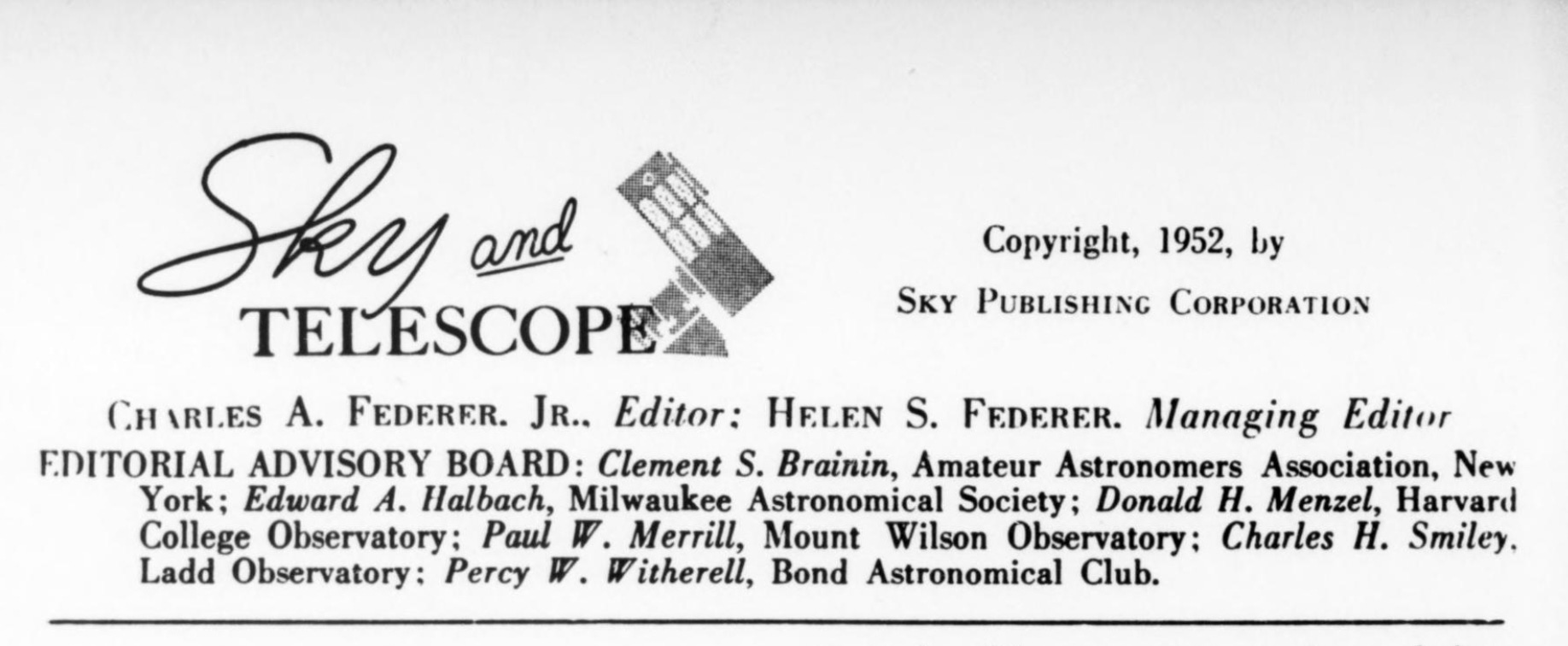
All these sorties into studying the existence of UAP/NHI–their reality still reported as classified higher than the H-bomb about to explode later in the year–had to be countered. Menzel’s experience and connections in having written for many years in popular science prints–plus his academic papers,106 military and intelligence reports–would give him the bulk of material to help write his premier debunking tome, “Flying Saucers”. His position at Harvard also allowed him extensive media and publishing connections, especially in this time period107 as he had sat on the Harvard University Press Board of Syndies for a four year term from 1 July 1948 to 1 July 1952,108 joining at the first available annual opening after the events of Roswell. He was also still in the midst of his long term role (1941-1959) on the Editorial Advisory Board of “Sky and Telescope” magazine. Meanwhile, MJ-12 colleague Vannevar Bush was on the Executive Committee at the Smithsonian Institution (1940-1955).109 His various publisher connections were following along closely, with the New York Times reporting later in the year that he would publish his first work on flying saucers as “a book due from Harvard this fall” in their Book Review section.110
The battle between the press in 1952 had no better salvo than the bombshell dropped 7 April on the cover of Life magazine, “THERE IS A CASE FOR INTERPLANETARY SAUCERS”.111
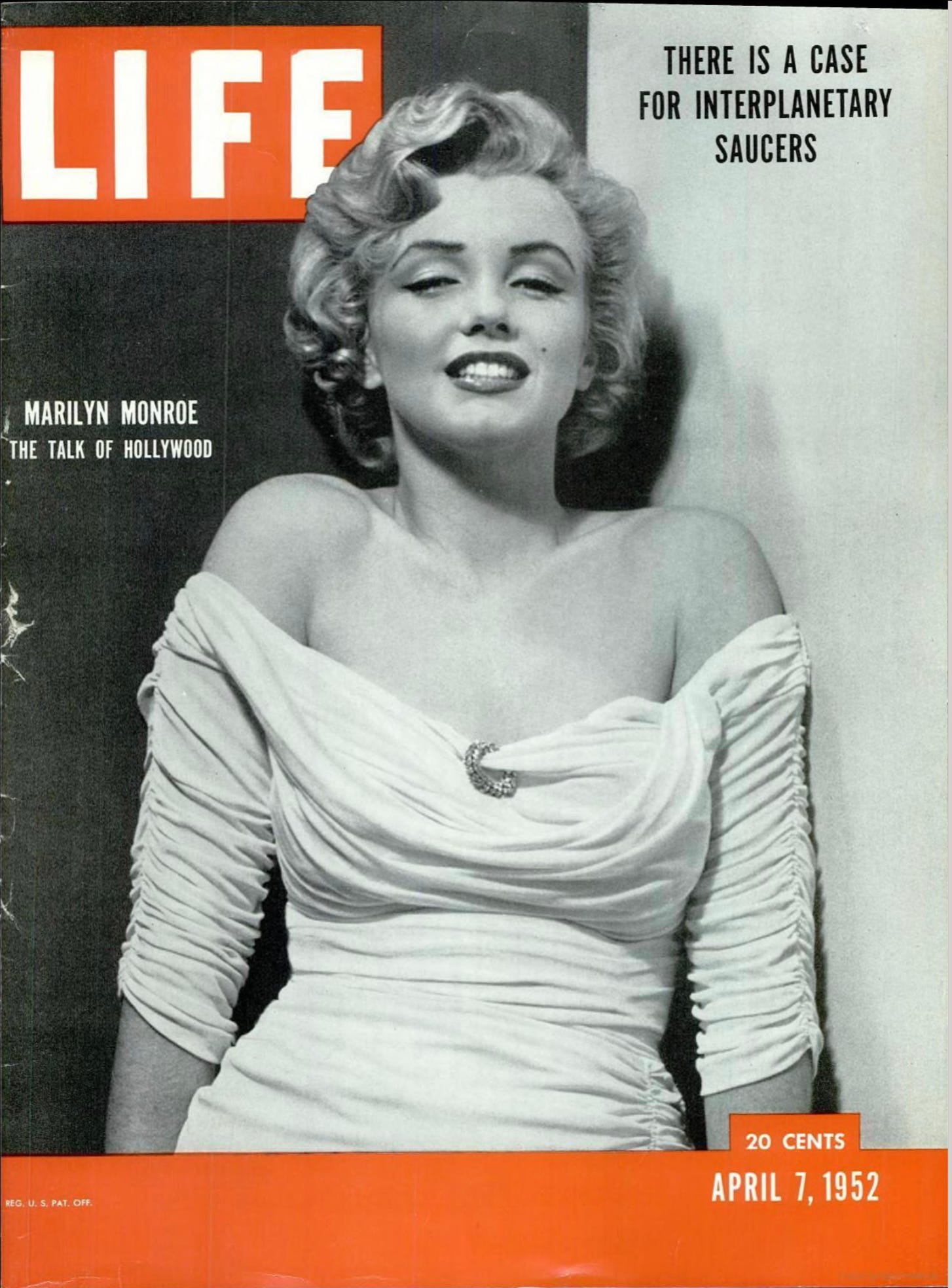
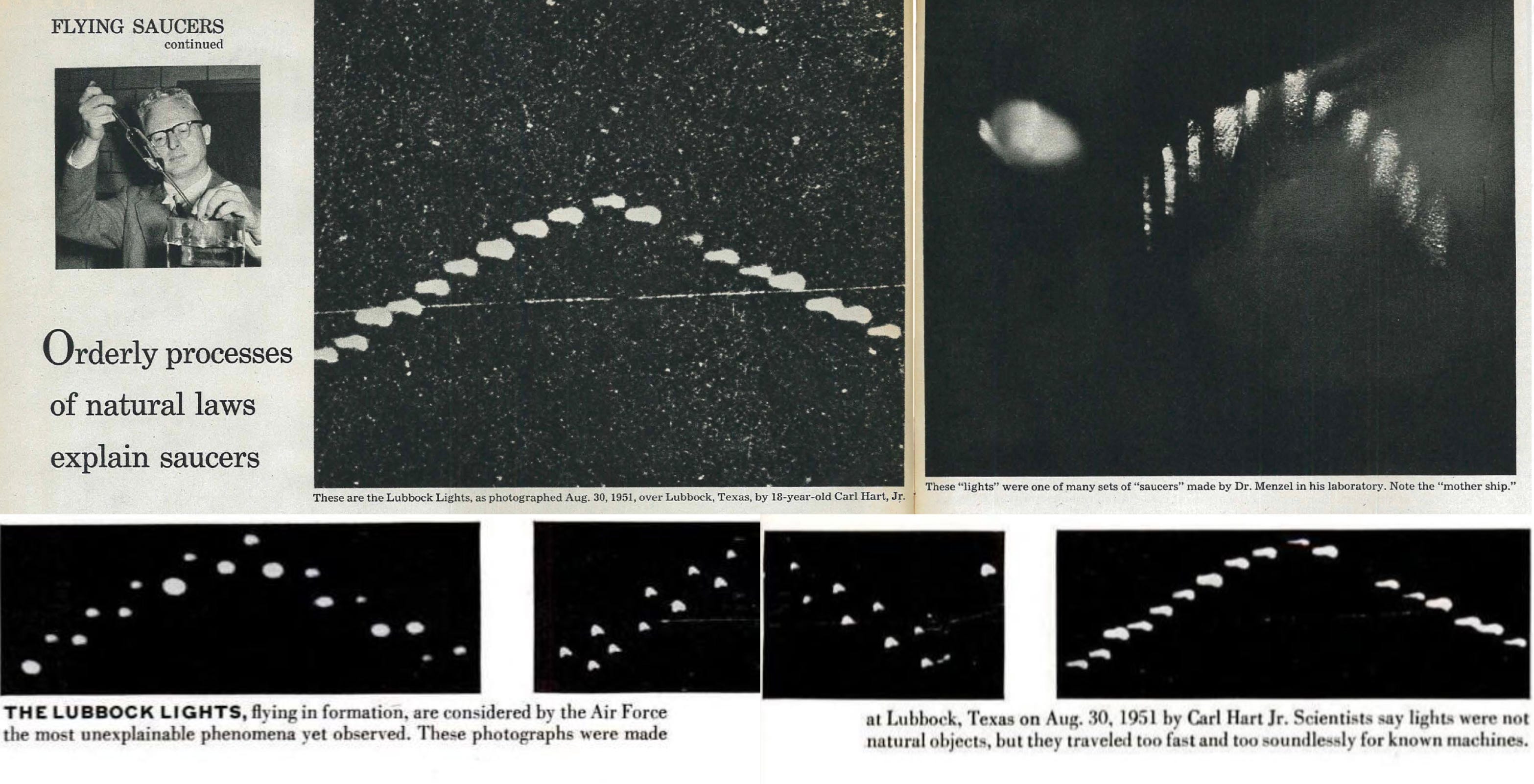
With rising star Marilyn Monroe’s debut magazine cover, this issue of Life magazine was clearly going to be one of its most popular.112 Of further concern to the Majestic-12 Committee, “There is a Case for Interplanetary Saucers” treated the existence of UAP/NHI in a straightforward way as a topic worth studying. Later that year, the British Interplanetary Society recounted the media battle thus, “Following the now famous Life article on April 7, Look for June 17 and Life's sister-journal, Time, for June 9, discussed at some length the theories about flying saucers of Dr. Donald H. Menzel, a professor of astrophysics at Harvard University.”113 Menzel’s self-authored article in Look directly countered the earlier article in Life using photos taken in his lab that mimicked the layout and style of those in Life of the Lubbock Lights.
Amplifying Menzel’s reach, his position was recounted in the July 3rd issue of The China Mail,114 June 11th issue of Variety,115 and the June 9th issue of Time116–to name a few. The biggest media firestorm, however, was yet to come.
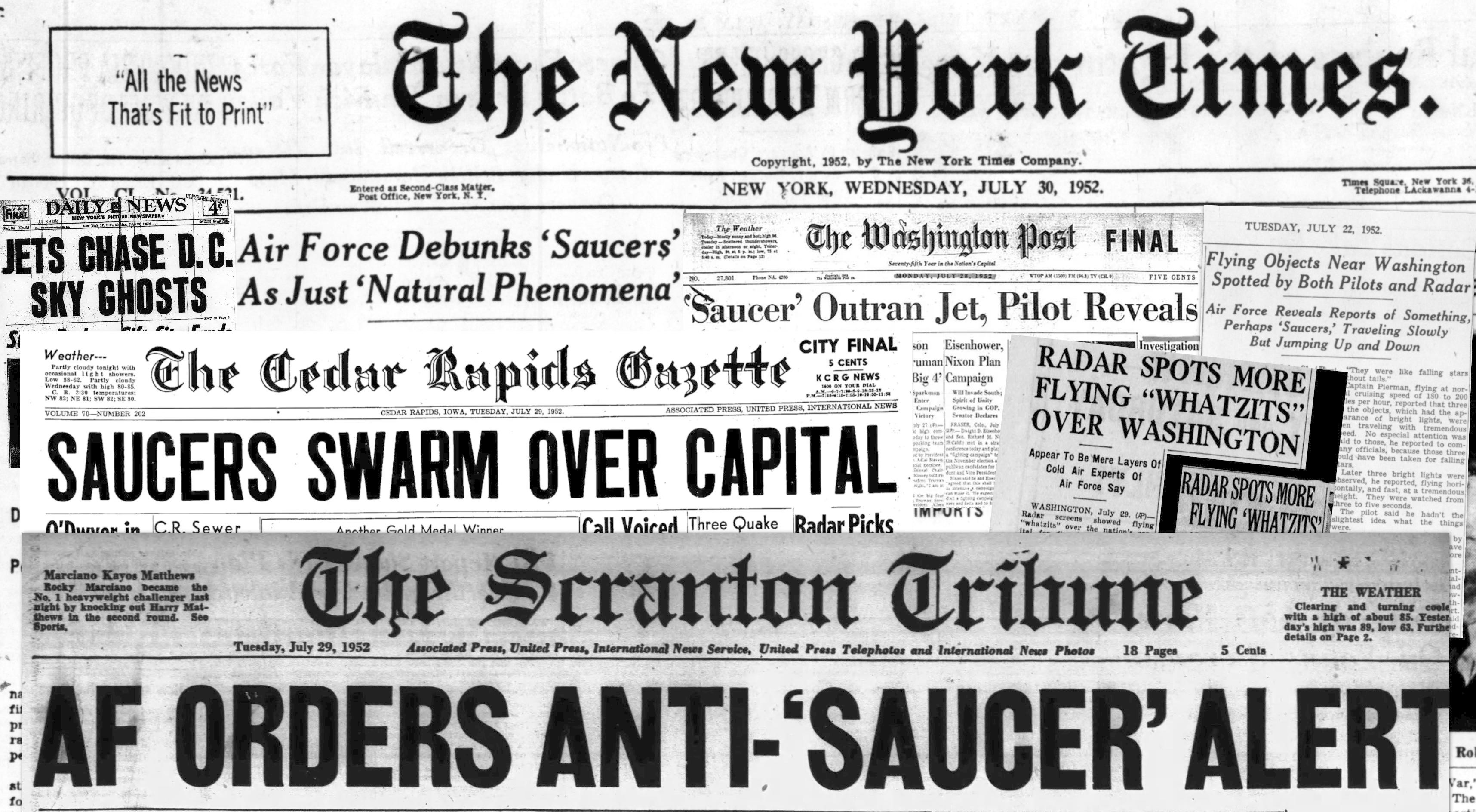
The tug-of-war in the press between documenters and debunkers in the summer of 1952 lost out to the third-party exploits of UAP and NHI. As a consequence, the U.S. Air Force held a press conference on 29 July where General Samford and others reiterated Menzel’s cover-up claims of “meteorological phenomena of one sort or another, light aberrations” for the radar returns:
THE PRESS: General, the Captain mentioned a moment ago or had the thought that when there is temperature inversion the men know who are observing radar. Is it all right to ask if the Air Force thinks that these objects the other night were a result of temperature inversion?
MAJOR GENERAL SAMFORD: Well, I’ll answer that first, try to, and then ask Captain Jemes for an opinion. I don’t think that we are quite sure that the Menzel theory of temperature inversion or that scientists are sure that that is a good theory: It’s supported by some people. Other people who have equal competence, it would appear, discredit it. So the gamble as to whether that is the cause or not is about a fifty-fifty proposition. It’s appealing. It does satisfy certain concerns. Is that a fair statement or answer to that question?
CAPTAIN JAMES: Sir, the Menzel theory applies mainly to light rays.
MAJOR GENERAL SAMFORD: Yes.
CAPTAIN JAMES: In regard to the temperature inversion effect on radar waves that is fairly well established.
THE PRESS: There’s no doubt about the latter, is there?
CAPTAIN JAMES: That’s right.
THE PRESS: That’s been established.117
Menzel was back on the clock and getting his mirage and inversion talking points in the mouths of the Air Force and in front of more press. When August came, the New York Times reiterated Menzel’s reflection lab work. These debunks were disconnected from the reality of the situation. As radar and visuals were not at all solely ground based and were multi-source from both trained witnesses on the ground and pilots with radar operators in the air watching the UAP converge and react to jet interceptor positions.118 Menzel and the Air Force deliberately concealed the scope of the encounters, covered recently in a retrospective by CNN:
Before Patterson could close the distance, the lights broke formation and began converging on his interceptor. Radar scopes in the tower showed the targets tightening around his position. In the cockpit, Shirley Red 1 was suddenly engulfed in blinding light.
“They’re closing in on me,” he radioed to controllers, voice edged with alarm. “What shall I do?”
Patterson, a Korean War veteran, was asking if he should open fire on whatever was drowning his aircraft in light.
There was no immediate answer. Controllers and military officials who had gathered in the tower, by several accounts, were stunned into silence.
For a breathless moment, Patterson was alone with the lights circling his aircraft. Then, as suddenly as they had appeared, they shot away into the night, streaking off radar in seconds.119
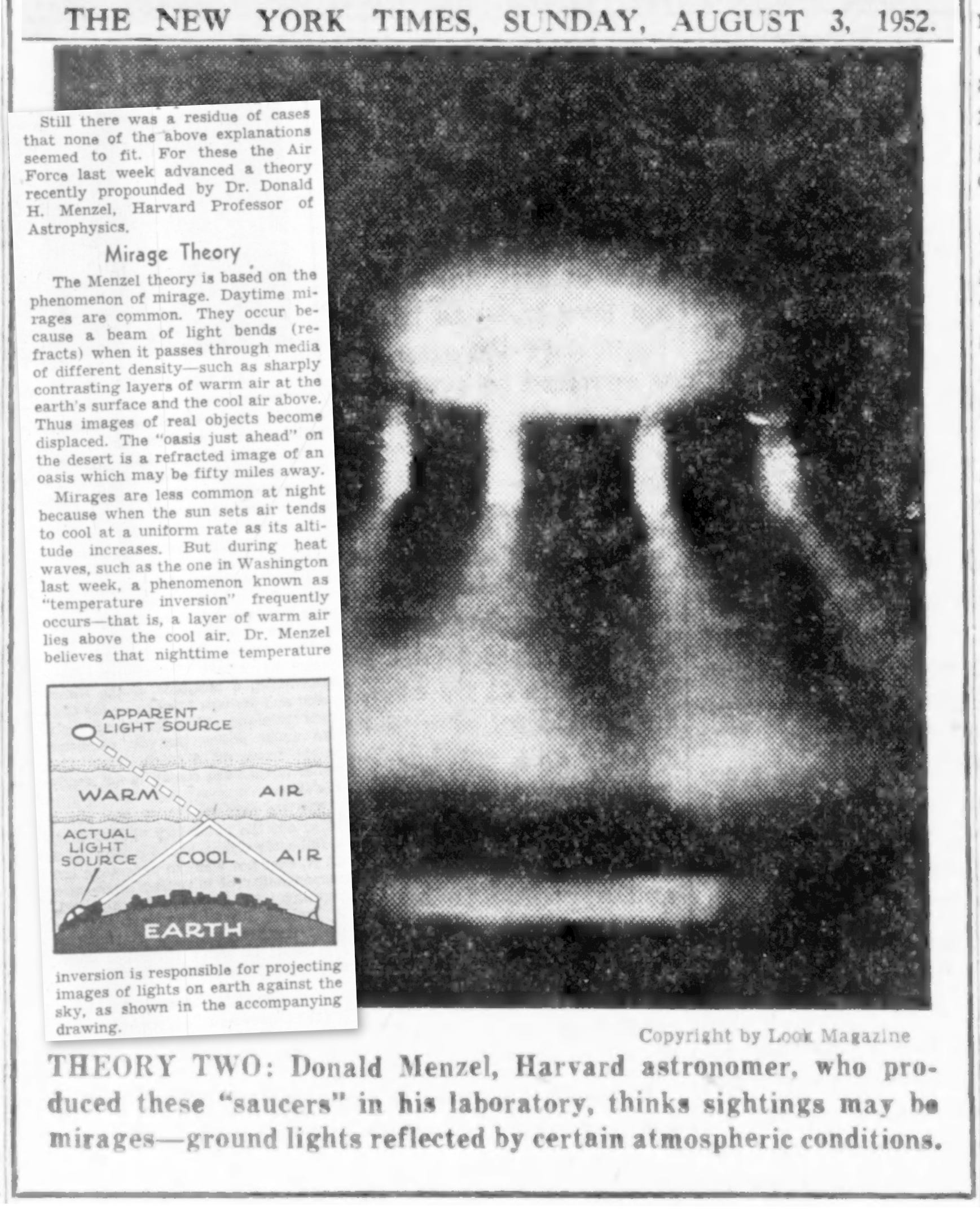
Remember that at this same time–the summer of 1952–Menzel was acquiring three years of Air Force ATIC UFO files through the clearance and request of Dr. Howard Aiken. Aiken, now running the Mark IV for the Air Force at Harvard, was able to provide cleared and secured storage on campus for the files while processing computer programs on the AF UFO files, mere blocks from where Menzel worked.120
This combination by Menzel of deception tactics—custody of case files and a mass-media explanatory campaign—maps cleanly onto the counterintelligence measures described in DNC 5, “which attempts to prevent the enemy from obtaining information of military value” and gives his cadre within MJ12 the upper hand in:
a. Capture or salvage of codes, ciphers, messages, plans, communication equipment, documents, or other classified material.
b. Theft, espionage, observation, and photography.
c. Interception of mail, wire, visual, radio, and telephone traffic.
d. Radio direction finding or tracking.
e. Traffic analysis.
f. Cryptanalysis.
g. Imitative deception, spurious messages, and falsification of communications.121
These are techniques that are common with dogmatic skeptics straight into our present day. Back in 1952, one more critical data source remained—Harvard’s own plates and programs—waiting just beyond Shapley’s retirement.
The Menzel Gap - Professor Menzel in the Vault Library with the Lead Pipe
As August gave way to September 1952, Harvard College Observatory (HCO) Director, Harlow Shapley, crossed into his mandatory retirement. Donald Menzel became Acting Director. A few historians depict this as a challenging choice for Harvard, but by then Menzel and close colleague Fred Whipple were bringing in the bulk of funding for the department.122 Another HCO astronomer, Dorrit Hoffleit, noted of the time:
Shortly before he reached mandatory retirement age, Shapley asked me to sample plates in the various series, selecting a pile of those I felt could safely be discarded, another of ones I thought might be controversial, and some of the poorer plates I thought should nevertheless be kept. When I finished, he would check my selections and draw his own conclusion, namely that the number of plates sufficiently poor to justify discarding was so small it would be a waste of time to search for them. Throw them away if you happen to come across any, he told me, and then be sure to make an appropriate note in the record books and card catalogs so that no one would subsequently search for them in vain.
But the new Director [Menzel] had other plans. His own work made comparatively little use of the plate collection, whereas office space seemed to be at a premium. He ordered his executive secretary, who had little if any experience in astronomy, to throw away the poorer plates to the extent of removing about a third of the collection, clearing the equivalent of one of the three floors of the plate vault. Moreover, this was being done in such a hurry that no records were kept of what was discarded. This wholesale destruction was driving me crazy. Finally I wrote the Dean what I thought. After that life naturally became intolerable and although I had tenure at Harvard, I resigned (nor was I the only one to do so).123
When Menzel became HCO Acting Director in September 1952,124 he quickly had one-third of the night sky photographic plates discarded. Further, he halted collecting night sky photographs during the entire period he was director.125 This became known as the “Menzel Gap” While historically the Menzel Gap126 has been explained as a cost-cutting or data-reduction measure, when all the pieces are assembled, the timeline is considered, and the outcome measured, the destruction of one-third of the astronomical photographic plates accomplished a targeted removal of UAP data.
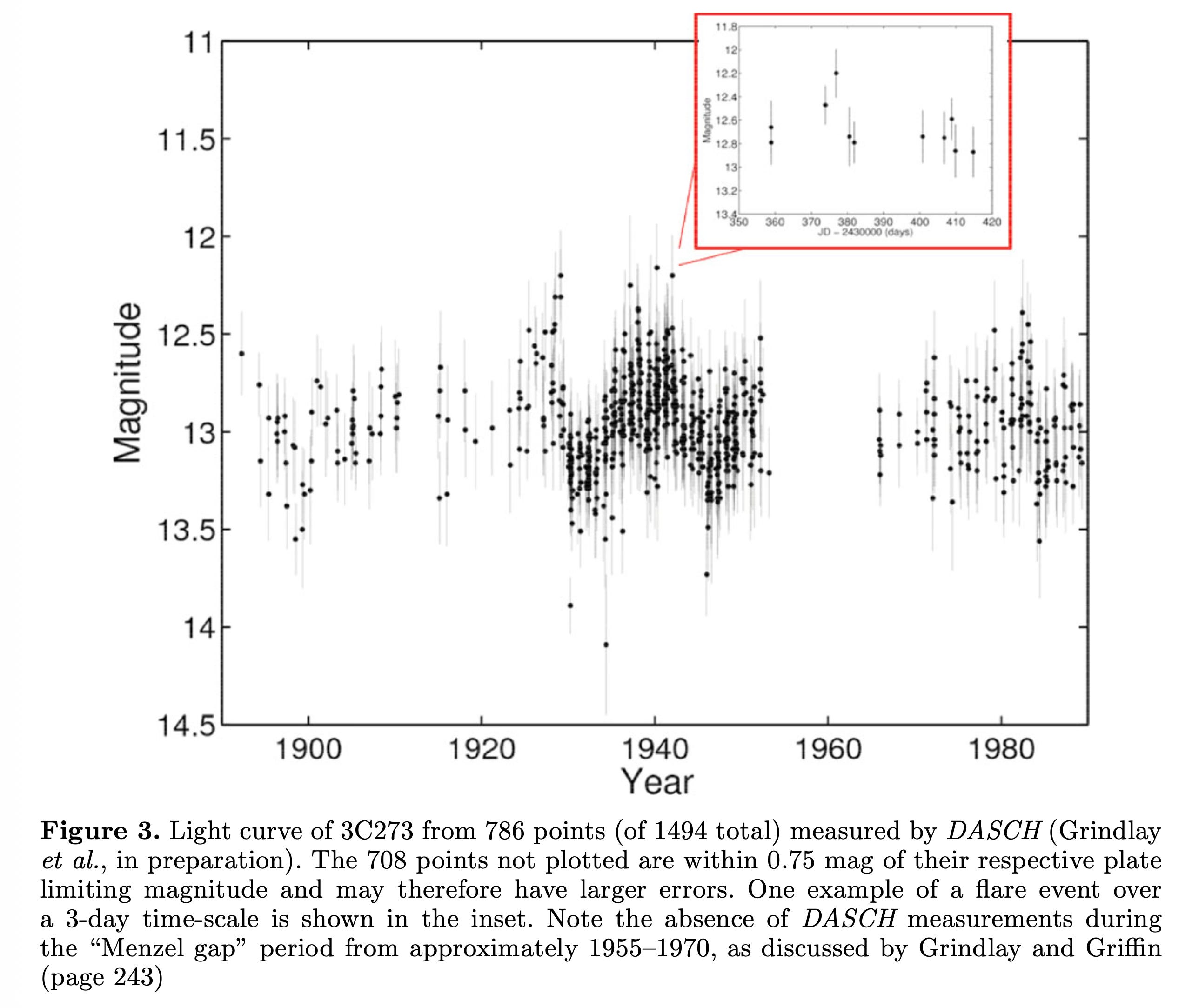
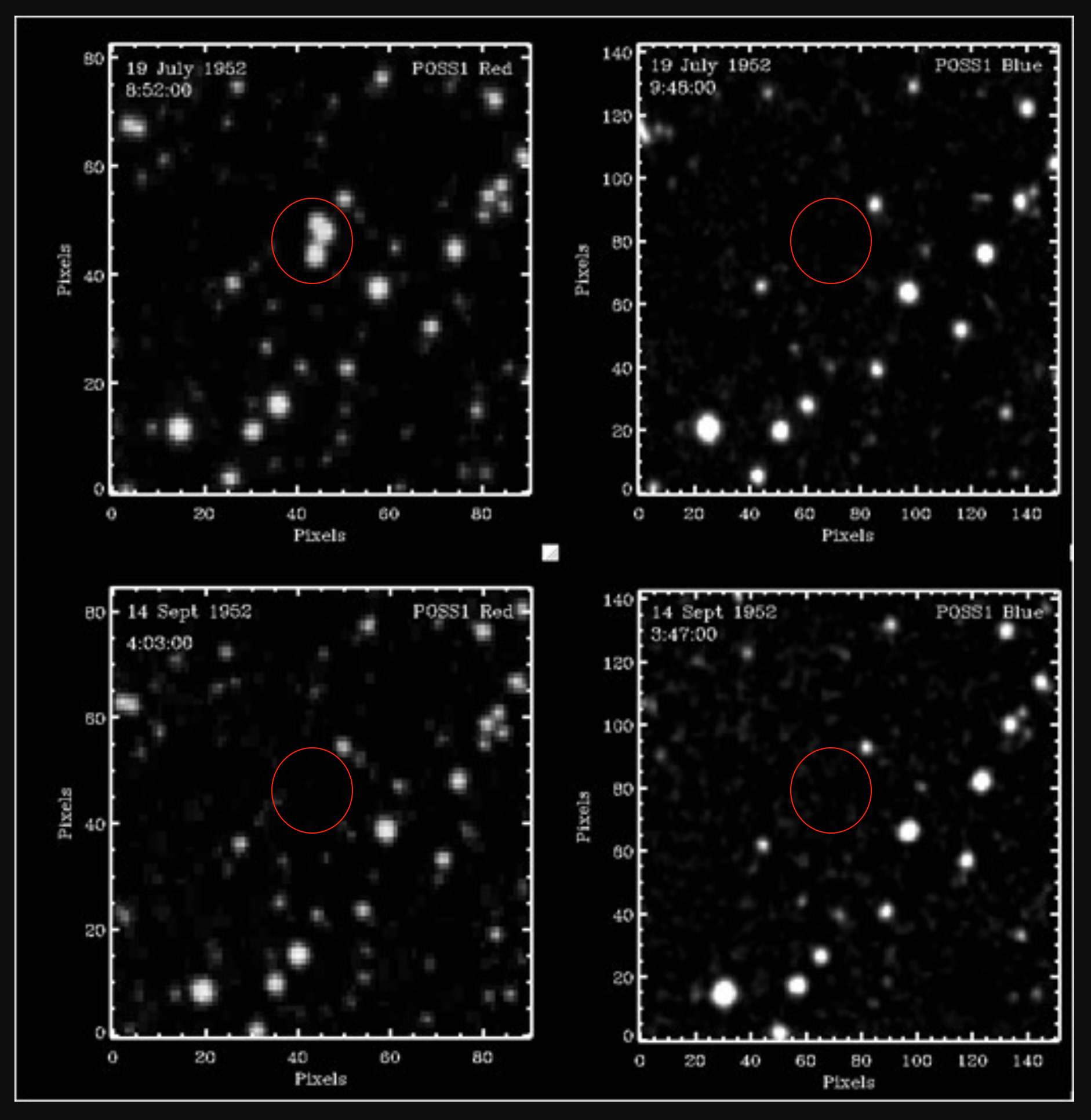
A present day astronomer, Beatriz Villaroel, reveals what was likely on the plates Menzel targeted for removal. In her work, she used data from the First and Second Palomar Sky Surveys (POSS-I and POSS-II) and measured photographic plates prior to the first satellite launched into orbit, Sputnik I on October 4, 1957.127 This allows for a proxy highly similar to the set of data as Menzel would have had at HCO in 1952–a pre-satellite plate-based record of the night sky. Her papers, “Aligned, multiple-transient events in the First Palomar Sky Survey”, “Transients in the Palomar Observatory Sky Survey (POSS-I) may be associated with nuclear testing and reports of unidentified anomalous phenomena”, and “A bright triple transient that vanished within 50 min” detail what she found. Namely, transients–bright flashes appearing and then disappearing–on photographic plates produced one hour apart.
Back into the timeline of 1952, the “A bright triple transient that vanished within 50 min” paper deals with one of the very nights of activity in Washington D.C., “A particularly interesting case of multiple transient event was discovered in the POSS I Red image, of 50 min exposure time, taken on 1952 July 19. They exhibit no evidence of peculiar shapes or elongation that would occur with asteroids, meteorites, cosmic rays, photographic plate defects, or aircraft.”128
In the paper “Aligned, Multiple-transient Events in the First Palomar Sky Survey” Villaroel finds her most statistically precise result, “...a highly significant (∼22σ) deficit of POSS-I transients within Earth’s shadow when compared with the theoretical hemispheric shadow coverage at 42,164 km altitude. The deficit is still present though at reduced significance (∼7.6σ) when a more realistic plate-based coverage is considered.”129 A 5σ threshold is often treated in physics as ‘discovery-level’ significance; 7.6σ and 22σ are far beyond that.130 In other words, the shiny, reflective transients do not reflect back sunlight when in the Earth’s shadow. What is the likelihood Menzel–conventionally most famous for his study of the sun, globetrotting efforts in viewing solar eclipses, and patents on tools to view the solar corona without an eclipse–would not have checked for eclipsing shadow effects when viewing photographic plates chronicling the nights of peak UFO waves?
Villarroel et al131 used automated pipelines, but even 70 years prior, Menzel had operationally feasible automation tools to pursue catalog-driven, punch-card-assisted screening. Here’s how this could have done in 1952:
With Air Force ATIC UFO data scrubbed by Aiken using the Mark IV, Menzel could identify suspect dates.
Further dates would be available from reports shared within Majestic-12. 1 and 2 create a targeted data set.
Working with Wallace and Dorothy Eckert, Menzel would have access to automatic star measuring machines.
Punched cards program the machine to locate stars on the plates, and vice versa, record all shiny objects on a plate.
Wallace Eckert explains the process in this way:
In the new machine we will not only place the photographic plate, but also a stack of a thousand cards, one for each star. Each card will contain the approximate position from the old catalog made 75 years ago. The machine will read the card, find the star, measure its position and punch the measured position on the same card. The new program will then be simply a matter of traffic control, so to speak, through the machinery.
After the machines have automatically performed the measurement and computation, certain data must be selected and displayed for inspection so that the astronomer can see what is going on; here again the machines come into use. We look upon this equipment as purely a slave which does the work and exhibits the material in such a way that the astronomer can exercise the judgment which formerly came only after he had exhausted himself on a lifetime of routine work.132
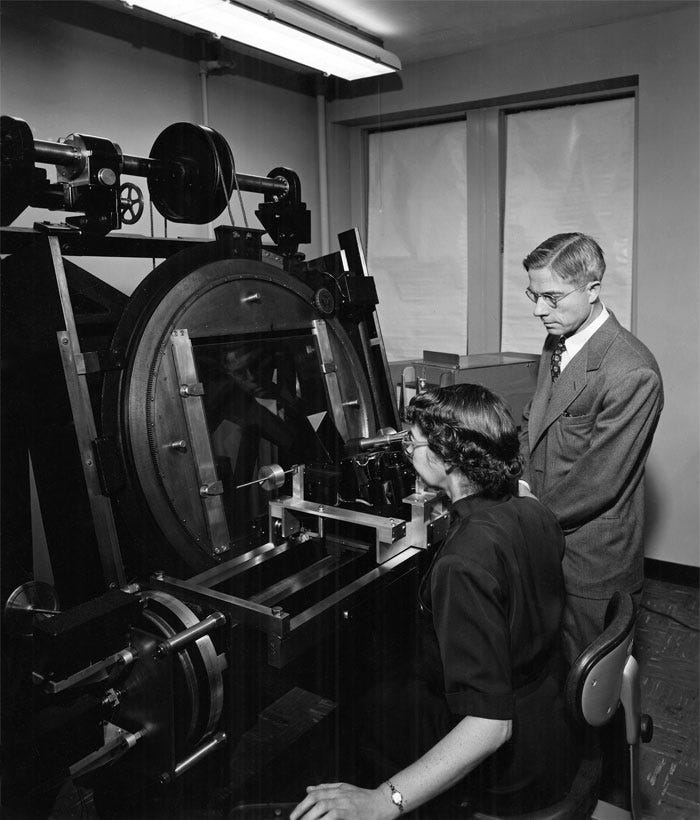
Whereas Menzel in his interview with Henry Tropp says:
Donald Menzel (DM): One thing that I was particularly interested in was the automatic measuring machines. Measuring the positions of stars.
Henry Tropp (HT): It was an automatic machine?
DM: It was an automatic machine. You put on the plate with a spectrum on it, and it went right through. You had, there were computing devices on it that made proper corrections for the different non-linearities in the machine itself, in the spectrograph itself. And at the same time, if I recall correctly, it measured the intensities of the spectral lines in some sort of a system of enquiry.
HT: But directly from the photographic plates?
DM: Yea. That’s correct.133
These machines could process both spectrum and position. Eckert published his paper “Automatic measurement of photographic star positions” with the fully running machine up in March 1954.134 While the non-automatic machines and Menzel’s relationship with the Eckerts was in place since 1927/1928. Dorrit Hoffleit expands on the plate destruction in her autobiography:
One of the first things Menzel did was to ask his secretary (whose previous job had been as personnel manager for the Jordan Marsh department store) to discard a third of the plates in the plate stacks in order to make room for more office space. When some astronomers took courage to object after many plates had been thrown out, he continued having plates removed from the stacks but stored in the cellar under the 15-inch telescope dome. He had long plank shelves made, and put so many plates on each shelf that the planks sagged in the middle in such a way that the upper shelves actually rested on top of the plates on the shelf below. Moreover, there was no concrete or other covering on the dirt floor. Although the foundation consisted of huge stone blocks, roots of trees penetrated the walls, and the humidity was high. Inevitably the plates were doomed.
The Harvard plate collection had been the largest in the world, probably the only one covering the sky from pole to pole with some series dating back to 1882. How could any astronomer, regardless of his own speciality in research, wantonly destroy so high a percentage of plates that were vital to many research projects, especially for variable stars?135
If some of the variable stars were equivalent to transients which prior to Sputnik were likely to be what Menzel and crew had tracked from space to crash sites on earth, the motivation for Menzel’s destruction is obvious. It was also a motivation that was an outlier for Menzel himself. The rocks and ores he collected as a child in Colorado he donated to the University of Denver where they can be found today. His ham-radio handle–W1JEX–he kept from childhood until he was a “Silent Key” in death.136 His letters, research and other materials populate archives at Harvard, Denver, the American Philosophical Society and more. His knowledge of the photographic plates was intimate and his ‘ingenious’ study of them was a key aspect of his Ph.D. thesis.
Even Menzel’s secretary in the year and a half prior, Catherine B Wyatt, is an outlier. Stanton Friedman tracked her down before she died, knowing that she likely held secret clearances:
Since it was clear from his comments to Kennedy that Menzel had the facilities for storing, preparing, shipping and receiving classified documents, I made a serious effort to find out who did his classified work for him in the late ‘40s and ‘50s. I eventually, after considerable effort, found a woman who had been a graduate student in one of the cryptograph courses, worked for him in Washington during the war as a kind of secretary and assistant, went back to Harvard with him, worked for him there, and wound up marrying one of his graduate students. He was like a father to her. As a matter of fact, her marriage took place in his house.137
After arranging an interview over the phone, when Friedman attempted to meet Wyatt in person she cancelled the meeting. Prior, Friedman had mentioned his interest in MJ-12 to Wyatt, but avoided the topic of UFOs. He later noted how seriously Wyatt reacted to the proposed meeting: contacting her lawyer, not daring to “tell Florence [Menzel] and Liz [daughter of D. Menzel] about MJ-12,” and “seemed more concerned about Navy stuff than gossip.” Near the close of Friedman’s note he adds a comment from Wyatt, “that Don’s Navy service was a lot more than people thought and that he was very special.”138
A gun is made up of pieces and works by a chain-reaction of events. It smokes after use. Here are the pieces of such a ‘smoking gun’ assembled, and Menzel working over the cellar grave of destroyed photographic plates.
Menzel Evicts the American Association of Variable Star Observers (AAVSO)
While the pruning of data was one Menzel initiative underway at Harvard, another was attempting to minimize the work and presence of AAVSO. In October 1952 at an AAVSO Council Meeting, Menzel, “spearheaded the creation of a re-evaluation committee to consider the future of the AAVSO, one of the first steps toward the eviction of the AAVSO from Harvard.”139 Martha Stahr Carpenter, who was then the AAVSO president, was given a deadline from Menzel of January 20, 1953 to have a full report from the re-evaluation committee. However even before that date was reached, Carpenter was, “presented with a plan for the AAVSO to be moved far away, to an institution that was already planning to acquire it, and had worked out the details of hosting the organization.”140 The move would have been not only a far one in distance, but a massive step down in stature as AAVSO was to be relocated to “a small college in the Midwest [Carpenter] had never heard of (and cannot remember the name of to this day). In her words, ‘Menzel had already given the AAVSO to this organization–he must have been embarrassed when he couldn’t deliver it.’”141 Carpenter averted the demise of AAVSO, but it would still have to leave Harvard.
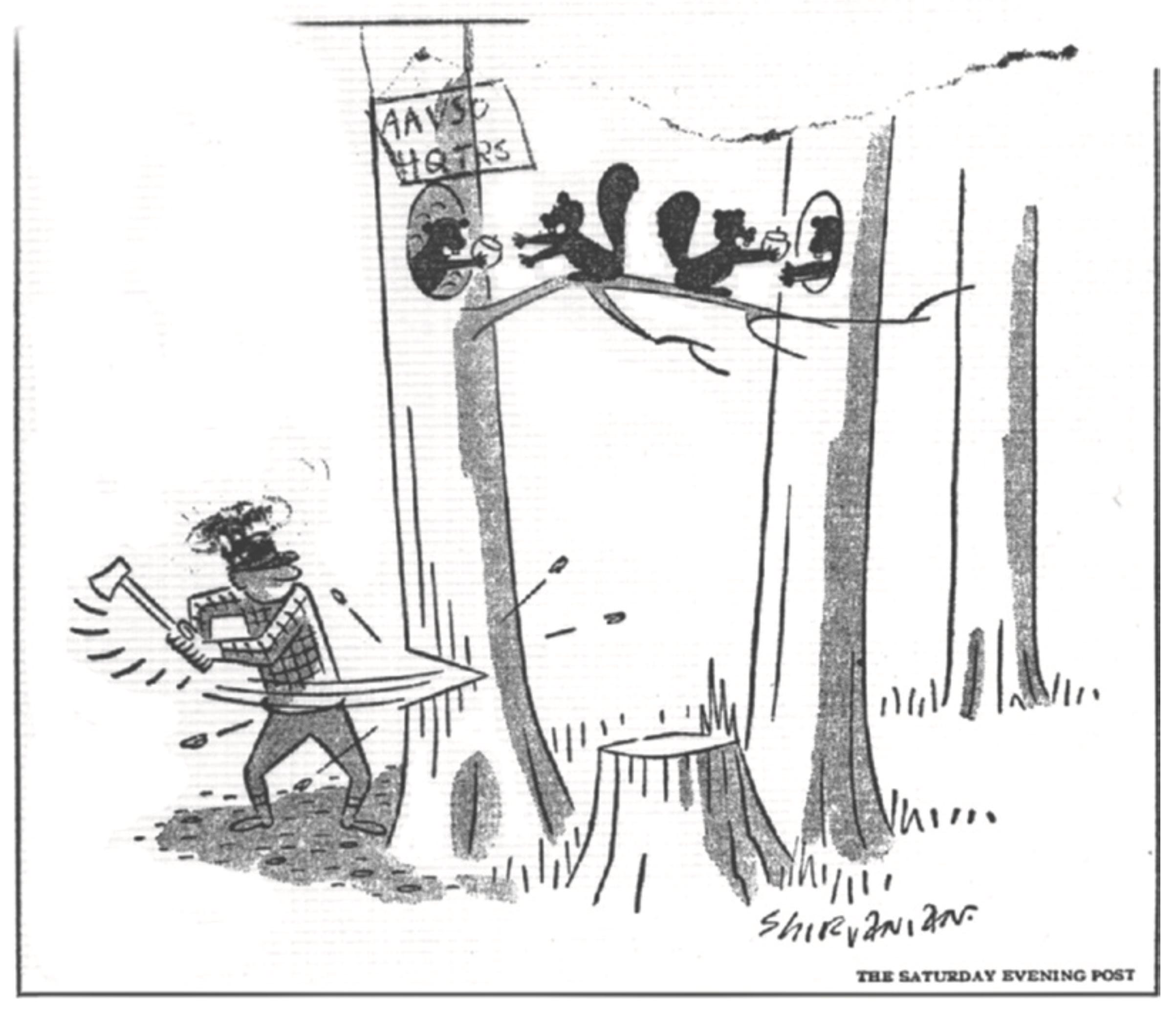
Even after AAVSO was on the way out, Menzel pursued ways to prevent them from remaining established. “In October 1953, [AAVSO Director] Margaret [Walton Mayall] was relieved to receive an offer from Boston University’s Physics Research Laboratory (AAVSO 1953). Unfortunately, the offer was withdrawn on January 6, 1954 but only, according to Stephansky, after BU officials had spoken with HCO’s Menzel (Stephansky 1954).”142 Eventually, AAVSO moved into a small, 405 square foot office less than a mile east of HCO and became an independent, non-profit organization.143 While finally out of the reach of Menzel, the effect was already done. No longer an active staff of star observers with equipment and a Harvard home, AAVSO HQ became an archive office and networking hub for other AAVSO volunteers around the globe. The centralized investigation, collection and repository of variable star data at Harvard was no more.
Menzel finds a friend in Phil Klass
1952 still had December. That month, recently hired Aviation Week journalist Philip J. Klass at Aviation Week authored a piece on digital computers from defense contractor Hughes Aircraft Co., and contributed an article to the Headline News section, “Radar Needs ‘Saucer’ Filter: CAA.”144 Klass would expand on this stub in the coming year with the article “That Was No Saucer, That Was an Echo” on 20 July 1953, citing both the CAA’s Richard C. Borden and Tirey K. Vickers as well as Dr. Donald H. Menzel. In coming decades, Klass would become a key figure on the private side of the military industrial complex, carrying forward Menzel’s debunking mantle past the latter’s death in 1976. The two, along with Edward Condon, would become regular pen pals with some of their correspondence being preserved in the archives at the American Philosophical Society.145
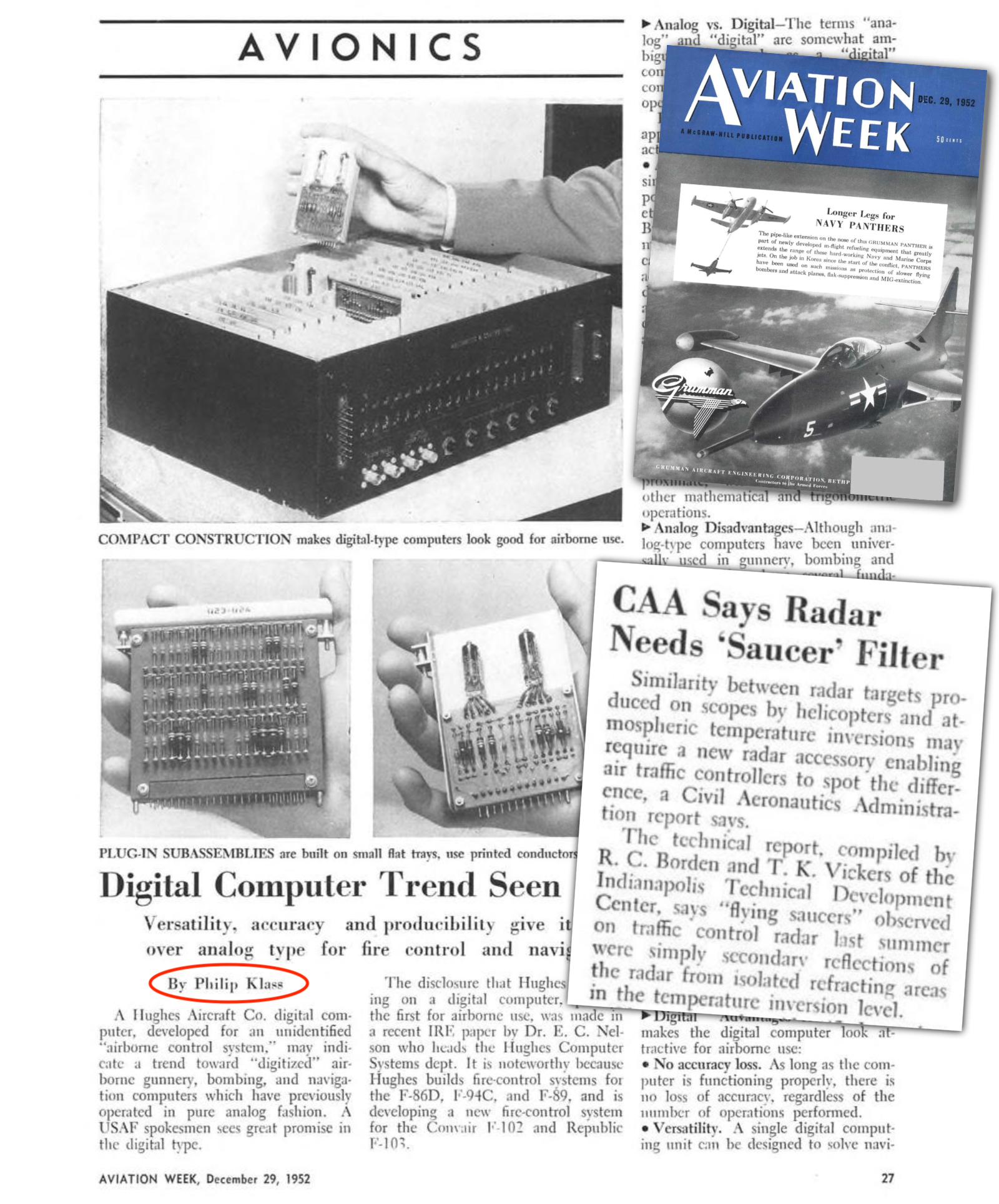
The breadth and depth of the relationship between the three was unknown at the time to people debating any one of them separately on the existence of UAP/NHI. In the years to come, Menzel would provide leadership, guidance and examples while Condon and Klass would grow influence within their given domains. The three would all have similar traits that Menzel greatly valued in his influence campaign:
Media training and journalistic output
Patent holders in engineering and sciences
Familiarity with clearances and the intelligence community
Menzel: OP-20-G, NSA, CIA, broad defense industry consulting, Secret, Top Secret, Top Secret Ultra, MJ-12
Condon: Q Clearance at AEC/DOE, National Bureau of Standards, clearance work in private industry (Corning)148
Klass: Secret Clearance work at General Electric during WWII, regular CIA and NSA meetings as a journalist149
Later, Carl Sagan would be recruited in a similar way. Then following the death of Condon and shortly before the death of Menzel, Sagan and Klass would go on to found the Committee for the Scientific Investigation of Claims of the Paranormal (CSICOP) in 1976. This is all getting a bit ahead of the situation in 1952 though, as there was still one major event Menzel had to prepare for as he finished out the year.
Menzel’s allies at the CIA and on the Robertson Panel
Also in December, the CIA was finalizing plans to review the work done in investigating UFOs, mostly by the Air Force, and make recommendations across broader Department of Defense and intelligence agencies regarding research and development concerning unidentified flying objects.150 This would become the Meetings of Scientific Advisory Panel on Unidentified Flying Objects convened by the Office of Scientific Intelligence, CIA on January 14 - 18, 1953; more commonly known as the Robertson Panel.151
The most notable panel participant in Menzel’s near sphere was fellow MJ-12 member, Dr. Lloyd Viel Berkner.152 Similar to Menzel, Berkner was a scientist with specialties in ionosphere and wave propagation who was closely connected to Vannevar Bush.153 He too carried the cadre line: “In McDonald’s files is a copy of a 1965 letter which Julian Hennessey, an English UFO researcher, had received from Berkner. Hennessey was interested in learning Berkner’s present attitude toward the UFO problem. Berkner wrote back on GRCS letterhead: ‘In the cases of all so-called unidentified objects brought to my attention to date there are none which cannot be explained as definable physical phenomena.’”154 Influencing the Panel from the inside was critical to MJ-12 as the scientists CIA had assembled were touching on some topics very close to Menzel’s home base at Harvard:
There was considerable discussion of a possible “sky patrol” by amateur astronomers (Hynek) and by wide-angle cameras (Page). Dr. Page and Dr. Robertson pointed out that at present a considerable fraction of the sky is now–and has been for many years–under surveillance every clear night in several meteor and aurora observing programs as well as sky mapping programs at the various locations listed below. Although the attention of those astronomers is largely directed toward identified rather than unidentified objects, no case of any striking unidentified object is known to Dr. Page or Dr. Hynek. Such an object would most certainly be reported if found on patrol plates.155
While that reporting eventually becomes true, as discussed previously above, there was a delay of roughly 70 years before such objects were written about by Villaroel, et al.
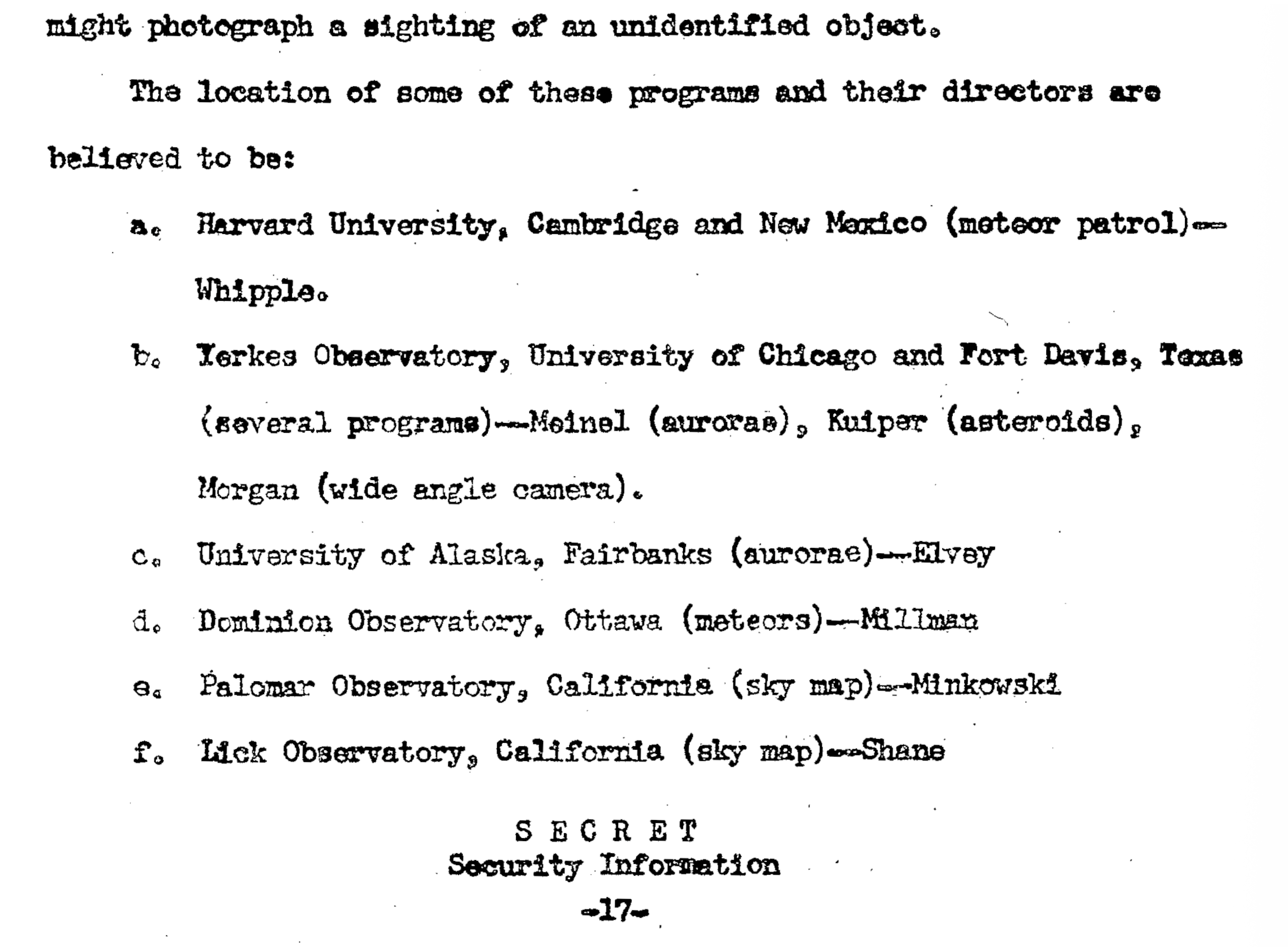
Back to the panel, the first location of the various sky patrols ‘listed below’ is item ‘a’: “Harvard University, Cambridge and New Mexico (meteor patrol)–Whipple.”156 Interestingly, while Harvard tops the list, its sky map function that was running since the 1800s is not recorded, nor is its observatory. Additionally, Fred Lawrence Whipple is named as director in place of Menzel or Shapley. Still, despite not being named, this helps account for why Menzel was in such a hurry to cull one-third of HCO’s photographic plate collection. It was a deletion so effective, that even after completing the Digital Access to a Sky Century @ Harvard (DASCH) on 29 December 2024,157 astronomers such as Villaroel have still had to rely on other observatories for data on UAP. In what reads like a feint of not knowing what was taking place on the Robertson Panel, Menzel’s last interaction with the panelists would be in a letter several years later after receiving the unclassified version of the report from Leon Davidson. His suggestions were not detailed by the CIA in their memorandum,158 but based on the cover up produced in the decades following, Menzel and the MJ-12 Committee achieved their aims.
While Menzel’s own involvement with the CIA is less well chronicled than his work with the NSA, almost 8 years later he would mention it in a letter to John F. Kennedy shortly before JFK’s election to president. “I have been associated since 1930 with a small organization that has now grown to the great National Security Agency. I served with them as a Naval Officer during World War II. I have been a consultant to that activity with Top Secret clearance and have also had some association with the ClA.”159
Menzel’s thank you missive to 1953
Leaving 1952 behind, a closer look at the Robertson Panel is a fitting beginning to 1953. The benefits Menzel and dogmatic skeptics derived from it paid out well in the decades following, enough so that Menzel thanked Panel doctors Robertson and Page in the 1963 preface of “The World of Flying Saucers”160 The path between that appreciation from Menzel and the largest impact for the general public following the Panel was the recommended and spun up Educational Program. As described in the report, “The Panel’s concept of a broad educational program integrating efforts of all concerned agencies was that it should have two major aims: training and ‘debunking’.”161
In the following paragraphs of the report a model CSICOP would later echo to extend Menzel’s counterintelligence work is outlined:
The “debunking” aim would result in reduction in public interest in “flying saucers” which today evokes a strong psychological reaction. This education could be accomplished by mass media such as television, motion pictures, and popular articles. Basis of such education would be actual case histories which had been puzzling at first but later explained. As in the case of conjuring tricks, there is much less stimulation if the “secret” is known.162
From the beginning when CSICOP formed, it incorporated magicians163 focused on showing the “secret” behind tricks. Their sleight of hand however was not a measure of reality, but substituting their staged solution for it. If this tactic came directly from Menzel’s suggestion it wouldn’t be shocking as his editorial work with Science and Invention magazine had him reviewing similar ploys.164
The Robertson Panel also mapped out the abundant need for psychologists, which would be exactly the type of troops needed in psychological warfare, “Members of the Panel had various suggestions related to the planning of such an educational program. It was felt strongly that psychologists familiar with mass psychology should advise on the nature and extent of the program.”165 Again, CSICOP would mirror this point upon forming in 1976 till today, where they still have the most fellows and production in psychology and its related fields.166
Menzel being an astronomer was not to be left out by the Panel however:
Dr. Hynek suggested that the amateur astronomers in the U. S. might be a potential source of enthusiastic talent “to spread the gospel”. It was believed that business clubs, high schools, colleges, and television stations would all be pleased to cooperate in the showing of documentary type motion pictures if prepared in an interesting manner. The use of true cases showing first the “mystery” and then the “explanation” would be forceful.167
Enthusiastically leading the charge on this front was Menzel. The criteria of people able to reach mass audiences would lead him to Klass and Sagan, who both would later be founding members of CSICOP.168 Menzel even helped spin up a CSICOP-like precursor at Harvard, where fellow astronomers took on the varied topics of CSICOP’s later ire:
Menzel: Debunking UFOs
Bart Bok: Debunking astrology, in print169 and in petitions170
Cecilia Payne-Gaposchkin: Velikovsky171
Harlow Shapley: Flying saucers174
None of these matched the enthusiasm of Menzel–nor the latter focused, dogmatic skepticism of CSICOP. Their lower activity in comparison to Menzel is probably due to their schedules requiring productive, scientific work plus a lack of incentive and orders since the others were not listed as engaged with MJ-12, the NSA and other counter-intelligence taskings. Still it is noteworthy that a CSICOP precursor formed in the Harvard Astronomy department and not at other universities. Perhaps Menzel’s enthusiasm was contagious. Or as a Navy Commander he learned how to lead up and down his chain of command.
Returning to the Robertson Panel, the educational program was outlined further:
...the educational program of “training and debunking” outlined above might be required for a minimum of one and one-half to two years. At the end of this time, the dangers related to “flying saucers” should have been greatly reduced if not eliminated. Cooperation from other military services and agencies concerned (e.g. Federal Civil Defense Administration) would be a necessity. In investigating significant cases (such as the Tremonton, Utah, sighting), controlled experiments might be required. An example would be the photographing of “pillow balloons” at different distances under similar weather conditions at the site.175
In case the use of psychologists was missed earlier the Panel reminds, “The help of one or two psychologists and writers and a subcontractor to produce training films would be necessary in addition.”176 Production value of those films was another key point as, “the Jam Handy Co. which made World War II training films (motion picture and slide strips) was also suggested, as well as Walt Disney, Inc. animated cartoons.”177 Finally, to the Panel’s surprise as it considered its counterpart in the Cold War, “The Panel noted that the general absence of Russian propaganda based on a subject with so many obvious possibilities for exploitation might indicate a possible Russian official policy.”178
Menzel would make ample use of so many obvious possibilities for exploiting the topic, and the ‘debunking’ apparatus proved exportable:
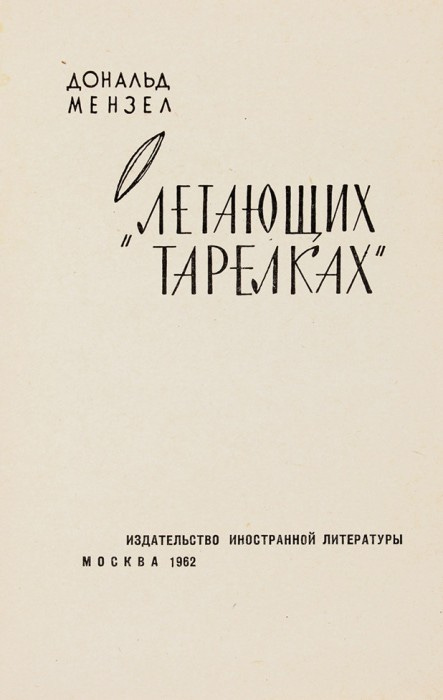
Menzel marks the card catalog
Coming on the heels of the Robertson Panel, Menzel’s first UFO book “Flying Saucers” was published in February 1953 by Harvard University Press, where Menzel recently finished his four year stint on the Board of Syndics. Adding to Menzel’s media coverage, it drew many reviews.179 Harvard’s own Crimson newspaper cuts to the core of the book and Menzel’s Robertson Panel-aligned Educational Program mission in their review, namely, “a first rate analysis of a phenomenon in social psychology.”180 The book itself also leans into this angle, “The illusion, if any, comes from our psychological impression and mental interpretation of the phenomenon.”181
While mainstream reviews touted “Flying Saucers” as science popularizing, working scientists noticed missing data. Dr. Robert Wood’s critique, “I read my first book, which was Donald Menzel’s book. After I read that book, I told my wife, ‘This guy’s allegedly a scientist, but he’s not talking logically–he’s ignoring the data.’”182 “Lead USAF flying saucer sighting investigator, and lifelong friend of Menzel, astronomer Dr. J. Allen Hynek reviewed the book as well. Hynek critiqued Menzel for offering explanations to cases for which Menzel had incomplete or incorrect data.”183 Stanton Friedman stated plainly, “I didn’t like the man when he was alive. I was shocked by the inadequacy of his ufological research.”184
Dr. James McDonald adds:
For about 15 years, Dr. D. H. Menzel, former Director of Harvard College Observatory, has been saying that UFO reports fall almost entirely in that category. His two books, other writings, and many television and lecture discussions have invariably emphasized that position. It has been of particular scientific interest to me that a majority of his alternative explanations fall within my own area of interest, atmospheric physics. Consequently I have examined his arguments rather carefully and must say that they do not at all convince me.185
All these scientists were at the time unaware of the details of the targeted destruction of the HCO plate collection and the marginalization of AAVSO. Even more so were they unaware of Menzel’s ongoing work with MJ-12 and the NSA. Yet they could still see how Menzel’s debunks of UFOs would contradict, dismiss, substitute or erase the measured data. The disconnect for scientists debating Menzel was that they broadly knew of his expertise in combining details, scientific accomplishments and rigor. They were thus on loose footing when considering that Menzel may be, as McDonald put it, “...deliberately sloughing off sound data by assigning inane explanations which did not fit the facts.”186
Why then would Menzel appear ‘inane’ to credentialed colleagues? Why erase or dismiss sound data–radar readings, photos, astronomical plates? Why make choices and apply methods that create such a disparity? McDonald, Wood, Hynek, et al, struggled to ask–or were diverted entirely from–these questions. Diversion, deception and dismissals were precisely the desired outcomes of Menzel’s counter-intelligence work. Any data available to the public was available to the enemy. If something did demonstrate NHI or their technology and was not kept secret, it had to be suppressed—by deletion where possible.
In an interview recorded in 1992 with George Knapp and personnel associated with the National Institute for Discovery Science (NIDS), former U.S. Army Colonel Philip Corso explained the policy surrounding the crash retrieval and reverse engineering program that fell under MJ-12 and related initiatives:
You know one of our greatest covers, I say, was the policy that says UFOs didn’t exist. If ever it didn’t exist, there was no crash. If there was no crash, there was no material. Nobody can investigate us because there was no such thing. And we played that up. We moved that ahead. The more the debunkers screamed, the more–the better we liked it. They’re doing the disinformation for us.187
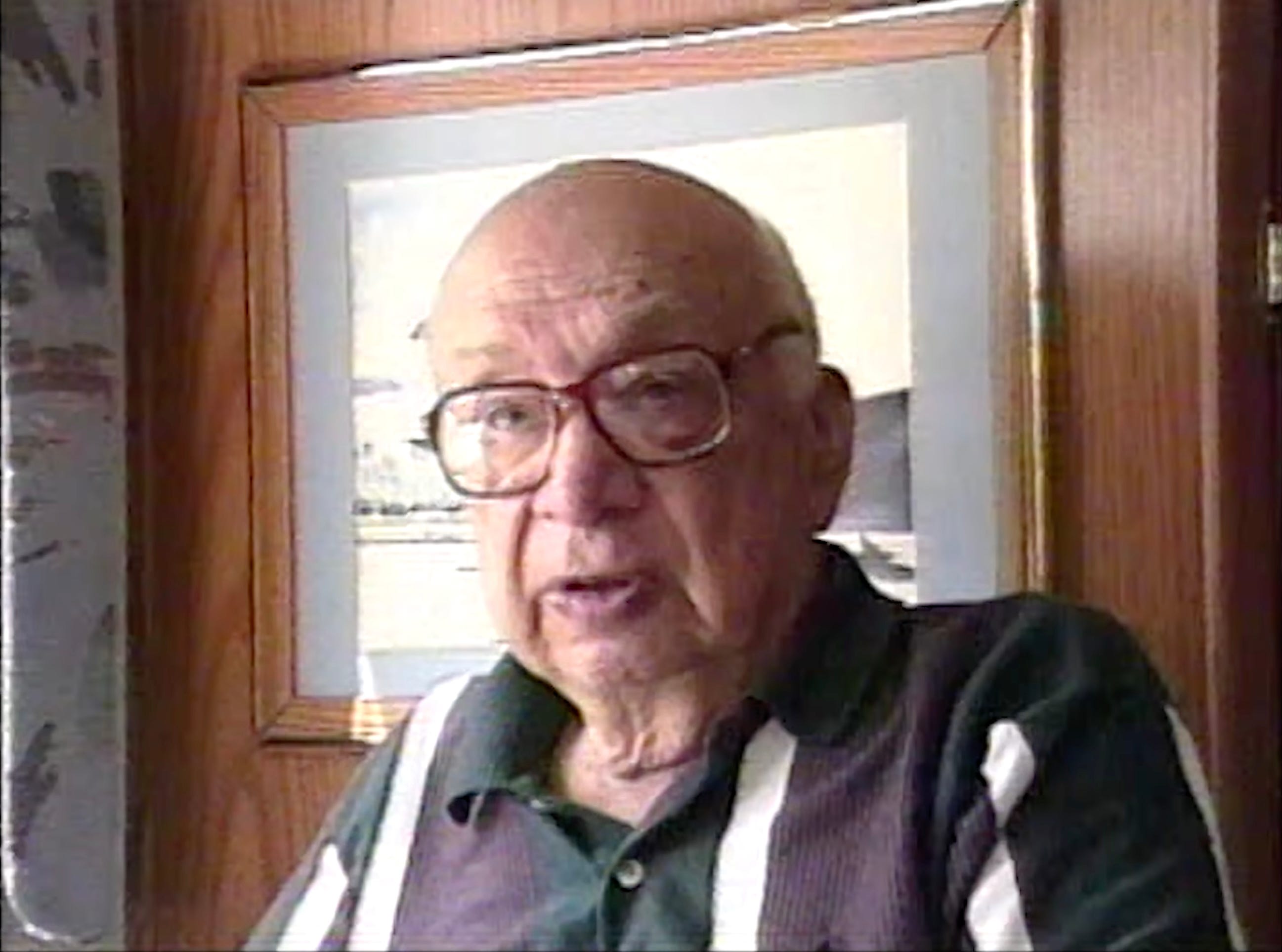
The theater of serious scientific study filtered through the Air Force and then ‘resolved’ by Menzel gave others the impression that the United States was spending money chasing mirages. Jacques Vallee recorded the chilling effect in his journal this way, “If I remain in Austin professional pressures are inevitable, since the department works closely with Harvard Observatory which is directed by arch-skeptic Donald Menzel, who has just published his second debunking book, The World of Flying Saucers. I do not want to put my friends there into such an awkward position.”188
Returning briefly to 1952, when Menzel was interviewed by Time magazine, he categorized his role in playing the debunker as, “the man who shot Santa Claus.”189 Packaged as a silly aside, it frames the UAP/NHI topic as a loaded question and a false binary choice: you are either mature enough to accept hard truth, or you are clinging to childish myth. Techniques like these–loaded questions, social authority maneuvers, false binary frames, villain as authority, pattern interrupts, emotional leverage and more–would carry forward into dogmatic skepticism. So too would a willingness to play the fool, a famed strategy of Montesquieu:190
“I have always observed that to succeed in the world one should seem a fool, but be wise.”
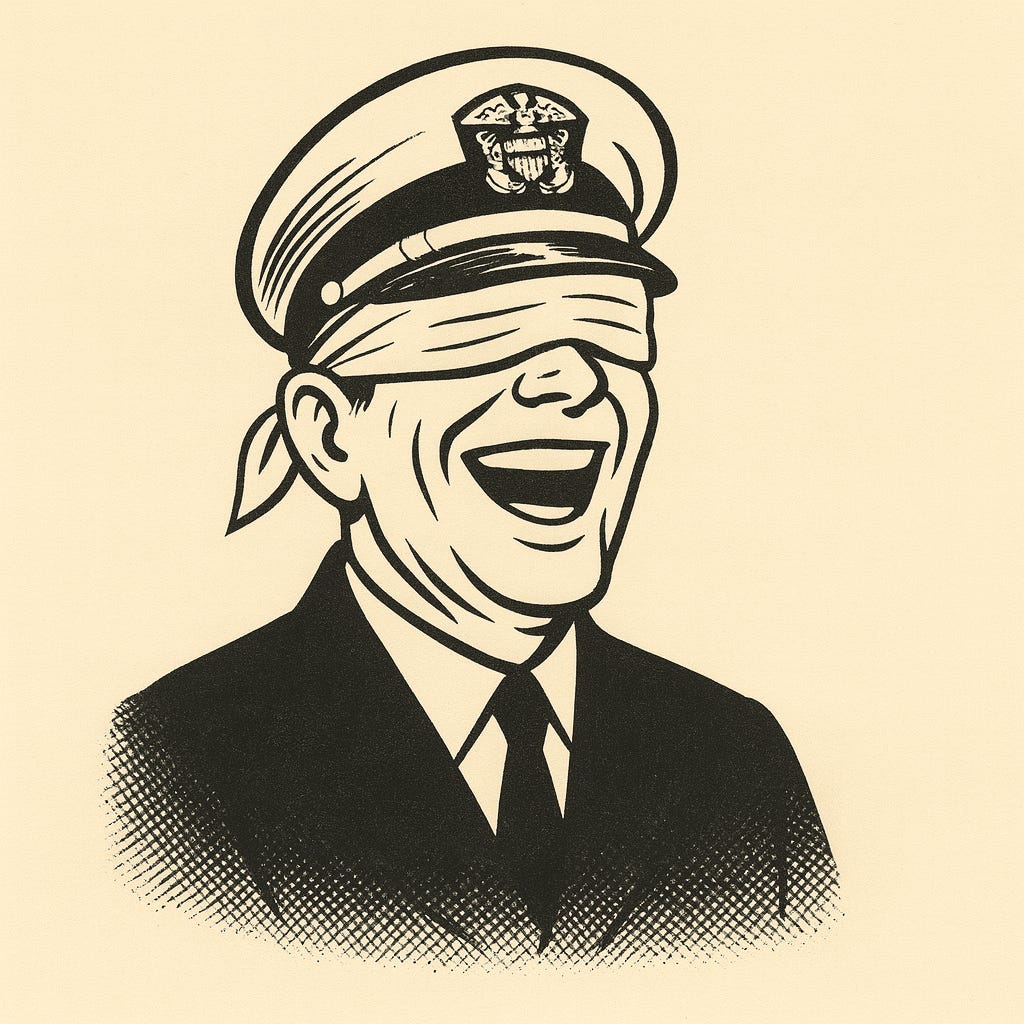
To be continued…
The role Donald H. Menzel played in the cover-up of the multi-decade UAP crash retrieval and reverse-engineering program has much more depth and detail than what is covered here, but even in this initial look the methods of how he grew his counter-intelligence efforts are clear. His exploits in cryptography, cryptanalysis, and communications with Op-20-G and later the NSA placed him in a small cadre of those inside the military-industrial-complex that had the ways, means and know how to control the secrecy over UAP/NHI. When given the chance, he destroyed data and pursued AAVSO to marginalize the records and people that could demonstrate the presence of NHI technology. As reverse engineering of retrieved materiel progressed, he ramped up his debunking in ways that preceded and precipitated the formation of CSICOP. Many of the people he interacted with on the side of secrecy excelled in their work. But in his time as director of the Harvard College Observatory and leadership of the astronomy department, William H. Press observed, “Over a period of two decades, Don Menzel and Bart Bok, both Shapley protégés, managed, mostly by academic inbreeding, to bring the department to another nadir of mediocrity.”191
NSA records show Menzel operating in the exact structures where information is compartmented, controlled, and weaponized: appearing as an Advisory Board member with Crypto status,192 and later listed under a Telecommunications Panel as “Indoctrinated.”193 This is the “how” in the way Menzel applied his genius not only to science, but to the art of controlled narratives–the discipline of saying just enough, with impeccable credentials, to force a cultural conclusion (“nothing to see here”), while ensuring the actual signal stayed buried behind classification, ridicule, and institutional gatekeeping. Indoctrination in these documents is the explicit mechanism of read-ins, panels, compartments, and clearance status that maps cleanly onto the public-facing tactics he pioneered: a debunking style optimized for mass adoption, where certainty replaces inquiry, anomalies are pre-labeled as error, and dissent is framed as gullibility.
That strategy endured. The modern dogmatic skeptic playbook–credential-first authority, selective standards of evidence, narrative closure, stigma as a tool, and the outsourcing of curiosity to “official conclusions”–did not arrive spontaneously in the late 1960s and 1970s. It was fathered in the Cold War’s communications-intelligence worldview, then exported to the public battlefield.
The next installment of Unquestionably Skeptical will trace the maturation of this system from 1953 to 1976, as the skeptic cadre grows from Menzel to Edward Condon, Philip Klass and others as they turned UAP denial into a durable, institutionalized doctrine.
These practices of manipulating popular media platforms have continued all the way to the present day where an example like LuckyLouie,194 a presumptive Mick West sock puppet account195 associated with the efforts of Guerrilla Skeptics, is an editor on Donald Menzel’s Wikipedia page:
From Menzel to Klass to CSICOP to Committee for Skeptical Inquiry to Guerrilla Skeptics196 to Mick West… the debunker chain continues.
There will be many more installments to come.
Appreciations
This deeper look into Donald Menzel was brought to you by the very first paid subscriber to Unquestionably Skeptical. The funds went to the production of the transcript and digital audio files of Menzel’s interview with Henry Tropp from the Smithsonian’s Computer Oral History Collection at the American History Museum. Sincere thanks to Analiese Oetting, Audiovisual Archives Specialist of the National Museum of American History’s Archives Center film collections for that production. Special thanks to all the people that communicated with me in the process of researching and writing this paper, including: Kathleen Marden, Allan Olley, Craig Bauer, Beatriz Villaroel, Geoff Cruickshank, Nick Cook, Whitley Streiber, Jacques Vallee, Rob Heatherly, Rob Jones, Pavel Ibarra, and many unnamed others.
Last, and most importantly, my heartfelt thanks to you, the reader.
It is my hope that this, and coming work, adds to the marvel of our wider universe of knowledge–the scope and scale of which should fill our days with many wonders and abundant curiosity, placing secrets and skepticism in a very distant and small perspective.
For my part, when examining people like Donlad Menzel, I hope to do so respectfully and in a way that makes us all better for life ahead. If any of his friends or family remain a custodian of his secrets, they will not come forward in a climate of disrespect. They will be welcome here. May this piece add to that conversation.
Any mistakes, errors, or omissions are the fault of this author.
Comments, criticisms and receipts are greatly appreciated.
Appendix
Reception and Criticisms
Dogmatic skeptics scored the opening of this series with “hit piece” accolades quickly–

“Hmm, he seems to have changed his name. Ryan Purkey is an SEO expert, so maybe he thinks it’s better to be anonymous when writing error-filled hit pieces.” @MickWest, Sep 9, 2025
[Note: Mick West, a user and author on Substack ( https://substack.com/@mickwest ), was asked to reply, citing any errors in the article “Unquestionably Skeptical (About UFOs)”. He has not done so.]
And – https://www.reddit.com/r/UFOs/comments/1nd7mnj/comment/ndg3z1t/ “This is basically just a MW hit piece by someone who obviously doesn’t like him and just likes to use appeal to authority.” @DisinfoAgentNo007 Sep 11, 2025
[Note: Argumentum ad verecundiam, the logical fallacy of ‘appeal to authority’ is based on proving a point using the opinion of an authority, as opposed to the data, experiments and research that is found to be authoritative. In the article, “Unquestionably Skeptical (About UFOs)” in contrasting Mick West with working scientists, the data of papers and citations as tallied by Semantic Scholar compared across two dozen people of similar media presence were used, creating work related to UAP/NHI but from differing affiliations: Skeptics vs Scientists. This dataset is reproducible and publicly available. Mick West has much lower measurable scientific output than Garry Nolan, Avi Loeb, Kevin Knuth, Alexander Wendt, Beatriz Villarroel and others by these metrics. In contrast to the scientific output, West’s talking points do get parroted in high volume by anonymous accounts on the internet though.]
From the image: https://digitalcollections.library.ucsc.edu/Documents/Detail/bredenbury-canada-eclipse-expedition/2176 Bredenbury, Canada eclipse expedition, 1945, Lick Observatory photographs, Series 7: Photographs, University of California, Santa Cruz. McHenry Library, Special Collections. Label identifying Donald H. Menzel appended by author. From “The Total Solar Eclipse of 1945” by Johns, Alfred E. “We looked up and saw nothing but cloud. Dr. Menzel was great in defeat. It was a sad disappointment for all of us, but for him it was tragic. All the months of planning, all the gathering of equipment, all the weeks of long days and short nights, all the expense, had yielded nothing–absolutely nothing. But he showed not the slightest irritation. He had photographs taken of the various groups who had helped. He thanked us all, the scientists, the engineers, the guards and drivers down to the army cook. He thanked the citizens of Bredenbury for their co-operation and assistance. In reply, Dr. Beals voiced our thanks to him for his leadership.”
Aiken, H. H. (1973, February 26-27). Transcript. Computer Oral History Collection, Archives Center, National Museum of American History. p. 85
From 1952 to 1967 as Director of the Harvard College Observatory, Menzel suspended plate-making operations ( https://hco.cfa.harvard.edu/about/ ) and eliminated one of three floors of the photographic plates stored at Harvard plate vault. ( Hoffleit, Dorrit 1992 January / February MERCURY “Some Glimpses From My Career” p.16 ) This era is referred to as the ‘Menzel gap’. As Harvard’s own Jonathan E. Grindlay wrote in 2012, “The Harvard archive suffers from the ‘Menzel gap’ of ∼15 years (caused by HCO Director Menzel cutting the Harvard plate programme from 1954–1965, but which was only recovered completely by ∼1970), and priority needs to be given to all data which will help to fill that gap.”
Leading experts. https://www.lbi.org/griffinger/record/243926 Part Of Albert Einstein Collection, AR 136, Accession Number F 5325D
Wilbert Smith, 21 November 1950. Memorandum to the Controller of Telecommunications at the Department of Transport. RG 97, volume 182, file 5010-4, part 1. Unidentified Flying Objects File. LAC, Ottawa, ON.
Friedman, Stanton T. (1988) The secret life of Donald H. Menzel, International UFO Reporter, January/February, V.13, N.1, https://cufos.org/PDFs/IUR%20issues/IUR%20Vol.%2013%20No.%201%20Jan.-Feb.%201988.pdf p.20-24
Born in Florence, Colorado. 11 April 1901.
Raised in Leadville, Colorado from age 4 to 15 at which point he and his family relocated to Denver, Colorado.
Leo Goldberg and Lawrence H. Aller (1991) Donald Howard Menzel 1901—1976 A Biographical Memoir National Academy of Sciences Washington D.C. http://biographicalmemoirs.org/pdfs/menzel-donald-1.pdf “Young Donald displayed a remarkable ability as a ‘quick study.’ By age five he was reading Gulliver’s Travels, and even before that his father had taught him to send and receive simple messages in Morse code. Fortunately for the precocious young Menzel, the school superintendent had initiated a program of progressive education that allowed exceptional students to advance at an accelerated pace, and Donald was able to graduate from high school at age sixteen. As a teenager, Menzel built a radio transmitter and receiver with a crystal detector, fabricating all the components himself except the earphone. Years later, in the 1930s, he acquired a “ham” (short for Hammerlund) radio transmitter and receiver with the call letters W1JEX.” p. 150 & 151
Two interviews late in Menzel’s life demonstrate his remarkable recall, up until his death on 14 December, 1976:
1. Menzel, D. H. (1972, July 31). Computer Oral History Collection, Archives Center, National Museum of American History
2. Menzel, D. H. (1976, August 18). Papers of Woodruff T. Sullivan III, “Interview with Donald H. Menzel,” NRAO/AUI Archives, accessed December 6, 2025, https://www.nrao.edu/archives/items/show/15064
Craig Bauer & John Ulrich (2006) The Cryptologic Contributions of Dr. Donald Menzel, Cryptologia, 30:4, 306-339, DOI: 10.1080/01611190600920951 https://www.tandfonline.com/doi/full/10.1080/01611190600920951, p. 328 & 329
Williams, Thomas R. and Saladyga, Michael "Advancing Variable Star Astronomy: The Centennial History of the American Association of Variable Star Observers" 2011, p. 57 & 58 ISBN 978-0-521-51912-0
Leo Goldberg and Lawrence H. Aller (1991) Donald Howard Menzel 1901—1976 A Biographical Memoir National Academy of Sciences Washington D.C. http://biographicalmemoirs.org/pdfs/menzel-donald-1.pdf
Dyson, Marianne J. Ed.: Cannon, William J. "Twentieth-Century Science: SPACE AND ASTRONOMY Decade by Decade" 2007 Facts On File, Inc. p.52
Leo Goldberg and Lawrence H. Aller (1991) Donald Howard Menzel 1901—1976 A Biographical Memoir National Academy of Sciences Washington D.C. http://biographicalmemoirs.org/pdfs/menzel-donald-1.pdf
Don Howard aka Donald H. Menzel (1924) The Machine From Outside, Weird Tales, Vol. IV, No. 2, p. 106 - 110. https://archive.org/details/WeirdTales1924050607ATLPM/page/n107/ [And image]
Craig Bauer & John Ulrich (2006) The Cryptologic Contributions of Dr. Donald Menzel, Cryptologia, 30:4, 306-339, DOI: 10.1080/01611190600920951 https://www.tandfonline.com/doi/full/10.1080/01611190600920951, p. 329
"Contributing Editors" Science And Invention. March 1926. Experimenter Publications, Inc.
Craig Bauer & John Ulrich (2006) The Cryptologic Contributions of Dr. Donald Menzel, Cryptologia, 30:4, 306-339, DOI: 10.1080/01611190600920951 https://www.tandfonline.com/doi/full/10.1080/01611190600920951, p. 316
https://patents.google.com/?inventor=Donald+H+Menzel
“Photoelectric centering device” US US2604601A, Donald H Menzel, Priority 1947-07-17 • Filed 1947-07-17 • Granted 1952-07-22 • Published 1952-07-22;
“High temperature bearing and the like” US US2966381A, Donald H Menzel, Priority 1958-01-09 • Filed 1958-01-09 • Granted 1960-12-27 • Published 1960-12-27;
“Automatic celestial navigation control system” US US2930545A Donald H Menzel, Priority 1956-01-23 • Filed 1956-01-23 • Granted 1960-03-29 • Published 1960-03-29;
“Method of seismic exploration and apparatus therefor” US US3034594A Donald H Menzel Priority 1958-04-08 • Filed 1958-04-08 • Granted 1962-05-15 • Published 1962-05-15;
“Heat transfer unit” US US3129754A Donald H Menzel Donald H Menzel, Priority 1959-06-17 • Filed 1959-06-17 • Granted 1964-04-21 • Published 1964-04-21
Menzel, D. H., Unpublished autobiography (manuscript), September 1974. Harvard’s copy is: Call Number: HUG 4567.3: Unpublished autobiography Harvard University Archives, Pusey Library. Cambridge, MA 02138.
[Note: In Menzel’s unpublished autobiography he recounts over one hundred planes being lost in the far Pacific due to communications failing between carriers, Navy pilots, and the island-based transponders where pilots could safely land. Pilots were being ordered to increase altitude if unable to connect with the transponder, but Menzel–after gathering weather data on the area–realized the cool air near the ocean surface interfered with the signal between the transponders and pilots. By having pilots descend instead of ascend when seeking transponder signals many lives were saved instead of being snuffed out in the vast Pacific. He was awarded an “Individual Citation Medal”.]
Friedman, Stanton T. "The secret life of Donald H. Menzel" INTERNATIONAL UFO REPORTER January/February 1988 p.23 “Can anybody really keep his true feelings so separated? Could he live a lie? Could he not tell his close friends and his family? My answer is yes. Menzel, who was known for his discretion and who appreciated the need for separating classified and unclassified activities, could have been on the inside of one of the most important postwar scientific events imaginable: the capture and recovery of an extraterrestrial spacecraft.”
https://richarddolanmembers.com/ufo-history/a-very-interesting-donald-menzel-chronology/ “Menzel was a classified consultant for the U.S. intelligence community, a fact that was unknown even to his wife.” Dolan, Richard M., 2024 January 25
Leo Goldberg and Lawrence H. Aller (1991) Donald Howard Menzel 1901—1976 A Biographical Memoir National Academy of Sciences Washington D.C. http://biographicalmemoirs.org/pdfs/menzel-donald-1.pdf
Menzel, D. H. (1972, July 31). Transcript. Computer Oral History Collection, Archives Center, National Museum of American History, pp. 118 - 120
Harvard University, Harvard University Archives, W431823_1, Provided by Harvard University, https://iiif.lib.harvard.edu/manifests/view/ids:12748355%241i (Image)
Menzel, D. H. (1972, July 31). Transcript. Computer Oral History Collection, Archives Center, National Museum of American History, p. 13
Gutzwiller, Martin C. “Wallace Eckert, Computers, and the Nautical Almanac Office” 1999 T. J. Watson IBM Research Center, p.155 in Proceedings: Nautical Almanac Office - Sesquicentennial Symposium 1999 U.S. Naval Observatory https://apps.dtic.mil/sti/tr/pdf/ADA470556.pdf
Menzel, D. H. (1972, July 31). Transcript. Computer Oral History Collection, Archives Center, National Museum of American History, p. 16
Ibid p. 24
Ibid p. 67
Ibid p. 22
Ibid p. 21
DeVorkin, David H. "Fred Whipple’s Empire: The Smithsonian Astrophysical Observatory, 1955–1973" 2017 Smithsonian Institution Scholarly Press p. 13
Calvocoressi, Peter 1980 “Top Secret Ultra” p.4 https://archive.org/details/topsecretultra00calv/page/2/mode/2up
Mundy, Liza “Code girls: the untold story of the American women code breakers of World War II” 2017 New York, NY, Hachette Books https://archive.org/details/codegirlsuntolds0000mund
https://www.nationalww2museum.org/war/articles/waves-us-navy “By the end of 1942, 3,190 enlistees and 770 officers joined the US Navy as Women Accepted for Volunteer Emergency Service, also known as the WAVES. By July 31, 1945, the WAVES had 73,816 enlisted women, 8,745 officers, and nearly 4,000 in training.”
Craig Bauer & John Ulrich (2006) The Cryptologic Contributions of Dr. Donald Menzel, Cryptologia, 30:4, 306-339, DOI: 10.1080/01611190600920951 https://www.tandfonline.com/doi/full/10.1080/01611190600920951, p. 321-322 “The Navy chose Menzel to tackle this problem because they knew that the sun exerted a profound influence on the ionosphere, which short waves bounce off and longer waves penetrate, and Menzel was an expert on solar activity. Menzel found that when the Navy set up the frequency schedule for the Greenland DF station (established in 1942) they used values found empirically back in 1939. This was problematic because the eleven year sunspot cycle was near a maximum in 1939, whereas present conditions (1943) were approaching the minimum. This led him to believe that higher frequency waves that were previously bouncing off the ionosphere were now penetrating it and being lost. His solution was to reduce the scheduled frequencies by twenty percent. A day later the Admiral congratulated Menzel, ‘Fine work, Commander. We’ve had 100 percent communication with Greenland for the last 24 hours.’ He went on to assign other problem circuits to him with hopes that he could find a fix for those as well [88, pp. 309–314].”
Liebowitz, Ruth Prelowski "Donald Menzel and the Creation of the Sacramento Peak Observatory" 2002 JHA, Hanscom Air Force Base p. 195
https://www.findagrave.com/memorial/8888153/ina-grace-menzel Grave of Ina Grace (née Zint) Menzel
https://www.findagrave.com/memorial/8888141/charles-theodore-menzel Grave of Charles Theodore Menzel
Editors: W. Orchiston, M. Rothenberg, C. Cunningham "Open Skies: The National Radio Astronomy Observatory and Its Impact on US Radio Astronomy" 2020 p. 58 https://doi.org/10.1007/978-3-030-32345-5
“The Origins of the NSA” National Security Agency 2007 https://media.defense.gov/2021/Jul/13/2002761891/-1/-1/0/ORIGINS_OF_NSA1.PDF “One solution was a unified cryptologic agency. He appointed a special board under Rear Admiral Earl E. Stone, Director of Naval Communications, to formulate a plan for merging all military COMINT and COMSEC activities and resources into a single agency.”
Menzel, D. H. (1972, July 31). Transcript. Computer Oral History Collection, Archives Center, National Museum of American History, p. 43
Ibid. p. 48-49
Page xv, COMMUNICATION INSTRUCTIONS, U.S. Navy, 1944, DNC 5, Navy Department Office of the Chief of Naval Operations, https://archive.org/details/nrf_dnc5-1944/page/n13/mode/2up
Menzel, D. H. (1972, July 31). Transcript. Computer Oral History Collection, Archives Center, National Museum of American History, p. 106
An example relevant to Menzel, but not his fate, is found in Bamford, James “Body of secrets: anatomy of the ultra-secret National Security Agency.” 2001 Doubleday p.19 ISBN 0-385-49907-8: “Between the attack on Pearl Harbor and August 1945, the Army’s Signal Security Agency’s Language Branch scanned more than 1 million decrypted messages and, of those, forwarded approximately 415,000 translations. But then it was over. Brigadier General W. Preston Corderman, chief of the Army codebreakers, was sure there would no longer be a need for much of a cryptanalytic effort. He therefore assembled the staff beneath the tall maple trees that gave his headquarters shade in the summer. The war was over, he told them, and so was their country’s need for their services.”
https://astronomy.fas.harvard.edu/history “Although the Department of Astronomy came into existence in 1931, the first chair, Donald Menzel, wasn’t appointed until 1945.”
FBI Office Memorandum, November 14, 1948, Subject: Donald H. Menzel Security Matter - C, “Presently he is the Commanding Officer of the Naval Reserve Unit in Boston in cryptography.”
Liebowitz, Ruth Prelowski "Donald Menzel and the Creation of the Sacramento Peak Observatory" 2002 JHA, Hanscom Air Force Base p. 195 https://articles.adsabs.harvard.edu/cgi-bin/nph-iarticle_query?2002JHA....33..193L&defaultprint=YES&filetype=.pdf
Ibid.
Ibid.
Ibid.
https://seas.harvard.edu/news/2021/07/mark-1-rebooted “Aiken shopped the idea around until IBM took interest. The machine itself, developed in collaboration with company scientists, was delivered to Harvard’s Cruft Lab in 1944, in time to lend a hand in the nation’s World War II effort, including the development of the atom bomb, missile trajectories, and the design of radar facilities.”
Memorandum for the Army Security Agency Technical Committee, 14 February 1949, Subject: Initiation of D/A Project No. 29-6G-030, NC-4 Mark II and Alphabetic Substitution Device https://www.nsa.gov/portals/75/documents/news-features/declassified-documents/friedman-documents/panel-committee-board/FOLDER_210/41761429080055.pdf
https://www.osti.gov/opennet/manhattan-project-history/Science/ParticleAccelerators/computer.html Department of Energy’s Office of History and Heritage Resources. “Von Neumann had several important contributions to the Manhattan Project in his role as a traditional “pencil and paper” mathematician, but it was also his knowledge of emerging computer technologies that led to the inclusion of such devices as the Mark I electromechanical calculator under development at Harvard.... During the war, the main contribution of these computers was in the design of the explosive lenses needed for the implosion device.”
Memorandum for the Members of USCIB, 10 June 1955, Subject: Lists or COMINT Indoctrinated Personnel Maintained by the Executive Secretary, USCIB. A further sample from the list: AIKEN, Howard; BAKER, James G.; BLOCH, Richard “Dick” M.; ENGSTROM, Howard T.; GROVES, Leslie; MENZEL, Donald H.; PURCELL, Edward M.; ROBERTSON, Howard P.; VON NEUMANN, John; and many others. https://www.nsa.gov/portals/75/documents/news-features/declassified-documents/friedman-documents/panel-committee-board/FOLDER_310/41793489083247.pdf
“Touching The Moon.” Pathfinder, 6 February 1946, p. 14 [and image] https://archive.org/details/sim_town-journal_1946-02-06_53_6/page/14/mode/2up
Amato, Ivan "Pushing the Horizon: Seventy-Five Years of High Stakes Science and Technology at the Naval Research Laboratory" 1998 U.S. G.P.O., Supt. of Docs p.229
https://majesticdocuments.com/documents/ Dr. Robert M. Wood & Ryan S. Wood.1999-2025 Majestic Documents Wood & Wood. [For the Cape Girardeau crash retrieval specifically, see “THE FIRST ROSWELL - Evidence For A Crash Retrieval In Cape Girardeau Missouri In 1941” by Ryan S. Wood. https://majesticdocuments.com/pdf/rswood_mufon2001.pdf]
https://majesticdocuments.com/documents/majestic-documents/documents-dated-prior-to-1948/ Dr. Robert M. Wood & Ryan S. Wood.1999-2025 Majestic Documents Wood & Wood. Memorandum: https://majesticdocuments.com/pdf/marshall-fdr-march1942.pdf
https://majesticdocuments.com/pdf/steinman-ipu_16may84.pdf DEPARTMENT OF THE ARMY Office of the Assistant Chief of Staff for Intelligence Memorandum, May 16, 1984, Subject: Freedom of Information Office. “...the so-called Interplanetary Phenomenon Unit (IPU) was disestablished and, as far as we are aware, all records, if any, were transferred to the Air Force in the late 1950’s. It is only through institutional memory that any recollection exists of this unit.
Full quote, “They [three dozen US government witnesses] also told me that, that um, recoveries started prior to Roswell, during World War II in fact. I don’t go into that history deeply in the film. Um, but yeah, this has been going on for, for 80 years.”
FBI report Intelligence Review, Number 49, January 9, 1947, "Ghost Rockets Over Scandinavia."
Liebowitz, Ruth Prelowski “Donald Menzel and the Creation of the Sacramento Peak Observatory” 2002 JHA, Hanscom Air Force Base p. 195 https://articles.adsabs.harvard.edu/cgi-bin/nph-iarticle_query?2002JHA....33..193L&defaultprint=YES&filetype=.pdf
Dolan, Richard M., “A Very Interesting Donald Menzel Chronology” 2024 January 25 https://richarddolanmembers.com/ufo-history/a-very-interesting-donald-menzel-chronology/
Elizondo, Luis. Imminent: Inside the Pentagon’s Hunt for UFOs. William Morrow, August 20, 2024 p.46 [Quote in context of the passage: “That’s when I started to learn about the US government’s secret history with UAP. At the dawn of the nuclear age, UAP started appearing in greater numbers–and sometimes they crashed. Roswell was one of those incidents. A UAP fell that day in the vicinity of a government test facility in New Mexico and broke into two crash sites. At first, government investigators assumed that the Roswell craft were from another nation, possibly some sort of reconnaissance mission gone awry. But within hours, the US Army realized the truth, that these craft were not made by humans. It is hypothesized that the UAP that crashed at Roswell had been conducting some sort of reconnaissance on our budding atomic program when the unexpected happened. An electromagnetic pulse generated from one of the nearby test ranges had inadvertently intervened with the craft’s technology and caused it to crash.”]
FBI Office Memorandum, March 22, 1950, Subject: FLYING SAUCERS INFORMATION CONCERNING. For further background on this memo see: https://www.theblackvault.com/documentarchive/the-guy-hottel-memo-and-the-crashed-flying-saucers-of-new-mexico-march-22-1950/
https://www.war.gov/News/Feature-Stories/Story/Article/4252019/air-force-celebrates-78-years-of-air-superiority/ “The Department of the Air Force was established 78 years ago on Sept. 18, 1947, making it the third military department, alongside the Departments of the Army and Navy.”
Of note, the leak of the first documents referencing Majestic-12 appeared in 1984, when Donald Menzel was still completely unknown by the general public to be a highly cleared military contractor. A retelling of this reveal can be seen in "Fact, fiction, and flying saucers: the truth behind the misinformation, distortion, and derision by debunkers, government agencies, and conspiracy conmen" 2016 by Friedman, Stanton T. and Marden, Kathleen New Page Books p.58-59 https://archive.org/details/factfictionflyin0000frie/page/58/
Menzel, Autobiography (ref. 5), typescript copy, chapter on Sac Peak, 5.
McNeff, Bill “ERA, Donald Menzel, Roswell and The Agency” Minnesota MUFON Journal. Issue #88 Mar./Apr. 2001
https://www.cia.gov/readingroom/docs/1947-07-26.pdf The National Security Act of 1947 – July 26, 1947. Public Law 253, 80th Congress; Chapter 343, 1st Session; S. 758. From the CIA Reading Room
https://www.af.mil/About-Us/Fact-Sheets/Display/Article/104590/unidentified-flying-objects-and-air-force-project-blue-book/ “From 1947 to 1969, the Air Force investigated Unidentified Flying Objects under Project Blue Book. The project, headquartered at Wright-Patterson Air Force Base, Ohio, was terminated Dec. 17, 1969. Of a total of 12,618 sightings reported to Project Blue Book, 701 remained ‘unidentified.’”
National Security Agency (NSA) “FUNCTIONS OF OP-20-G” Collection of memo, org charts and other related materials from: https://www.nsa.gov/portals/75/documents/news-features/declassified-documents/friedman-documents/reports-research/FOLDER_531/41771439081052.pdf
Ibid.
https://physicstoday.aip.org/features/edward-condon-and-the-cold-war-politics-of-loyalty Wang, Jessica “Edward Condon and the Cold War Politics of Loyalty” Dec 01 2001 Physics Today DOI: 10.1063/1.1445546 “On 1 March 1948, the House Committee on Un-American Activities (HUAC) fired the opening shot in what was then the most public cold war political attack on a scientist. On that day, HUAC chairman J. Parnell Thomas (R-N.J.), recovering from gastrointestinal hemorrhages, but still suffering from a chronic case of political theater, issued a report from his sickbed that labeled Edward Uhler Condon, renowned physicist and director of the National Bureau of Standards (NBS), “one of the weakest links in our atomic security.” Thomas’s allegations immediately made headlines across the nation. For physicists, the news confirmed that the binding of the cold war to the nuclear age had extended the anticommunist search for the disloyal and subversive into their community.’
Ruppelt’s personal papers, File R086. In the files of Professor Michael Swords. This excerpt is available online as part of archives of Loren Gross at: https://sohp.us/collections/ufos-a-history/pdf/GROSS-1952-July-21-31-SN.pdf
https://richarddolanmembers.com/ufo-history/a-very-interesting-donald-menzel-chronology/ “The reports, which were finally and very belatedly retrieved from Harvard University (in a state of disarray), caused a delay in the completion of the Battelle study.” Dolan, Richard M., 2024 January 25
Ibid.
Authors C. Bauer and J. Ulrich also note, "...the clashes Harlow Shapley, director of the Harvard College Observatory in 1950, was having with Senator Joseph McCarthy." The Cryptologic Contributions of Dr. Donald Menzel 22 Nov 2006 Cryptologia
Menzel, D. H., Unpublished autobiography (manuscript), September 1974. Harvard’s copy is: Call Number: HUG 4567.3: Unpublished autobiography Harvard University Archives, Pusey Library. Cambridge, MA 02138. p.571
“Case of the Flying Saucer.” CBS, hosted by Edward R. Murrow, 7 April 1950. Archived via Stellar Productions:
“Review by Donald H. Menzel of the history of the Loyalty Hearings (1950)” HUA, Menzel Papers, Military Correspondence, 1941-1975, HUG 4567.35. https://hollisarchives.lib.harvard.edu/repositories/4/archival_objects/1123770
Burns, Thomas L. The Origins of the National Security Agency 1940-1952 1990 UNITED STATES CRYPTOL0GIC HISTORY CENTER FOR CRYPTOLOGIC HISTORY NATIONAL SECURITY AGENCY
https://www.nsa.gov/History/Cryptologic-History/Insignia/ "NSA was established in 1952"
DeVorkin, David H. "Fred Whipple’s Empire: The Smithsonian Astrophysical Observatory, 1955–1973" 2018 Smithsonian Institution Scholarly Press pp. 22-24
Records of the National Security Agency/Central Security Service [NSA/CSS].(Record Group 457). National Archives “Established: NSA established in the Department of Defense (DOD) by National Security Council Intelligence Directive 9, December 29, 1952, under authority of a Presidential memorandum, October 29, 1952, effective November 4, 1952. CSS established in DOD by DOD Directive S-5100.20, December 23, 1971, under authority of a Presidential memorandum, November 5, 1971. NSA Director serves as Chief, CSS. Most CSS functions are carried out by NSA personnel.” https://www.archives.gov/research/guide-fed-records/groups/457.html
MacDonald, James E., "UFOs - An International Scientific Problem" Institute of Atmospheric Physics, University of Arizona, Tucson, Arizona (Presented March 12, 1968, at the Canadian Aeronautics and Space Institute Astronautics Symposium, Montreal, Canada)
Gross, Loren E. UFOs : A HISTORY 1952 JANUARY - MAY 1982 Fremont, California Second edition March 1993. Online at: https://sohp.us/collections/ufos-a-history/pdf/GROSS-1952-Jan-May.pdf
Gross, Loren E. SUPPLEMENTAL NOTES - UFOs : A HISTORY 1952 JANUARY - MAY 1982 Fremont, California Second edition March 1993. Online at: https://sohp.us/collections/ufos-a-history/pdf/GROSS-1952-Jan-May-SN.pdf
Stringfield, Leonard H. (2019) UFO Crash Retrievals: The Complete Investigation - Status Reports I-VII (1978-1994) Lulu Press, Inc.
Majestic Documents from this year include, "Majestic Twelve Project, Purpose and Table of Contents, Summer 1952?"; "Majestic Twelve Project, Annual Report, Summer 1952"; "Truman to Secretary of Defense, 24 October 1952"; "Annex C Fragment"; and "Eisenhower Briefing Document, 18 November 1952" from https://majesticdocuments.com/documents/majestic-documents/documents-dated-1948-1959/
An in situ example of this quote can be found at the United States Marine Corps University website: https://www.usmcu.edu/Outreach/Marine-Corps-University-Press/MCU-Journal/JAMS-vol-14-no-1/Trying-Not-to-Lose-It/
https://ourworldindata.org/grapher/number-of-nuclear-weapons-tests Arms Control Association (2024) – with minor processing by Our World in Data. “Nuclear weapons tests per year” [dataset]. Arms Control Association, “The Nuclear Testing Tally” [original data]. Retrieved December 24, 2025 from https://archive.ourworldindata.org/20250909-093708/grapher/number-of-nuclear-weapons-tests.html (archived on September 9, 2025). [Note: that the numbers in the chart do not include the bombings of Hiroshima and Nagasaki.]
https://nuclearweaponarchive.org/Usa/Tests/Ivy.html Details of Operation Ivy and the Ivy Mike bomb. “It inaugurated the thermonuclear age with the first “true” thermonuclear test (code name Mike), which was considerably more powerful than all the high explosives used in two World Wars put together. Ivy also tested the highest yield pure fission weapon ever exploded.”
Hoffleit, Dorrit “Some Glimpses From My Career” MERCURY, January / February 1992, p. 16
Originally published in London by Carroll and Nicolson in 1950 and titled “The Riddle of the Flying Saucers: Is Another World Watching?” Heard’s book was republished in the USA in 1951 as “Is Another World Watching? The Riddle of the Flying Saucers” by Harper with an additional 26 pages added.
Gross, Loren E. UFOs : A HISTORY 1952 JANUARY - MAY. 1982 Fremont, California Second edition March 1993. Online at: https://sohp.us/collections/ufos-a-history/pdf/GROSS-1952-Jan-May.pdf
Ibid.
https://cufos.org/PDFs/UFOI_and_Selected_Documents/NICAP_Selected_Documents/NICAP%20Founding/1957_01_14_First_Annual_Meeting_02.jpg “The first annual meeting of the members of the National Investigations Committee on Aerial Phenomena will be held in the Assembly Hall at Committee headquarters, 1536 Connecticut Avenue N. W., Washington, D. C. at 8 p.m. on Monday, January 14, 1957.”

https://cufos.org/PDFs/UFOI_and_Selected_Documents/NICAP_Selected_Documents/NICAP%20Founding/1956_08_30_LittleListeningPost.jpg “There has now been formed in Washington, D. C. THE NATIONAL INVESTIGATIONS COMMITTEE ON AERIAL PHENOMENA. A 24 page Prospectus shows the wide scope of the organization, which will act as an Information Center and Clearing House for every phase of the subject related to the phenomena in our skies. It will also act as liaison between objective science and abstract interpretations in this field.”

https://robrutten.nl/bibfiles/ads/publists/menzel.pdf Bibliography from ADS file: menzel.bib September 14, 2022
https://www.thecrimson.com/article/1950/11/7/university-press-provides-scholars-with-agency/ “The present Syndics from the College are John O. Brew, director of Peabody Museum, Mason Hammond '25, professor of Greek and Latin, Oscar Handlin, professor of American History, Howard Mumford Jones, professor of English, Paul C. Mangelsderf, professor of Botany, Donald H. Menzel, professor of Astronomy, and Samuel A. Stouffer, professor of Sociology.” 1950
FBI Office Memorandum, August 29, 1949 Subject: DONALD HOWARD MENZEL, AEA-A “...July 1, 1948 made a member of the Board of Syndies of the Harvard University Press for four years.”
Report of the Secretary of the Smithsonian Institution and financial report of the Executive Committee of the Board of Regents for the year ending June 30. 1952 Smithsonian Institution p.v
Dempsey, David. “In and Out of Books: Ad Interim” New York Times, 17 August 1952, Section 7. p.8. https://archive.org/details/sim_new-york-times_the-new-york-times_1952-08-17_101_34539/page/n209/mode/2up
Darrach Jr., H. B. and Ginna, Robert “Have We Visitors From Space?” Life 7 April 1952 https://archive.org/details/Life-1952-04-07-Vol-32-No-14/page/80/
https://www.nydailynews.com/2022/11/22/life-magazine-through-the-years-see-the-most-iconic-covers/ “Life magazine through the years: See the most iconic covers”
"Notes and News - From the World's Press" Journal of the British Interplanetary Society, Vol. 11, No. 6 XLIX November, 1952 p. 290
Dow, James "The Flying Saucer is blown right out of the sky: I Solve The Mystery of Portsmouth Road" The China Mail 3 July 1952
“Luce-Look 'Saucers' Feud” Variety 11 June 1952
“An Astronomer’s Explanation: THOSE FLYING SAUCERS” Time 9 June 1952 https://time.com/archive/6608795/an-astronomers-explanation-those-flying-saucers/
Department of Defense Minutes of Press Conference Held by Major Genesal John a. Samford Director of Intelligence, U.S. AIR FORCE 29 July 1952 - 4:00 p. m. - Room 3E-869, The Pentagon
For one example of a complete breakdown of the faulty science in the debunks of Menzel and the Air Force around UFO events of the 1952 flap, see James E. McDonald’s 6 January 1970 letter to Maj. Donald E. Keyhoe, beginning, “Dear Don: A few days ago (1/3/70), I talked on the phone with an ex-Air Force pilot involved in a 1952 UFO Case, which I know would still interest you.” Available online at: https://sohp.us/collections/ufos-a-history/pdf/GROSS-1952-July-21-31-SN.pdf
Gainor, Danya “In 1952, DC’s skies were littered with US fighter jets chasing UFOs. More than 70 years later, the mystery persists” 2025 Cable News Network. A Warner Bros. Discovery Company. All Rights Reserved. CNN Sans ™ & © 2016 Cable News Network. https://edition.cnn.com/2025/12/28/us/fighter-jets-ufos-1952-dc
Aiken, H. H. (1973, February 26-27). Transcript. Computer Oral History Collection, Archives Center, National Museum of American History
Chapter 4. COMMUNICATION SECURITY, Section A. INTRODUCTION TO SECURITY, 4000. DEFINITION AND OBJECTIVES, 4001-4003, U.S. Navy, 1944, DNC 5, Navy Department Office of the Chief of Naval Operations, viewable online at: https://archive.org/details/nrf_dnc5-1944/
DeVorkin, David H. "Fred Whipple’s Empire: The Smithsonian Astrophysical Observatory, 1955–1973" 2018 Smithsonian Institution Scholarly Press [“By the early 1950s, however, Whipple and Menzel, through Air Force and Navy projects, were pulling in more funding for astronomy than any other astronomer, and Shapley’s observatory was a beneficiary. Whipple, of course, was clear in his convictions ever since he had reported in 1947 to the Joint Chiefs of Staff that ‘all basic upper atmospheric research is fundamentally and inherently of value to the general problems of national defense.’” pp. 137-138]
Hoffleit, Dorrit “Some Glimpses From My Career” MERCURY, January / February 1992, p. 16
See pp 24-27 in “Fred Whipple’s Empire” for further details and timing around Menzel’s appointment as Acting Director. Footnote 130 from the same gives precise insights as well, “130. Menzel to Dorrit Hoffleit, 3 November 1952; Menzel to "All Observatory Personnel, 23 January 1953. Hoffleit had already performed an assessment and felt strongly that everything had to be preserved. Hoffleit (2002), 61. Still, Menzel directed Payne-Gaposchkin to organize a major "weeding" and consolidation of the collection to make it fit on two floors of Building A instead of three floors, relieving the third floor for offices. By 24 November, she announced the detailed plan and said it would work. For "weeding and consolidation, see "C.P.G. Reorganization of the Harvard Plate Collection, 24 November 1952. Hoffleit Papers. Box 22.5, "Donald Menzel 1952-1958," MC 529, Schlesinger Library, Radcliffe College.” DeVorkin, David H. "Fred Whipple’s Empire: The Smithsonian Astrophysical Observatory, 1955–1973" 2017 Smithsonian Institution Scholarly Press
Grindlay, J. E. and Griffin, R. E. M. "Historical Time-Domain: Data Archives, Processing, and Distribution" 2012 International Astronomical Union doi:10.1017/S1743921312000671 [From the paper, “The total number of direct-image plates is ∼450,000, covering the full sky (with approximately uniform coverage) from∼1890–1990 except for the “Menzel Gap” between∼1954–1970. The Harvard archive suffers from the “Menzel gap” of∼15 years (caused by HCO Director Menzel cutting the Harvard plate programme from 1954–1965, but which was only recovered completely by∼1970), and priority needs to be given to all data which will help to fill that gap.”]
Grindlay, Jonathan; Tang, Sumin; Los, Edward; Servillat, Mathieu "Opening the 100-Year Window for Time-Domain Astronomy" Harvard Observatory & Center for Astrophysics, Cambridge, MA. 2012 https://dasch.cfa.harvard.edu/publications/Grindlay-IAUS285-DASCHoverview.pdf
Garber, Steve “Sputnik and The Dawn of the Space Age” 2007 National Aeronautics and Space Administration (NASA) https://www.nasa.gov/history/sputnik//index.html
Enrique Solano, Geoffrey W Marcy, Beatriz Villarroel, Stefan Geier, Alina Streblyanska, Gianluca Lombardi, Rudolf E Bär, Vitaly N Andruk “A bright triple transient that vanished within 50 min” Oxford University Press on behalf of Royal Astronomical Society. Monthly Notices of the Royal Astronomical Society, Volume 527, Issue 3, January 2024, Pages 6312–6320, https://doi.org/10.1093/mnras/stad3422
Beatriz Villarroel, Enrique Solano, Hichem Guergouri, Alina Streblyanska, Stephen Bruehl, Vitaly M. Andruk, Lars Mattsson, Rudolf E. Bär, Jamal Mimouni, Stefan Geier “Aligned, Multiple-transient Events in the First Palomar Sky Survey” 2025 October 17 IOP Publishing Ltd on behalf of the Astronomical Society of the Pacific (ASP) https://iopscience.iop.org/article/10.1088/1538-3873/ae0afe
https://home.cern/resources/faqs/five-sigma “A result that has a statistical significance of five sigma means the almost certain likelihood that a bump in the data is caused by a new phenomenon, rather than a statistical fluctuation.”
Beatriz Villarroel, Enrique Solano, Hichem Guergouri, Alina Streblyanska, Stephen Bruehl, Vitaly M. Andruk, Lars Mattsson, Rudolf E. Bär, Jamal Mimouni, Stefan Geier “Aligned, Multiple-transient Events in the First Palomar Sky Survey” 2025 October 17 IOP Publishing Ltd on behalf of the Astronomical Society of the Pacific (ASP) https://iopscience.iop.org/article/10.1088/1538-3873/ae0afe
Da Cruz, Frank “Rebecca Jones and Wallace Eckert at the Star Measuring Machine” 13 September 2023 Columbia University Computing History https://columbia.edu/cu/computinghistory/jones.html
Menzel, D. H. (1972, July 31). Transcript. Computer Oral History Collection, Archives Center, National Museum of American History, pp. 94-96
Eckert, W. J. ; Jones, R. B. “PROBLEMS IN ASTROMETRY: Automatic measurement of photographic star positions” March 1954 Astronomical Journal, Vol. 59, p. 83 “A card-controlled measuring engine, designed to locate automatically a star image on a photographic plate from approximate coordinates in a punched card and to measure and record its position to tenths of microns, has been built and tested at the Watson Laboratory. A general description of the machine and results of test measurements are given here. A comparison of direct and reversed readings, corrected for screw and way errors, for 430 stars gives a probable error for a setting of 0.56 micron.” https://ui.adsabs.harvard.edu/abs/1954AJ.....59...83E/abstract
Hoffleit, Dorrit “MISFORTUNES AS BLESSINGS IN DISGUISE - The Story of My Life” American Association of Variable Star Observers 2004 https://www.aavso.org/dorrit-hoffleit-autobiography-misfortunes-blessings-disguise
West Coast DX Bulletin 5 April 1977 https://ncdxc.org/wcdxb/1977/WCDXB%2014-77.pdf [MORE SHORLY NOTED W1JEX/WB4PHH was a Silent Key in December This was Donald Menzel, Director Emeritus of the Harvard Observatory and known among astronomers for work he has done on the sun and gaseous nebulae. The April issue of SKY AND TELESCOPE carries a lead article on Dr Menzel and some of the work he did. If you come across a copy you might find it interesting to note that the ranks of amateur radio does include many who are prominent and leaders in their own chosen fields of endeavor. W1JEX built his first gear at the age of nine. He was issued W1JEX in 1933 and held the call the remainder of his life.]
Friedman, Stanton "Memo to file: Conversation with Mrs. Wyatt, E. Falmouth, MA" May 11, 1986.
Ibid.
Larsen, Kristine "Reminiscences on the Career of Martha Stahr Carpenter: Between a Rock and (Several) Hard Places" Presented at the 100th Annual Meeting of the AAVSO, October 5, 2011; received February 13, 2012; revised March 21, 2012; accepted March 24, 2012 The Journal of the American Association of Variable Star Observers Volume 40 Number 1 2012 p.56
Ibid.
Ibid.
Saladyga, Michael “A History of AAVSO’s Headquarters” Presented at the 95th Annual Meeting of the AALSO, October 28, 2006; received March 5, 2007; revised March 17, 2008; accepted March 17, 2008 The Journal of the American Association of Variable Star Observers Volume 35 Number 1 2007 p.397 https://articles.adsabs.harvard.edu/pdf/2007JAVSO..35..390S
Ibid.
Klass, Philip J. “Digital Computer Trend Seen” and “Radar Needs ‘Saucer’ Filter: CAA” Aviation Week 29 December 1952, Volume 57 Number 26 McGraw-Hill Publishing Company, Inc. https://archive.org/details/Aviation_Week_1952-12-29/
https://as.amphilsoc.org/repositories/2/resources/2894/collection_organization “Klass became one of the leading UFO skeptics along with Edward Uhler Condon and Donald Howard Menzel (whose papers are also at the APS).”
https://www.optica.org/history/biographies/bios/edward_u_condon “After graduating from high school in Oakland, California in 1918, he worked as a journalist for three years at the Oakland Inquirer and other papers.”
“A Tribute: Philip J. Klass 1919-2005” Aviation Week & Space Technology, 15 August 2005 Volume 163 Number 7, McGraw-Hill Publishing Company, Inc. https://web.archive.org/web/20231214025633/https://gpposner.com/Klass_Av_Wk_Tribute.pdf p. 58
Branscomb, Lewis M. “Edward U. Condon, Ph.D., 1958-1964” 13 October 2025 © Washington University in St. Louis https://libguides.wustl.edu/c.php?g=338660&p=2280746
“A Tribute: Philip J. Klass 1919-2005” Aviation Week & Space Technology, 15 August 2005 Volume 163 Number 7, McGraw-Hill Publishing Company, Inc. https://web.archive.org/web/20231214025633/https://gpposner.com/Klass_Av_Wk_Tribute.pdf “On more than one occasion, Phil would be told to show up in a particular Washington hotel room, where a knock on the door would be followed by the entry of the deputy director of the Central Intelligence Agency or the director of the National Security Agency.” p. 58
CIA Memorandum collection - “Memorandum for: Director of Central Intelligence - Subject: unidentified flying objects” 2 December 1952; “Memorandum to: The Executive Secretary National Security Council”; “Enclosure - National Security Council Directive - Subject: Unidentified flying objects” Routing and Record Sheet. https://www.cia.gov/readingroom/docs/CIA-RDP81R00560R000100020008-2.pdf
Durant F. C. “Report of Meetings of Scientific Advisory Panel on Unidentified Flying Objects Convened by Office of Scientific Intelligence, CIA” January 14 - 18, 1953 https://www.cia.gov/readingroom/docs/CIA-RDP79B00752A000300100010-4.pdf
Ibid. Tab C
Swift, David W. "Seti Pioneers: Scientists Talk About Their Search for Extraterrestrial Intelligence" University of Arizona Press, September 1990 https://archive.org/details/isbn_9780816514083/ ["NRAO was founded essentially by a scientist politician, Lloyd Berkner, a pioneer in wave propagation, and one of the early explorers of the ionosphere. He was a compatriot of Vannevar Bush's at MIT (who first proposed the International Geophysical Year of 1957-58), and headed the team of nine universities which had established the Brookhaven National Laboratory."] p. 383
Druffel, Ann “Firestorm: Dr. James E. McDonald’s Fight for UFO Science”, 2003 Wild Flower Press https://archive.org/details/druffel_firestorm_james_mcdonald_fight_ufo_science p. 382 Inline quote sourced from Letter from Lloyd V. Berkner to Julian Hennessey, January 25, 1965.
Durant, F.C. “Report of Meetings of Scientific Advisory Panel on Unidentified Flying Objects Convened by Office of Scientific Intelligence, CIA” January 14 - 18, 1953 https://www.cia.gov/readingroom/docs/CIA-RDP79B00752A000300100010-4.pdf pp. 16-17
Ibid p. 17
https://dasch.cfa.harvard.edu/ “2024 December 29: The DASCH legacy data release, Data Release 7, is now available! DR7 represents the culmination of two decades of work.”
Donald H. Menzel in a Letter to John F. Kennedy, November 3, 1960, Confidential
Menzel, Donald H. and Boyd, Lyle G. “The World of Flying Saucers: A Scientific Examination of a Major Myth of the Space Age” 1963 Doubleday & Company, Inc. https://www.gutenberg.org/cache/epub/66639/pg66639-images.html#PREFACE “Others who have helped us in various ways include Dr. Isaac Asimov, Mr. Carleton Atherton, Miss C. M. Botley, Mr. Wilfred J. Chambers, Mr. Albert M. Chop, Dr. Leon Davidson, Mr. Charles W. Dean, Mr. John F. Gifford, Mr. Richard Hall, Mr. Theodore Hieatt, Prof. Seymour B. Hess, Prof. J. Allen Hynek, Dr. Luigi G. Jacchia, Mr. Craig L. Johnson, Dr. Urner Liddell, Mr. Oscar Main, Prof. Charles A. Maney, Dr. Richard E. McCrosky, Mr. John W. McLellan, Capt. William B. Nash, Dr. Thornton W. Page, Dr. Vernon G. Plank, the late Dr. H. P. Robertson, Dr. Donald H. Robey, Dr. Carl Sagan, Dr. Clyde W. Tombaugh, Mr. John Walkin, Prof. Fred L. Whipple, and Mr. John G. Wolbach.”
Durant F. C. “Report of Meetings of Scientific Advisory Panel on Unidentified Flying Objects Convened by Office of Scientific Intelligence, CIA” January 14 - 18, 1953 https://www.cia.gov/readingroom/docs/CIA-RDP79B00752A000300100010-4.pdf p. 19
Ibid. p. 20
“The History of CFI” https://centerforinquiry.org/about/the-history-of-cfi/ “In 1976, humanist philosopher Paul Kurtz brought together… Carl Sagan, Isaac Asimov, B. F. Skinner, Martin Gardner, Ray Hyman, and James Randi joined Kurtz to form what was then the Committee for the Scientific Investigation of Claims of the Paranormal, or CSICOP–today known as the Committee for Skeptical Inquiry, or CSI.” Both James Randi and Martin Gardner were focused on using stage and prop magic in their debunking campaigns.
"Slater Refuses Spirit Test: Medium Who Reads Messages Refuses One More for $21,000" Science And Invention. September 1929. Experimenter Publications, Inc. p. 398-399
Durant F. C. “Report of Meetings of Scientific Advisory Panel on Unidentified Flying Objects Convened by Office of Scientific Intelligence, CIA” January 14 - 18, 1953 https://www.cia.gov/readingroom/docs/CIA-RDP79B00752A000300100010-4.pdf p. 20
“The History of CFI” https://centerforinquiry.org/about/the-history-of-cfi/ “In 1976, humanist philosopher Paul Kurtz brought together… Carl Sagan, Isaac Asimov, B. F. Skinner, Martin Gardner, Ray Hyman, and James Randi joined Kurtz to form what was then the Committee for the Scientific Investigation of Claims of the Paranormal, or CSICOP—today known as the Committee for Skeptical Inquiry, or CSI.” Kurtz and Hyman lead psychological activities while even today, the main sciences represented by those listed as CSI Fellows (https://skepticalinquirer.org/csi-fellows/) are: Psychiatry, Psychology, and Philosophy in both number of people and research output.
Durant F. C. “Report of Meetings of Scientific Advisory Panel on Unidentified Flying Objects Convened by Office of Scientific Intelligence, CIA” January 14 - 18, 1953 https://www.cia.gov/readingroom/docs/CIA-RDP79B00752A000300100010-4.pdf p. 21
Frazier, Kendrick “Organized Skepticism: Four Decades … and Today” Skeptical Inquirer. March / April 2015. Volume 39, No. 2. Online at: https://skepticalinquirer.org/2015/03/organized-skepticism-four-decades-and-today/ “Like the AAAS Velikovsky symposium, it was electric. And it was here that the Committee for the Scientific Investigation of Claims of the Paranormal (CSICOP) was founded. The news media widely covered the event (including the New York Times, Science magazine, Time, and my own cover article in Science News). Kurtz, Randi, Gardner, Hyman, and Truzzi were on the original CSICOP Executive Council. So were Phil Klass and Nisbet. Sagan was one of the founding fellows. So was Isaac Asimov. So were a number of other famous scientists and scholars (including, by my count, eight professors of philosophy in addition to Kurtz and Nisbet). Truzzi was the first editor of CSICOP’s journal, initially called The Zetetic. I succeeded him the next year, and in 1978 we renamed it the Skeptical Inquirer. I’ve told the fuller story of this beginning of the modern-day skeptical movement many times so I won’t say much more here.”
Bok, Bart J. “Objections to Astrology” Simon & Schuster 1 June 1975 https://www.simonandschuster.com/books/Objections-to-Astrology/Bart-J-Bok/9780879750596
Davidson, Keay “The Universe and Carl Sagan” Skeptical Inquirer. November/December 1999. “Sagan would always feel ambivalence about certain elements of the skeptics movement. Some of its members were too fanatical, too lacking in "compassion" (as Sagan complained) for those deluded by foolish ideas. He refused to sign astronomer Bart Bok's anti-astrology petition”
Gordin, Michael D. “The Pseudoscience Wars” The University of Chicago Press 2012 “During its annual meeting of April 24–26, 1952, the American Philosophical Society in Philadelphia—America’s oldest scholarly organization—held a symposium devoted to unorthodoxy in science. In addition to pieces on dowsing and extra-sensory perception, Payne-Gaposchkin was to present a paper on Velikovsky.” p.33
https://www.velikovsky.info/fred-whipple/ “I am now then a fellow author of the Doubleday Company along with Velikovsky. My natural inclination, were it possible, is to take Earth, Moon and Planets off the market and find a publisher who is not associated with one who has such a lacuna in its publication ethics.” Fred Whipple letter to associate editor, Eunice Stevens (June 30, 1950)
Druffel, Ann “Firestorm: Dr. James E. McDonald’s Fight for UFO Science”, 2003 Wild Flower Press https://archive.org/details/druffel_firestorm_james_mcdonald_fight_ufo_science “[Hynek] told McDonald that, during the summer, he’d gone to Blue Book and that they regarded McDonald as “off his rocker.” He also told him that he’d asked Fred Whipple [an eminent astronomer who was sometimes consulted on UFO cases] if he knew Jim McDonald. “Yes, he’s a competent physicist,” Whipple had answered. “Well, he’s seriously interested in UFOs,” Hynek told Whipple. “Oh, I thought he was a competent physicist,” Whipple had replied.” p. 78
“Astronomer Calls Saucers Lot of Nonsense” Allentown, PA Call. 30 July 1952 “‘Flying saucers are a lot of complete nonsense.’ That is the opinion expressed by Dr. Harlow Shapley.” Online at: https://sohp.us/collections/ufos-a-history/pdf/GROSS-1952-July-21-31-SN.pdf
Durant F. C. “Report of Meetings of Scientific Advisory Panel on Unidentified Flying Objects Convened by Office of Scientific Intelligence, CIA” January 14 - 18, 1953 https://www.cia.gov/readingroom/docs/CIA-RDP79B00752A000300100010-4.pdf p. 22
Ibid. p. 23
Ibid. p. 21
Ibid. p. 20
Reviews include: Kaempffert, Waldemar “Those Strange Little Men” The New York Times. 1 March 1953 p. 10. https://archive.org/details/sim_new-york-times_the-new-york-times_1953-03-01_102_34735/page/n309/ | “No Flying Saucers” Nature Magazine. March 1953. Vol 46 Issue 3 https://archive.org/details/sim_nature-magazine_1953-03_46_3/page/162/ | Wylie, C.C. “Flying Saucers” Science. New Series 31 July 1953 pp.145-146 118(3057) | Nichols, Herbert B. “Wheels within Wheels” The Scientific Monthly. April 1953 pp.255-256 | Streeter, John W. “Books and the Sky: Flying Saucers” Sky and Telescope. May 1953 pp. 188-189 https://archive.org/details/sim_sky-and-telescope_1953-05_12_7/page/188/
Ullman, Richard H. “Menzel Says ‘Flying Saucers’ Real, But Are Usually Familiar Objects” 13 March 1953 The Harvard Crimson https://www.thecrimson.com/article/1953/3/13/menzel-says-flying-saucers-real-but/ “’Flying Saucers’ is popular science at its best. It can be recommended to at least four groups: those who believe in flying saucers; those who do not believe in them; those who do not know what to believe; and those who are interested in a first rate analysis of a phenomenon in social psychology.”
Menzel, Donald H. “Flying Saucers” Harvard University Press. 1953 https://archive.org/details/dli.ernet.248019/page/6/ p. 6
Greer, Steven M. "Disclosure: Military and Government Witnesses Reveal the Greatest Secrets in Modern History" 9 May 2001 Testimony of Dr. Robert Wood, McDonnell Douglas Aerospace Engineer September 2000
Dorsch, Kate “Reliable Witnesses, Crackpot Science: UFO Investigations In Cold War America, 1947-1977” University of Pennsylvania 2019 https://www.academia.edu/110619509/Reliable_Witnesses_Crackpot_Science_UFO_Investigations_in_Cold_War_America_1947_1977
Friedman, Stanton T. (1988) The secret life of Donald H. Menzel, International UFO Reporter, January/February, V.13, N.1, https://cufos.org/PDFs/IUR%20issues/IUR%20Vol.%2013%20No.%201%20Jan.-Feb.%201988.pdf p.24
“UFOs - An International Scientific Problem” James E. McDonald, Institute of Atmospheric Physics, University of Arizona, Tucson, Arizona (Presented March 12, 1968, at the Canadian Aeronautics and Space Institute Astronautics Symposium, Montreal, Canada) p. 16
Druffel, Ann “Firestorm: Dr. James E. McDonald’s Fight for UFO Science”, 2003 Wild Flower Press p. 380 https://archive.org/details/druffel_firestorm_james_mcdonald_fight_ufo_science
Corbell, Jeremy “Saucers, Bodies, Debris - The Lost Tapes Of UFO Whistleblower Col. Corso : WEAPONIZED : EPISODE #43” 13:47 - 14:12 Philip J. Corso in an interview with George Knapp, others, recorded in 1992.
Vallee, Jacques “Forbidden Science” p. 73
“An Astronomer’s Explanation: THOSE FLYING SAUCERS”“, TIME, JUNE 9, 1952 - “One aspect of his saucer research saddens Dr. Menzel. People like sensations, he says. The marvelous ships from space, manned by wise little people from Venus or Mars, brought a kind of frightening diversion into a jittery world. Dr. Menzel is aware that a debunker is not always a popular man. ‘I,’ he says sadly, ‘am the man who shot Santa Claus.’”
Montesquieu, Charles de Secondat, baron de "Maximes du duc de La Rochefoucauld, précédées d'une notice sur sa vie" 1855 Paris, F. Didot frères https://archive.org/details/maximesduducdela00laro/page/136/ p. 136 [Original quote, in French, "J'ai toujours vu que pour réussir dans le monde il fallait avoir l'air fou et être sage."]
Press. William H. “ More Than Curious” Darwin-Finch Publishing Company 2023 ISBN 979-8-9895497-0-2 DOI 10.5281/zenodo.10094781 Library of Congress Control Number: 2023921483
“Personnel Security Clearance File” The National Security Agency. Archival files of personnel from the time of NSA inception (1952) to 1954. https://www.nsa.gov/portals/75/documents/news-features/declassified-documents/friedman-documents/reports-research/FOLDER_378/41896239093516.pdf p. 22
Ibid. pp. 3, 8, 12.
Ford, Matt “UFO Coverup: Is Debunker Mick West Lucky Louie?” The Good Trouble Show. 29 January 2024
Heatherly, Rob @RobHeatherly1


“It’s like Mick West and LuckyLouie have each other on speed dial.”
Fidalgo, Paul “The Guerrilla Skeptics Got Your Back” https://centerforinquiry.org/blog/the-guerrilla-skeptics-got-your-back/ 27 October 2017 Center for Inquiry
Apologies for a few wonky placements of footnotes—a compromise in not being able to footnote image captions.
Masterpiece. Brilliant deep-dive!