About Unquestionably Skeptical
Unquestionably Skeptical charts the history and manufactured popularity of modern, media-authority “dogmatic skeptics”—especially where their certainty outruns the evidence, and where their talking points function more like stigma, perception management, and counter-inquiry than science.
The operative motto here: save your receipts and show your work!
If you’ve ever wondered why certain topics (especially UAP / NHI) are treated as career-ending to even study, while a small handful of “debunkers” seem to get endlessly amplified despite thin empirical output or weak methods—this publication is built to map that terrain and name names with sources.
The fastest way to understand what we’re doing
Here’s the 1 through 3 run through, which an extra-credit 4th :
The foundation & thesis: manufactured skepticism, networks, targets, and incentives, at: Unquestionably Skeptical (About UFOs)
The core history, at-a-glance: Summary: Donald Menzel, from birth to 1953
The historical starting point: Donald Howard Menzel and the origin story of “professionalized” debunking, at: Unquestionably Skeptical (like Donald Howard Menzel)
Ask questions or throw your own receipts into the ring, at: Hello questioners! (Join the chat) And get the Substack app if you’d like to have audio and community features.
What “Unquestionably Skeptical” means here
In ordinary life, skepticism is healthy. It’s a posture: test, verify, revise.
But in modern media ecosystems, there’s a distinct construct: Dogmatic skepticism. In this sense, skepticism if a cover for conclusions that are fixed (“nothing to see here”), the method is performative, and the goal is social control: ridicule, derailment, reputational harm, and the quarantining of inquiry.
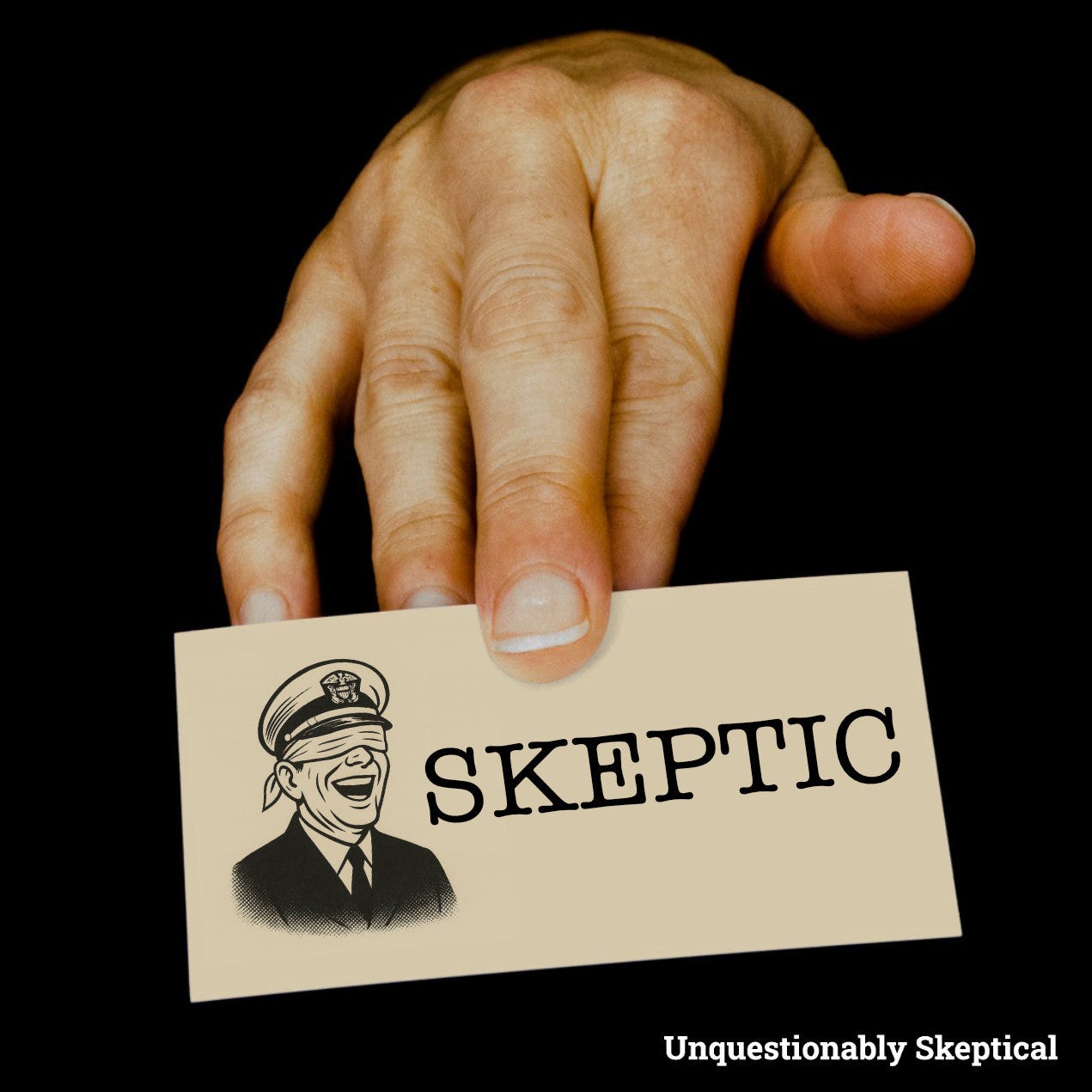
This publication tracks the institutional evolution of that playbook—how it becomes “respectable,” how it is funded and platformed, how it recruits credential signaling, and why it clusters around specific subjects (again: especially UAP/NHI).
What you’ll find here
1) Investigations into key figures, institutions, and influence paths
Expect deep dives that connect biographies to outcomes: who had access, who had incentives, who controlled archives, who shaped narratives, and who benefited.
A current focal point is Donald H. Menzel: Harvard astronomer, public debunker, and, in this series, a central case study for how scientific authority can be weaponized in public while serious classified work happens elsewhere.
2) “Receipt-first” sourcing
This project prioritizes primary sources (declassified docs, archival materials, direct correspondence, contemporaneous records) and treats claims like an evidence-weighting exercise.
When something is interpretation, it will be framed as interpretation. When something is a citation, it will be findable.
3) Why UAP / NHI sits at the center of this project
UAP / NHI is one of the clearest modern examples of a domain where:
witness data is abundant,
institutional messaging is unusually coordinated, and
the social cost of “taking it seriously” is unusually high.
That combination makes it a perfect litmus test for studying how stigma is engineered, how “acceptable opinion” gets enforced, and how scientific curiosity can be managed—sometimes for decades.
About the author
I’m Ryan Purkey, and I started by looking into modern “debunker culture” and didn’t expect the trail to run straight into Donald Howard Menzel—or to keep going from there.
I’m also happy to discuss this work in long-form conversations outside Substack, like so on That UFO Podcast, as well as in a series on stigma at LinkedIn.