



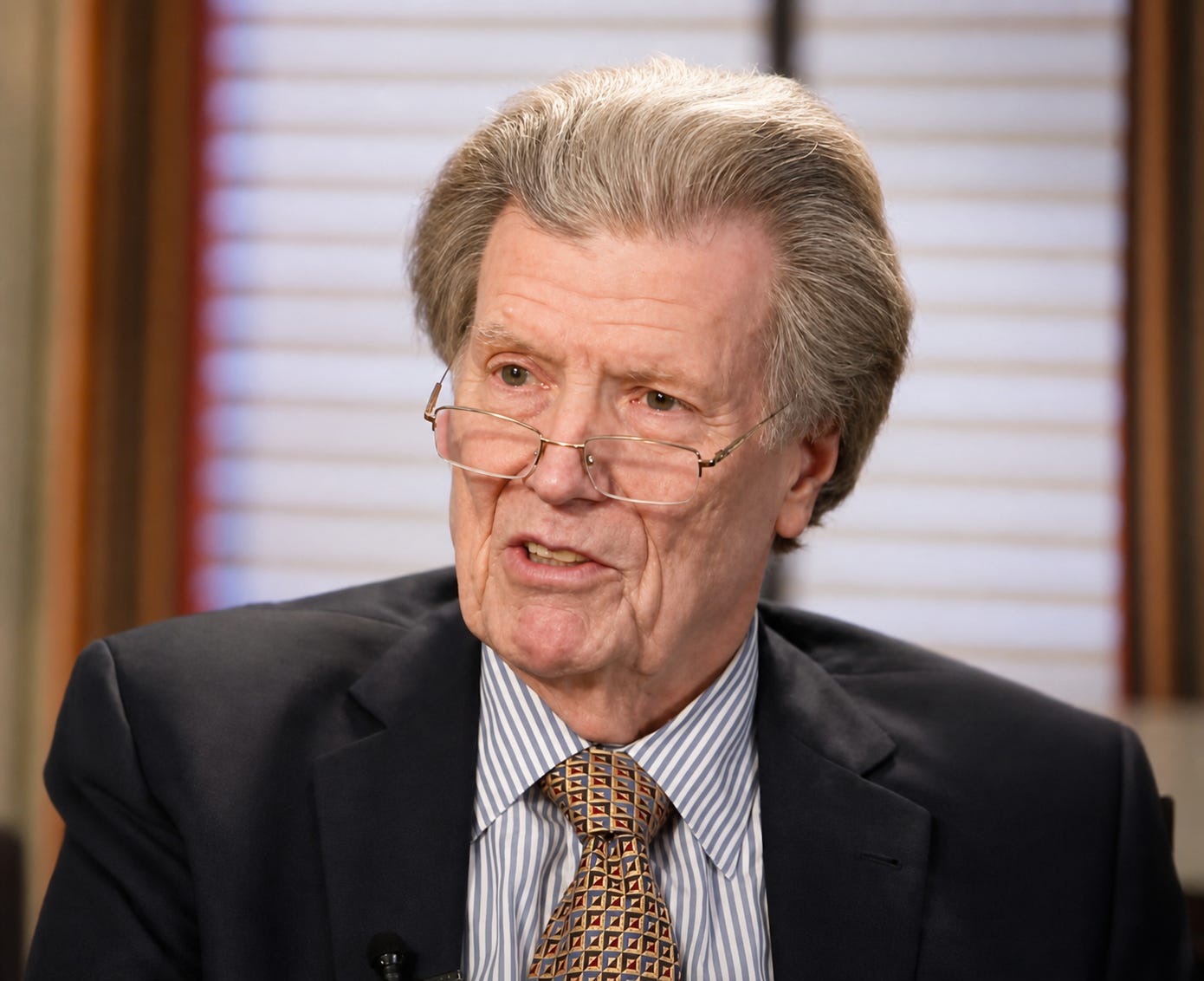
Harald Malmgren had secrets
Those secrets–later revealed–were following a rapid and broadly developing brilliance from his youth, and then an accomplished career. This career put Harald Malmgren in a unique position amongst UAP/NHI whistleblowers: Senior Executive Service Presidential advisory insider. Coming forward prior to the initiation of the Presidential Unsealing and Reporting System for UAP Encounters (PURSUE),1 Malmgren, as he often did in life, offered prescient insight into how the historical reality of UAP/NHI, and its coverup, would begin to confront the larger systems of governance, economies, and public common knowledge.
26 August 2026 update: David Burkett—cybersecurity researcher, investigator, and author of Lies Above—has just released his own thorough examination of Malmgren’s claims, bio and possible intelligence work. A fascinating look from an angle different than mine: https://liesabove.com/articles/my-time-with-the-malmgrens-part-1-an-atomic-whiz-kid/
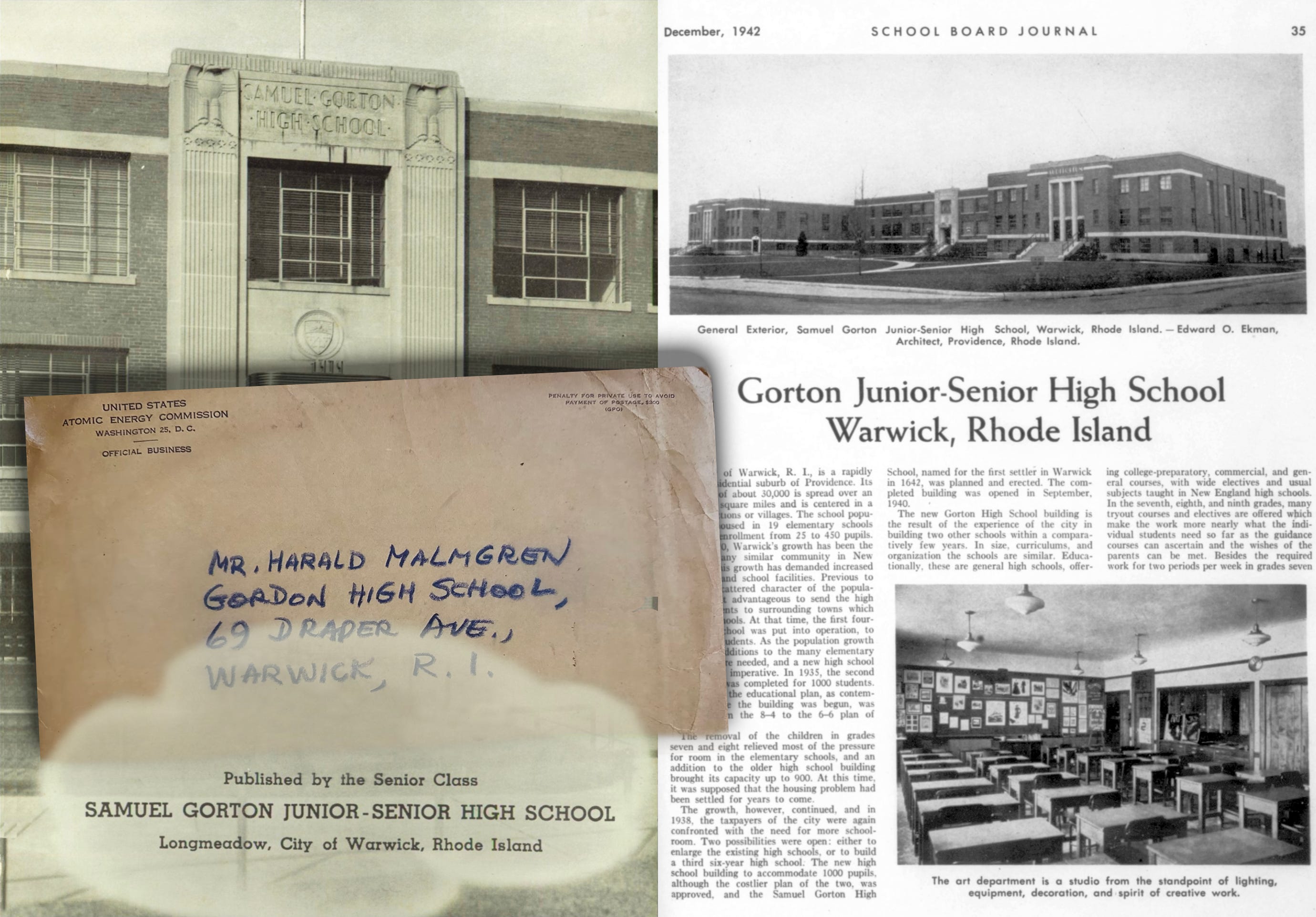
Before all that, a brief review of his early years marks the following highlights. Born on July 13, 1935, he had high executive function in his formative years fishing and harvesting seafood for his family on his own by age 7. He sought out divergent thinking. Between ages 10 to 13 he wrote the Atomic Energy Commission for information on nuclear energy. Early on he could engage with expert evaluation. By age 13, while contracting with his father on home restorations, he met and impressed president of MIT, Karl Compton.2
For his collegiate years, as an undergrad he first studied Physics at Rensselaer Polytechnic Institute3 and then attended Yale on a full scholarship. There he became a member of the Scholars of the House4, culminating in his graduate paper “Investment, Allocation, Technology, and Economic Development.”5 He graduated in 1957 at age 226 and was “awarded Yale's Howland Fellowship for study and travel abroad.”7 Again, hitting high marks and passing expert evaluation, he was Research Assistant to Nobel Laureate Professor Thomas Schelling while at Yale.8 He went on to further education at Oxford and Harvard, earning his Oxford PhD in the 1961-62 school year at age 26.9 His published thesis, “Information, expectations, and the nature of the firm”10 was seen as, “original and constituted a first attempt in paving the way to a new kind of industrial organisation.”11

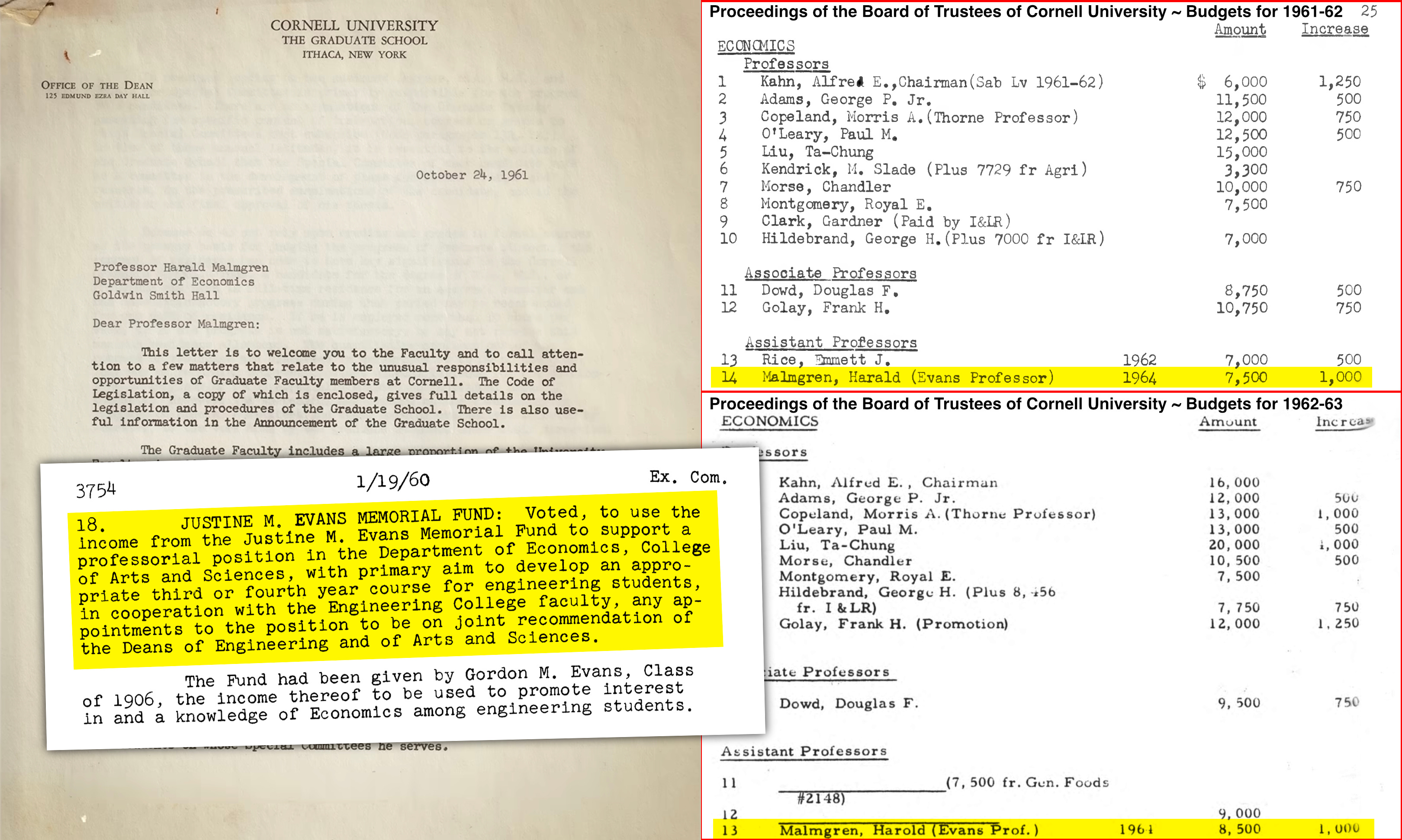
Having published works and excelled at Oxford, Malmgren continued to be sought out academically. He was soon secured as a Professor at Cornell University–welcome letter,12 dated October 24,1961–and began as the inaugural recipient of the Justine M. Evans Memorial Fund.13 This fund was set up following the 1956 death of Gordon Maynard Evans, a 1906 B.S. Cornell graduate in Electrical Engineering. Malmgren can be seen with the label ‘Evans Professor’ in Cornell University salary records. The fund also gave him an explicit focus on both Engineering and Economics since its mandate was “to support a professorial position in the Department of Economics, College of Arts and Sciences, with primary aim to develop an appropriate third or fourth year course for engineering students, in cooperation with the Engineering College faculty, any appointments to the position to be on joint recommendation of the Deans of Engineering and of Arts and Sciences.” Malmgren’s specific role at Cornell combined Mathematical Economics with the Department of Engineering and College of Arts and Sciences. And to do so required a “joint recommendation” of Deans from both schools.14 Thus, his technical, mathematical and economic talents were fully engaged.
In another rapid progression, Malmgren would become a consultant at RAND in March 1962, and in July that same year, shift to the Institute for Defense Analyses (IDA), where by 1963 he was Head of the IDA Economics Group. And still, the 1962/63 CV for Malmgren is not yet finished. Since IDA served as advisers to the Office of the Secretary of Defense, Malmgren joined the Administration of President John F. Kennedy as one of Defense Secretary Robert McNamara’s “Whiz Kids” inside the U.S. Joint Chiefs of Staff, Weapons Systems Evaluation Group, in the Pentagon.15
On the family front, also in 1962, Harald and wife Patricia welcomed their first child Karen Phillipa “Pippa” Malmgren.16
A busy few years.
Again, he did all this prior to reaching the age of 30.
But was Harald Malmgren a Walter Mitty?
This question–was Malmgren a Walter Mitty–seems like a wild non-sequiter even considering Malmgren’s accomplishments before age 30, but this was actual reasoning put forward in articles17 and an op-ed by Douglas Dean Johnson following Harald Malmgren’s death on 13 February 2025. Considering Johnson is using the ‘Walter Mitty’ tag in 2025 one also has to ignore the following 60+ years from 1963, where Malmgren’s exploits grew even further, going on to serve in Senior Executive positions for Kennedy, the next three presidents, becoming an Ambassador, and building out an international who’s who in his personal contacts. Yet this article will persist with the full analysis because ultimately the works by Johnson fall squarely into the Unquestionably Skeptical wheelhouse: dogmatic skeptics running disinformation efforts to buttress the UAP/NHI cover up.
Moving on, tagging the Top Secret cleared Malmgren as a Walter Mitty is nonsensical even by 1962. He was a highly cleared, youthful leader forming the early economic foundations that would later be used to leverage the defeat of the Union of Soviet Socialist Republics (USSR) and secure victory for the West in the Cold War. More on that later.
A different question has many more threads leading into it—did Harald Malmgren have an undisclosed resume entry—where the Central Intelligence Agency or other federal Intelligence branch was his employer? This deserves a deeper analysis as well.
To recap: Walter Mitty? No. CIA? Maybe…
Was Harald Malmgren an “Unglamorous Economist” and “Low-to-Mid-Level Analyst” or a “Senior Advisor” and “Whiz Kid”?
In Johnson’s works, he charts out a difficult position. In a tricky balancing act, he introduces Malmgren as an “unglamorous economist” and “low-to-mid-level analyst” who inflated his position but was really a “very much less consequential figure.” In the next breath though, Johnson states Malmgren was “a very significant player” in trade policy and a decades-long “successful consultant and lobbyist” dealing at the highest levels of international economic issues.
So which one is it?
Perhaps it is due to his own confusion that Johnson concludes Malmgren’s claims to be fiction. Thankfully though, Johnson provides much of the material that helps to decide the matter in the form of federal records listing roles, clearances, and work done by Malmgren. Supplementing these records with the contemporaneous diary entries of Malmgren–and other items missed by Johnson–the portrait of Malmgren becomes much more clear, even for someone who appears to have spent quite a bit of time in the shadows.
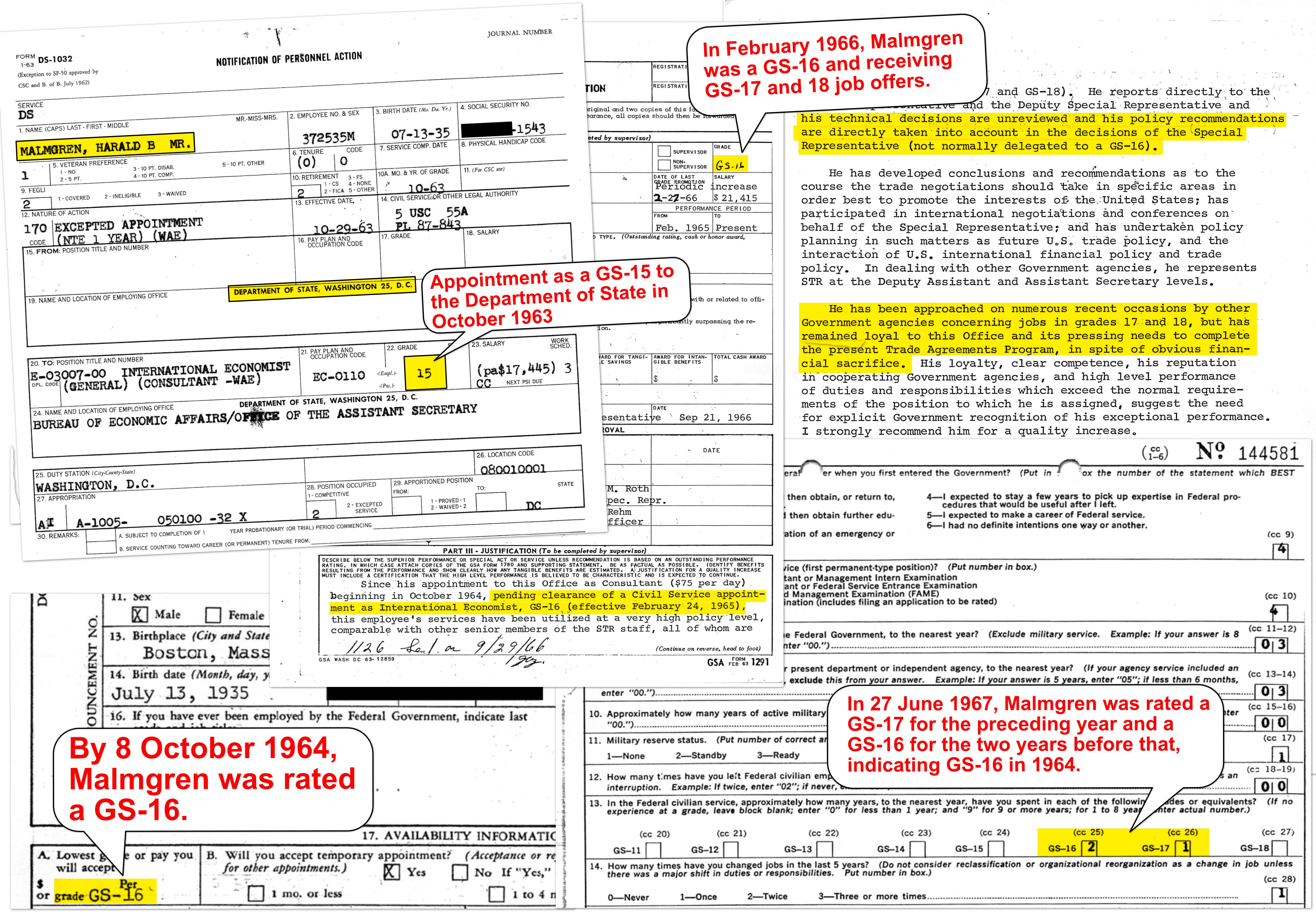
The question of whether Malmgren was a Senior Advisor Whiz Kid or an Unglamorous, Low-to-Mid Level Economic Analyst is easy to settle. Per his federal records provided by Johnson, when he was first working at IDA he was graded as a GS-15 and quickly progressed from there to GS-16, then GS-17. Historically, the ranks of GS 16-18 were absorbed into the Senior Executive Service,18 so Malmgren would carry a “Senior” tag by default.19
As for being a “Whiz Kid,” by Johnson’s own admission–”nobody was issued an official government ID that said ‘whiz kid’”–and the term was more broadly applied to the young, credentialed civilian analysts working inside the Pentagon through consultant arms such as RAND and IDA–both of which were on Malmgren’s CV. From the April 1966 essay “The Pentagon’s Whiz Kids” by Richard J. Stillman, ‘Whiz Kids’ were defined at the time as, “Most are young—in their thirties and early forties, have an Ivy League education, are highly intellectual, and eager to exercise power. Educational backgrounds of the new breed parallel that of Secretary of Defense Robert S. McNamara (Harvard Business graduate and later professor) who assumed top leadership of the Military Establishment in 1961—age 45.”20
Stillman wasn’t alone in chronicling this trend, quoting a recent–in 1966–article from The Journal of the Armed Forces he cites:
Of the 27 top officials of the Defense Department—old and new—11 including Secretary McNamara hold either graduate and/or undergraduate degrees from Harvard; six including Deputy Secretary of Defense Cyrus Vance, hold graduate and/or undergraduate degrees from Yale; two, Assistant Secretary of Defense (Public Affairs) Arthur Sylvester and Under Secretary of the Navy Robert Baldwin are graduates of Princeton… Twenty-two of the 27 went on to graduate school earning 12 LLB’s, 6 PhD’s and 6 MA’s. Eight earned their graduate degrees at Harvard.21
Was Malmgren, at IDA actively until October 1964, one of the described Yale undergraduates or one of six of the listed PhD’s? He very well could have been.
To list the 1960s Whiz Kid watchers explicitly, Malmgren was:
Young (He was 26-29 while at RAND & IDA)
Ivy League educated (Yale undergraduate; Harvard exchange; Oxford PhD)
Highly intellectual (Malmgren’s FBI interviewees–Schelling, Cross, Gates, Evans, et al–cite his high intelligence)
Eager to exercise power (Apparent from his progress in promotions and length of service in the Executive Branch)
Had an educational background similar to McNamara (McNamara as a Harvard Professor, Malmgren a Cornell Professor)
Worked for RAND, IDA or other federal think tank (Worked at both RAND and IDA)
Civilian (Malmgren did not serve in the military)
i.e. a Whiz Kid (✓)
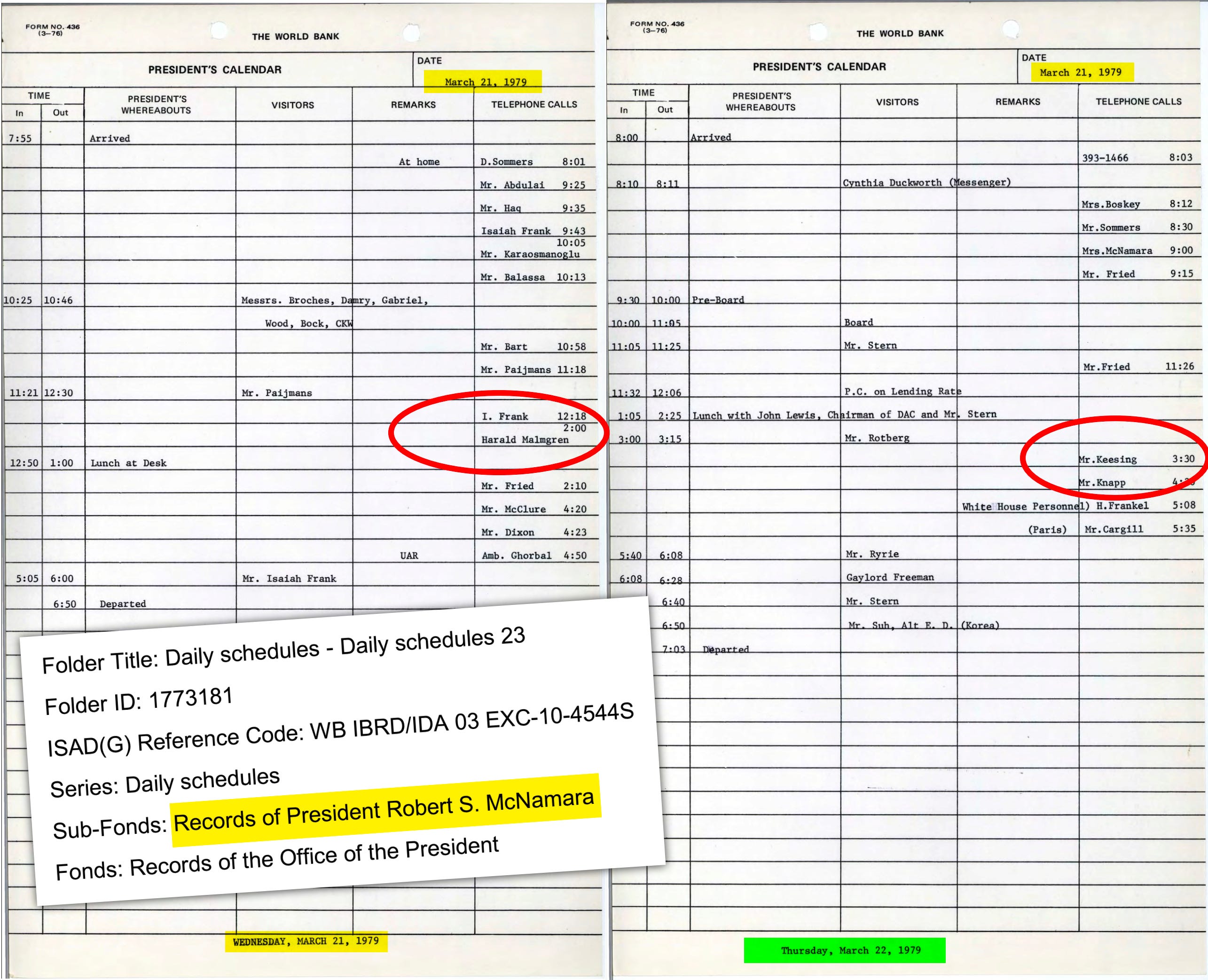
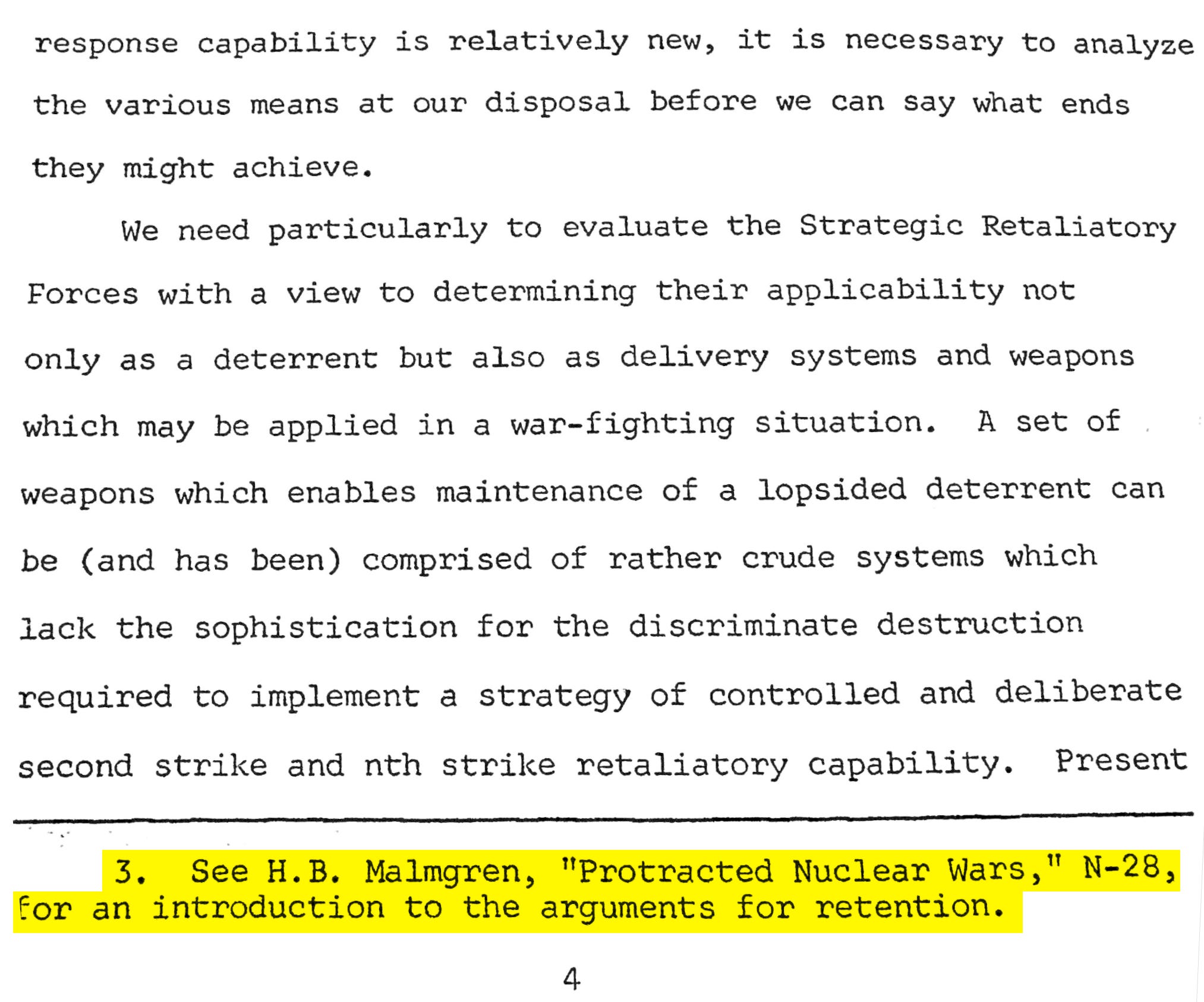
Finally, to lay this to rest, from the thoroughly researched 1990 book “America’s Frontline Trade Officials,” author Charles Lewis states in his biography of Malmgren, “In 1962, he came to Washington as one of Secretary of Defense Robert McNamara’s ‘Whiz Kids,’ working for the Institute for Defense Analysis.”22 Then in a 1997 interview with John J. Harter, held by Charles Stuart Kennedy, Harter said of his time working with Malmgren from 1966 to 1970, “Hal had been one of McNamara’s “Whiz Kids” at the Pentagon.”23 Giving the last word to McNamara himself, in between the 1960s and 1990s, McNamara still found time to have meetings with Malmgren while President of The World Bank, such as this post-lunch time appointment on 21 March 1979.24
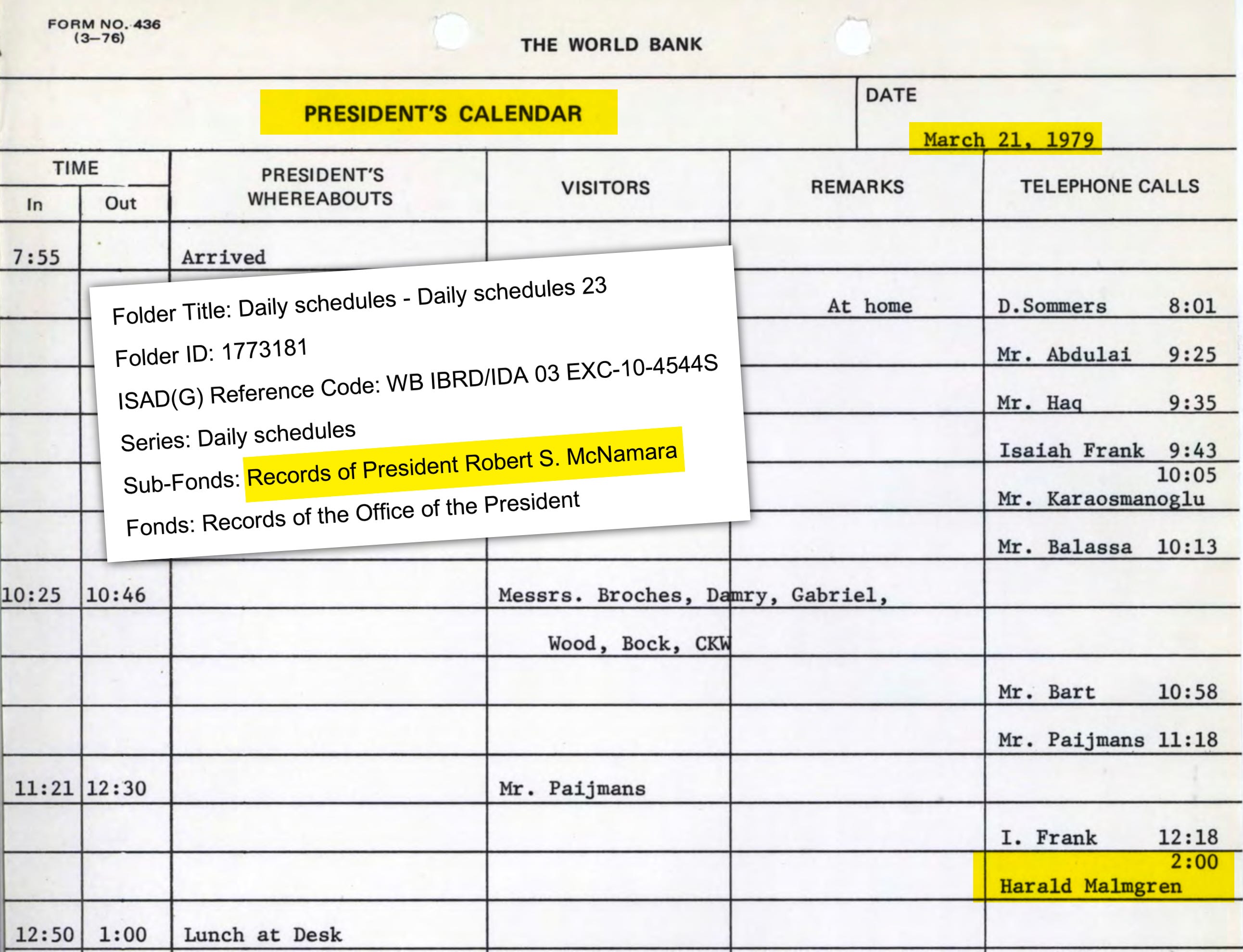
The record definitively puts Malmgren in the Whiz Kid camp at an SES-level with an enduring connection to McNamara.
A Closer Look at Malmgren in the Early 1960s
Since much of Johnson’s deconstruction work of Malmgren rests on the time Malmgren spent in the truncated presidency of John F. Kennedy it is critical to revisit in more detail the work done and connections made by Malmgren during that period. A stark miss by Johnson, by 1 May 1962 Harald Malmgren was already employed as a consultant in the Economics Department at RAND Corporation. And this work was not that of an “unglamorous economist,” rather it required a Secret security clearance issued by the Department of the Air Force. Johnson makes no mention of Malmgren’s employment at RAND in his article, even though he had the FBI file and even highlighted the “Clearances” section.
Employed by RAND Corporation
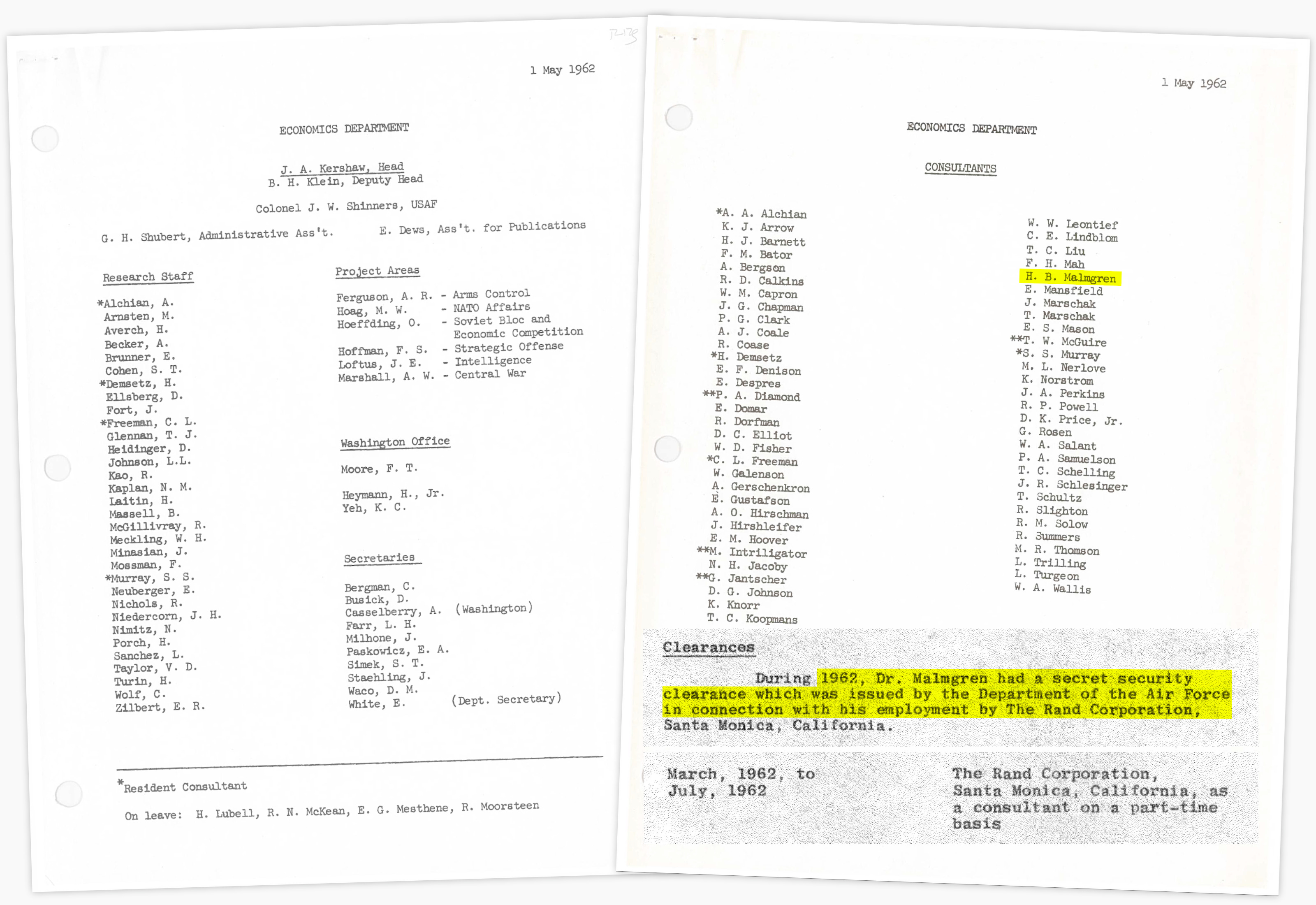
Johnson was also well aware of the RAND Corporation and its connective tissue to Whiz Kids because he later cites Alain C. Enthoven and K. Wayne Smith’s work there, “Two of the most prominent ‘whiz kids’ were Alain C. Enthoven25 and K. Wayne Smith.26 They co-authored a book titled How Much Is Enough? Shaping the Defense Program, 1961-1969. It was originally published in 1971, and republished in 2005 by the RAND Corporation.”27
Clearly Malmgren was working in Defense programs at RAND Corporation or else he would not have required a Secret clearance from the Air Force. Johnson makes no mention of this. As a general historical evaluation of these organizations, consider this Naval War College summary of RAND, IDA, the Joint Chiefs of Staff and the Weapon Systems Evaluation Group:
The Navy transformed its Operations Research Group into an Operations Evaluation Group that became the Center for Naval Analyses. The Air Force established RAND. The Army established its Operations Research Office at Johns Hopkins University, which became the Research Analysis Corporation. The Joint Chiefs of Staff (JCS) founded a Weapons Systems Evaluation Group that became the Institute for Defense Analyses. Initially these organizations provided mechanisms for contracting university professors; eventually, they developed permanent staffs.28
Looking more closely at the list of Malmgren co-workers in the RAND Economics Department during May 1962, there are many notable ones: Joseph E. Loftus - CIA agent;29 Andrew W. Marshall - Q-cleared30 and later longtime director of the United States Department of Defense’s Office of Net Assessment;31 Daniel Ellsberg–of Pentagon Papers fame–held extensive compartmented clearances32 and also had a Q-Cleared father;33 Thomas C. Schelling - Nobel prize winner34 with extensive clearances and classified work;35 and James R. Schlesinger - later Chairman of the U.S. Atomic Energy Commission, Secretary of Defense, and CIA Director.36
Malmgren, soon to make the move to the IDA and join the advisory staff to the Kennedy Administration, was among peers at RAND Corporation. Its exclusive and clearance-based nature assured that.
Understanding the history of RAND Corporation with some more detail is useful as well. Here Thomas Fraise in his journal article “The Magicians of Nuclear Strategy” provides the essential overview:
In the 1950s, a new figure emerged in American strategic debates: the nuclear strategist. These civilians with impressive academic backgrounds moved freely between academia and the national security state, held security clearances, briefed and advised military officers and policymakers; and almost single-handedly produced a new field of knowledge: nuclear strategy and, more specifically, nuclear deterrence theory. This group of intellectuals emerged essentially out of the RAND Corporation, an entity of a new genre, created by the Air Force but filled with civilian researchers.37
Omitting a mention of Malmgren’s RAND employment in his article is a fairly consequential blunder by Johnson, and in the spirit of journalistic rigor, hopefully just that–an oversight. Pointedly though, when the Washington Examiner published a summary by Johnson of his longer self-published article, it did so as an opinion piece in its Op-Ed section.38 The paper does have investigative journalists, an “Investigations” department and related section,39 but Johnson’s work on Malmgren was not placed there.
More importantly though, returning to Malmgren, did his five months at RAND lead to greater security access and deeper involvement? The short answer is obviously yes, as already discussed, but those details also deserve a closer look.
Malmgren moves to the IDA
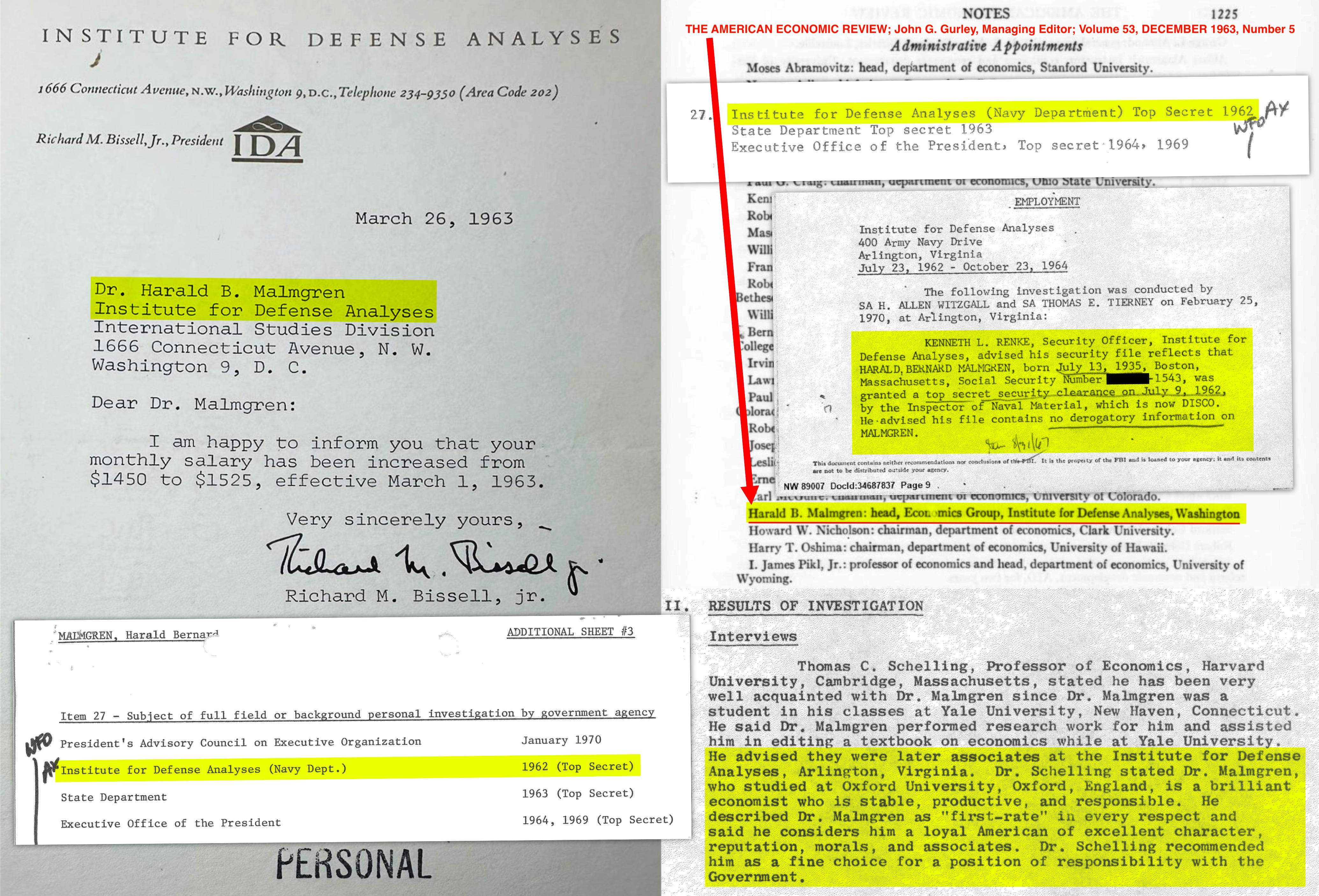
From his Secret clearance consultant role at RAND, Malmgren directly transitioned to his new Top Secret cleared position at the Institute for Defense Analyses (IDA) with his clearance being issued by the Department of the Navy, Inspector of Naval Material on 9 July 1962 without delay.40 In parallel to his increased access, his pay and promotions likewise steadily progressed while at IDA. He maintained his relationship with Schelling–already having been connected since their Yale days together, which continued through to RAND, and then IDA. In addition he was now working with Richard Bissell, President of IDA. By December of 1963, Malmgren would be promoted to head of the Economics Group as recorded in the Administrative Appointments of The American Economic Review. More critically though, he was no longer in New York or California, but living and working in the National Capital Region where he would remain active for decades to come.
At the same time of Malmgren’s arrival at IDA, the Economic and International Studies Divisions were busily researching, writing, and publishing Study PACIFICA, a report “to assess the significance for the United States of the emergence of Communist China as a nuclear power.” One of the article authors that contributed to the collective report was Donald B. Keesing, a Q-cleared economist who delivered his Secret - RESTRICTED DATA report, “The Communist Chinese Nuclear Threat: Warheads and Delivery Vehicles (U)” on 15 September 1962, two months after Malmgren’s arrival. In other words, they were colleagues that worked together on Economics at IDA.
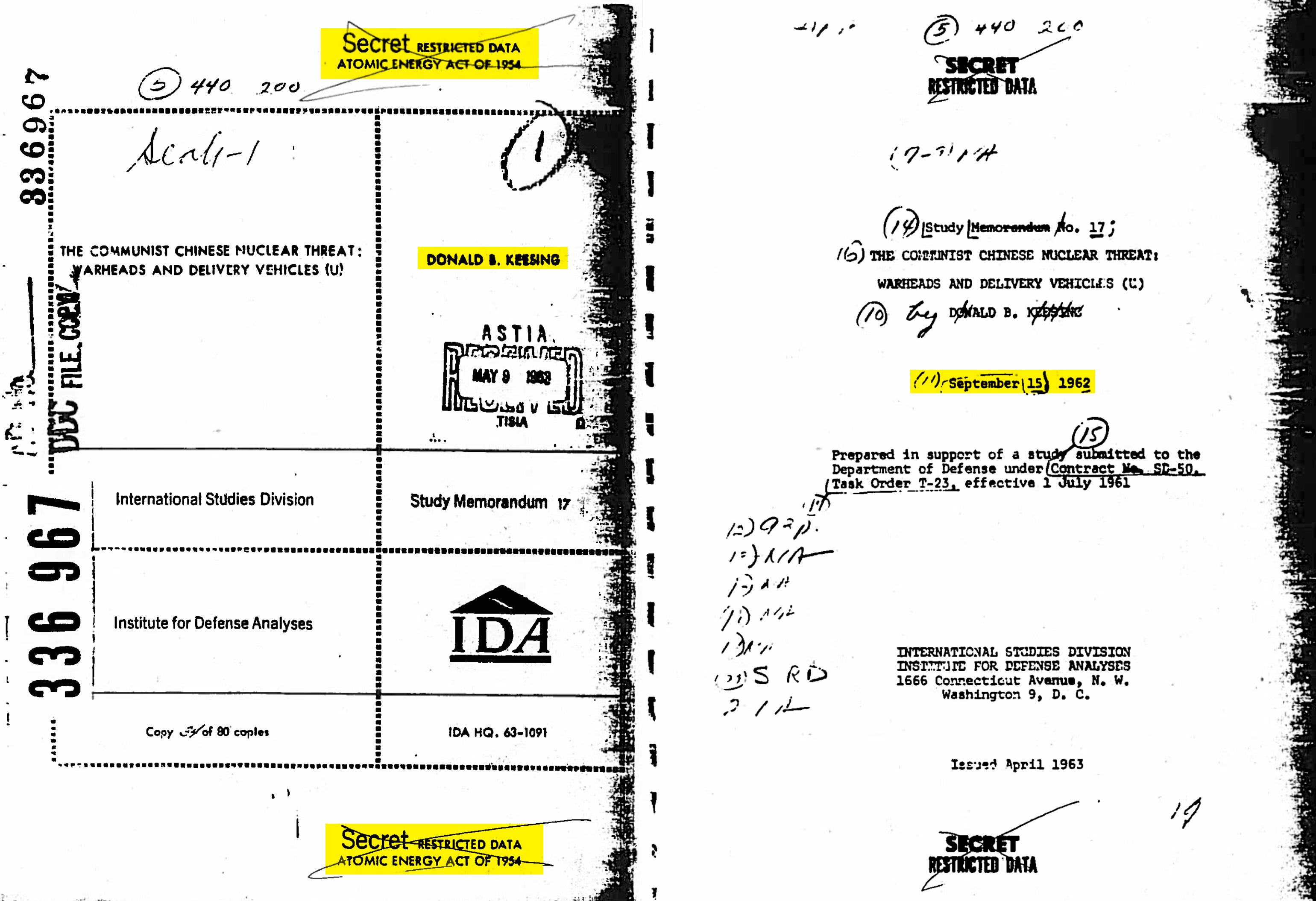
In the foreword to the report by Keesing, Director James E. King wrote:
The author, Donald B. Keesing, is an economist and Far Eastern specialist. Before joining the Institute for Defense Analyses he was with the Systems Analysis Office, Air Force Cambridge Research Laboratories, where he co-authored a number of analytic studies on theater air powers, space research needs, command and control, and other subjects. He has also taught economics at Harvard University, where he served on the staff of the Harvard Defense Studies Program and later as an associate of the Harvard Economic Research Project.
This paper was written in support of Study PACIFICA, an analysis of the emergence of Communist China as a nuclear power.
Study PACIFICA was prepared by the International Studies Division of IDA for the Department of Defense, under Contract No. SD-50, Task Order I-23, effective 1 July 1961. Brigadier General Sidney F. Giffin, USAF (Ret.) was Study Leader.
Further alignments between Keesing and Malmgren’s background include:
Keesing taught economics at Harvard while Malmgren taught economics at Cornell.
Keesing was at Air Force Cambridge Research Laboratories prior to joining IDA and Malmgren joined from RAND Corporation.
Keesing was a Far Eastern specialist while Malmgren went to Europe and Turkey when studying abroad.
The only missing piece for Malmgren is a document like the one by Keesing that explicitly shows his Q-Clearance at work. Uncontroversially, Malmgren worked on anti-ballistic missile and nuclear intercept studies while at IDA—work requiring a Q-clearance—but the concrete proof that he employed a Q-clearance to do so is likely still locked up somewhere. Even the released report by Keesing has page after page of fully redacted content and references.
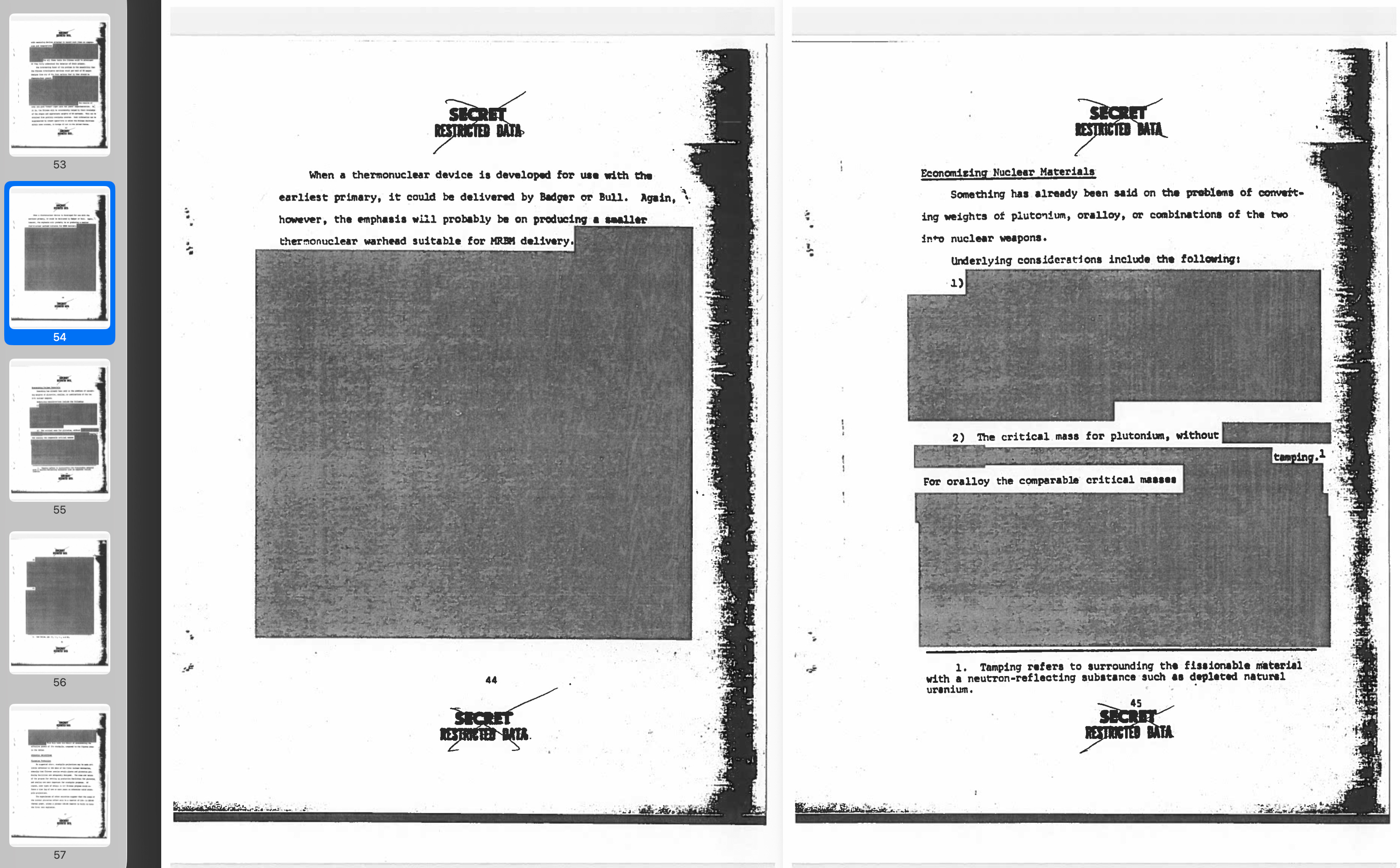
Thus, the idea that Johnson’s search for evidence of Malmgren’s Q-Clearance was exhaustive is not a serious one. The public does not have every record, and of the files in the public sphere, many remain redacted–especially in relation to Restricted Data governed by the Atomic Energy Act of 1954.
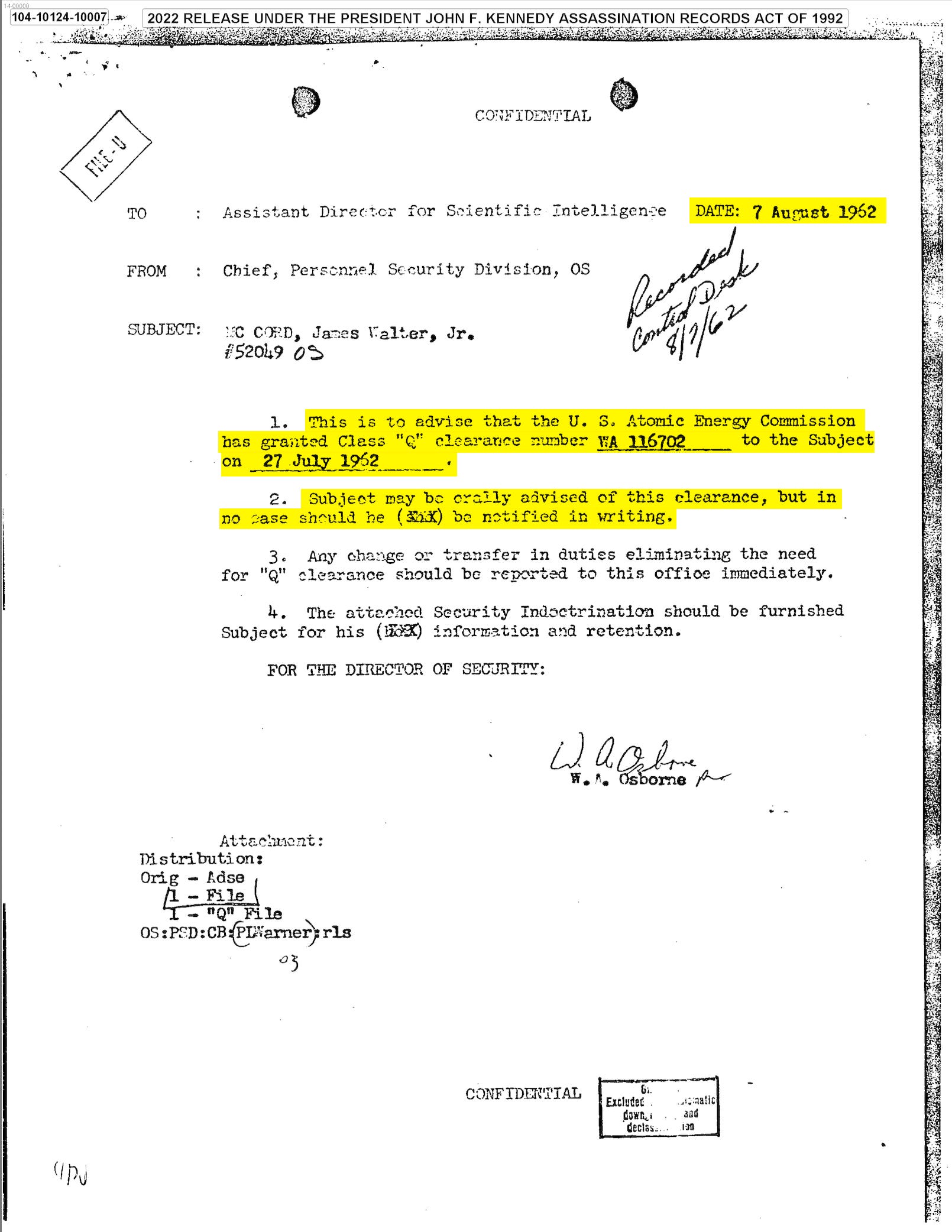
More evidence of a missing Q Clearances–in time, place and procedure–can be seen in the records of James Walter McCord Jr.41 In a Confidential CIA memo from 7 August 1962, the Personnel Security Division records that the U.S. Atomic Energy Commission granted McCord a “Q” clearance–number WA 116702–on 27 July 1962. Critically though, McCord was to only be advised of the clearance orally, and “in no case should he be notified in writing.” Yet another factor that could confound a Q clearance records search.
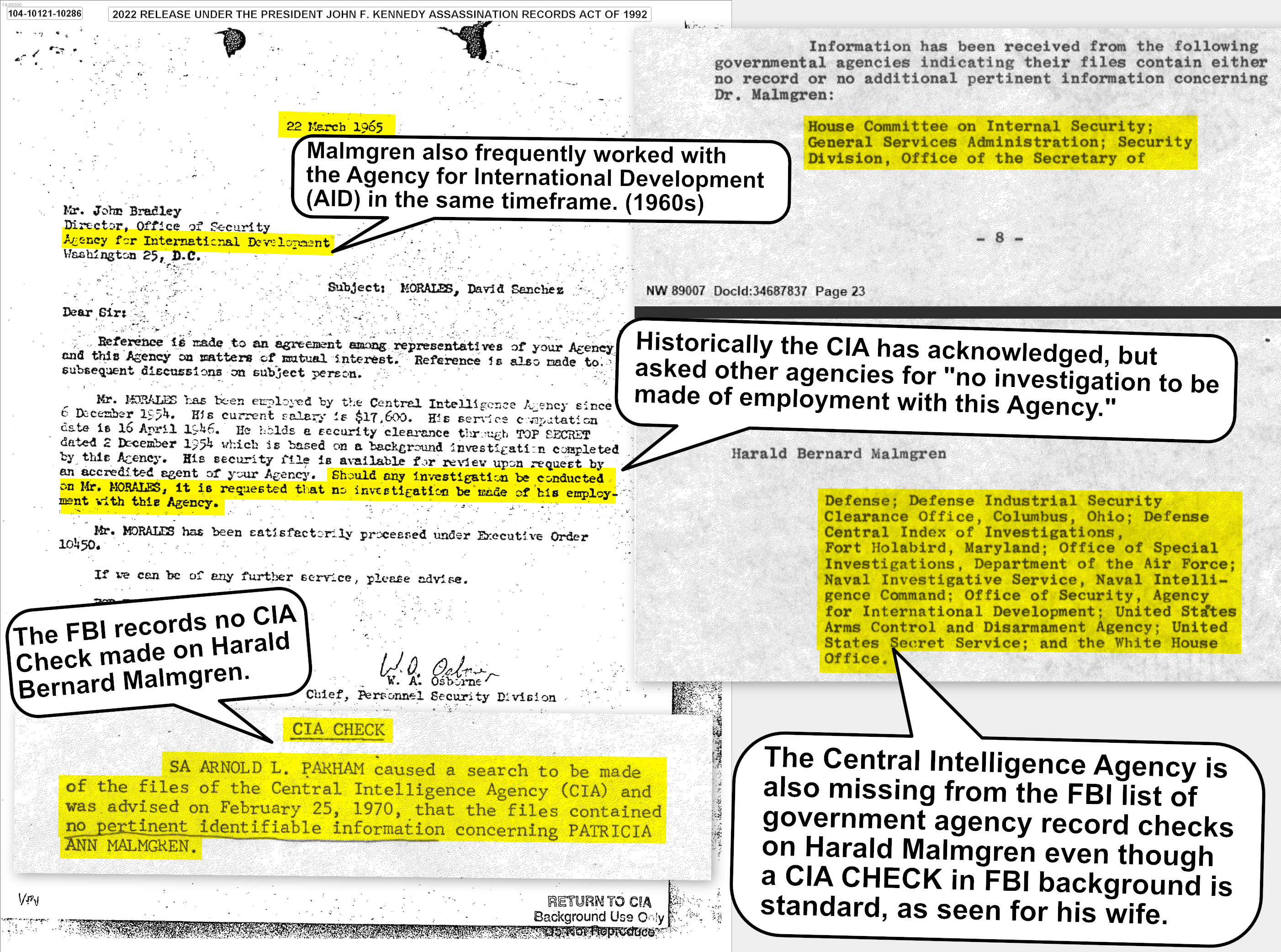
For yet another example of CIA record keeping practices that could impact Malmgren’s documented clearance history, there is the 1965 case of David Sanchez Morales. A long time employee of the CIA, when the Office of Security for the Agency for International Development (AID) made an enquiry to CIA on Morales’ background, they were informed of his employment, but explicitly asked, “that no investigation be made of employment with this Agency.”42 In other words, keep it out of the record. Similarly, in the FBI investigation into Malmgren, the CIA CHECK section only mentions Malmgren’s wife, Patricia Ann Malmgren. Harald is conspicuously absent. The CIA is also absent from the governmental agency list that the FBI notes on pages 8 and 9 of their file. With his work in the Executive branch and frequent international travel, it is highly doubtful that the CIA would not have a file on Malmgren, and much more believable that the missing FBI search is due to being asked to not investigate his background at CIA.
As an aside, but an even more pointed and older example of known hidden documents, the Interagency Security Classification Appeals Panel (ISCAP), the National Archives group in charge of declassifying–or retaining as classified by appeal–documents older than the 75 year maximum still have wholly classified documents from the 1940s. Case in point, “ISCAP Appeal No.: 2012-034” from the Harry S. Truman Presidential Library and Museum is a Top Secret - Codeword letter from Hillenkoetter to Truman on 19 April 1948. The ISCAP decision? “Affirmed the classification of the document in its entirety”.43 Again, Johnson’s search is de facto incomplete due to documents still remaining classified in whole and heavily redacted in part.
Back to the specific case of Keesing though, in him we have a direct connection to Malmgren, both working on studies of nuclear missiles, both at IDA, both economists, both in the Economics Group, both part of Secretary of Defense Robert McNamara’s IDA advisers to his Office. Further, their working relationship was a familiar one. In 1963 Malmgren had several meetings with Keesing as contemporaneously recorded in Malmgren’s diary.44 In the same year, Malmgren had frequent appointments at the Pentagon, ABM meetings, Intercept meetings, appointments with Bissell, Schelling, Enthoven, and many others that formed the backbone of the Kennedy Administration’s Defense planning arm.
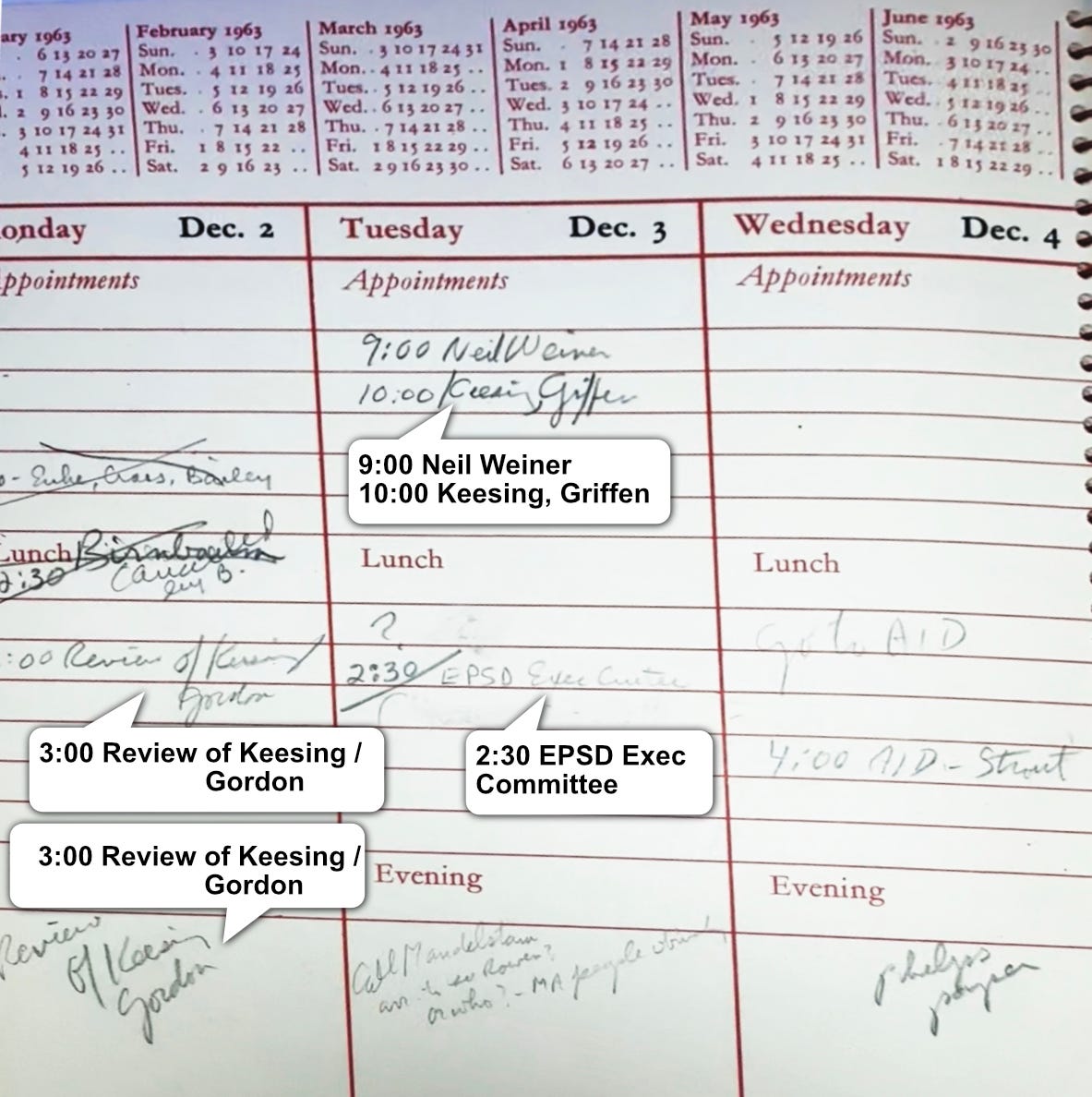
Recall McNamara’s 21 March 1979 meeting with Malmgren. On the day following McNamara met with Keesing. Not only did he know both Malmgren and Keesing, but through either remarkable coincidence or some more purposeful alignment, McNamara scheduled the two former IDA colleagues for meetings just 24 hours apart–or on the same day if the matching top right dates correspond.
Malmgren and Bissell
From his own contemporaneously kept 1963 diary, Malmgren recorded several meetings with Richard Bissell. Notably, his first in the year on 30 January 1963 corresponds in time with Malmgren’s retelling of this history in his interview with Jesse Michels more than 60 years later, “Okay. So, a few months after this series of episodes–Missile Crisis, Los Alamos–Richard Bissell called me up and said, ‘I’d like to spend some time talking to you. Maybe Friday afternoons after work would be good.’ I said, ‘Sure.’”45
The date for the ‘series of episodes’ was October 1962. A ‘few months after this series’ would be January 1963. In Malmgren’s diary on 30 January 1963 is a 3PM meeting to end his day with Richard Bissell.46 This very well could have been the meeting where Malmgren describes Bissell bringing out a bottle of whiskey and debriefing Malmgren, “There were things you need to know.”
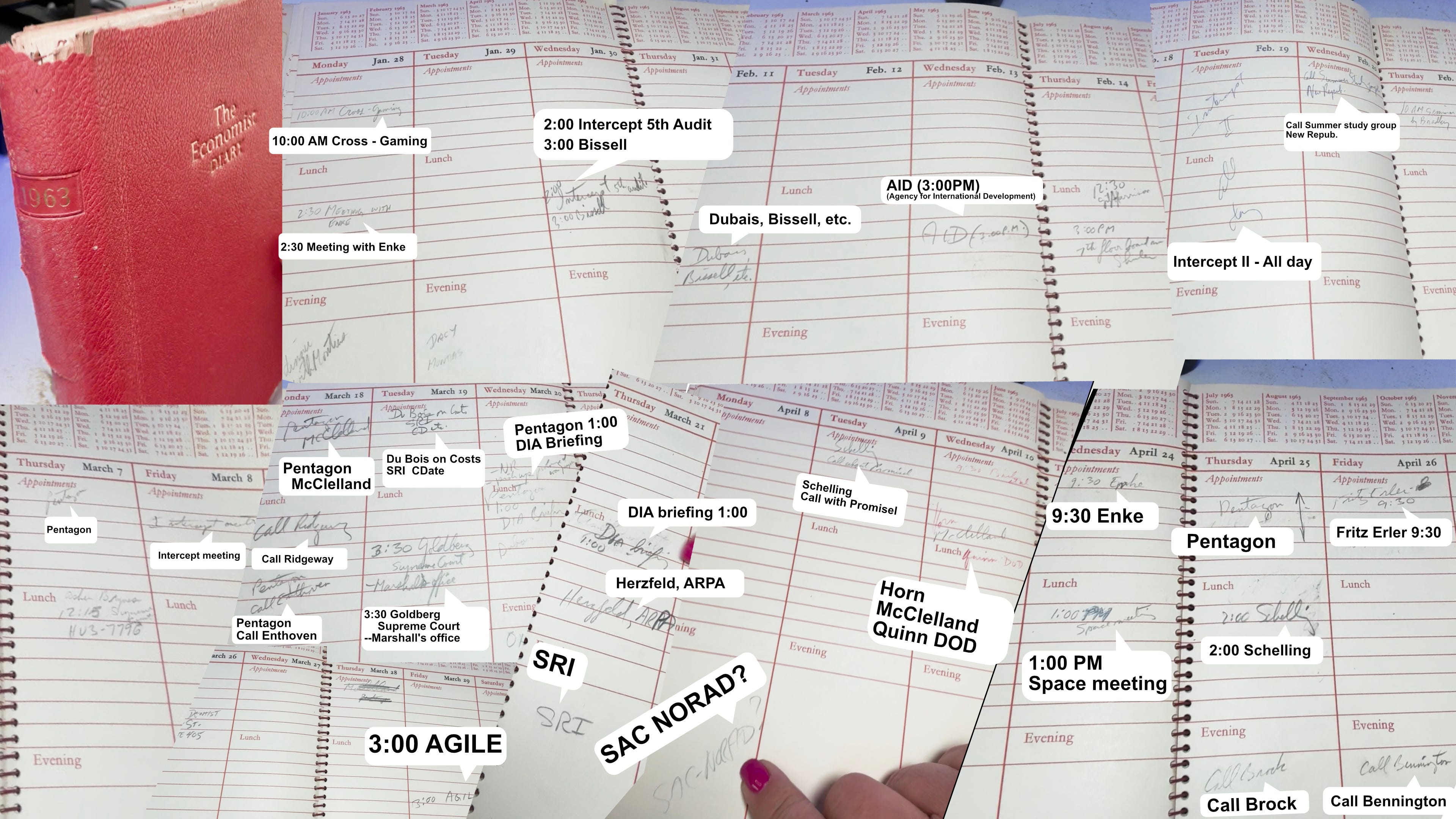
To further corroborate Malmgren’s history, the diary contains many appointments at the Pentagon, with meetings related to Anti-Ballistic Missile (ABM) defense: Intercept, Intercept II, SAC NORAD, Air Defense of the North American Continent (ADNAC) and so on. Additionally, he met with the Defense Intelligence Agency (DIA), Stanford Research Institute (SRI), and Advanced Research Projects Agency (ARPA) all of which were active in this space and era. Finally his records cover meetings with people such as: Richard M. Bissell, Thomas C. Schelling, Alain Enthoven, Stephen Enke, Arthur Goldberg, Charles M. Herzfeld, and many notable others.
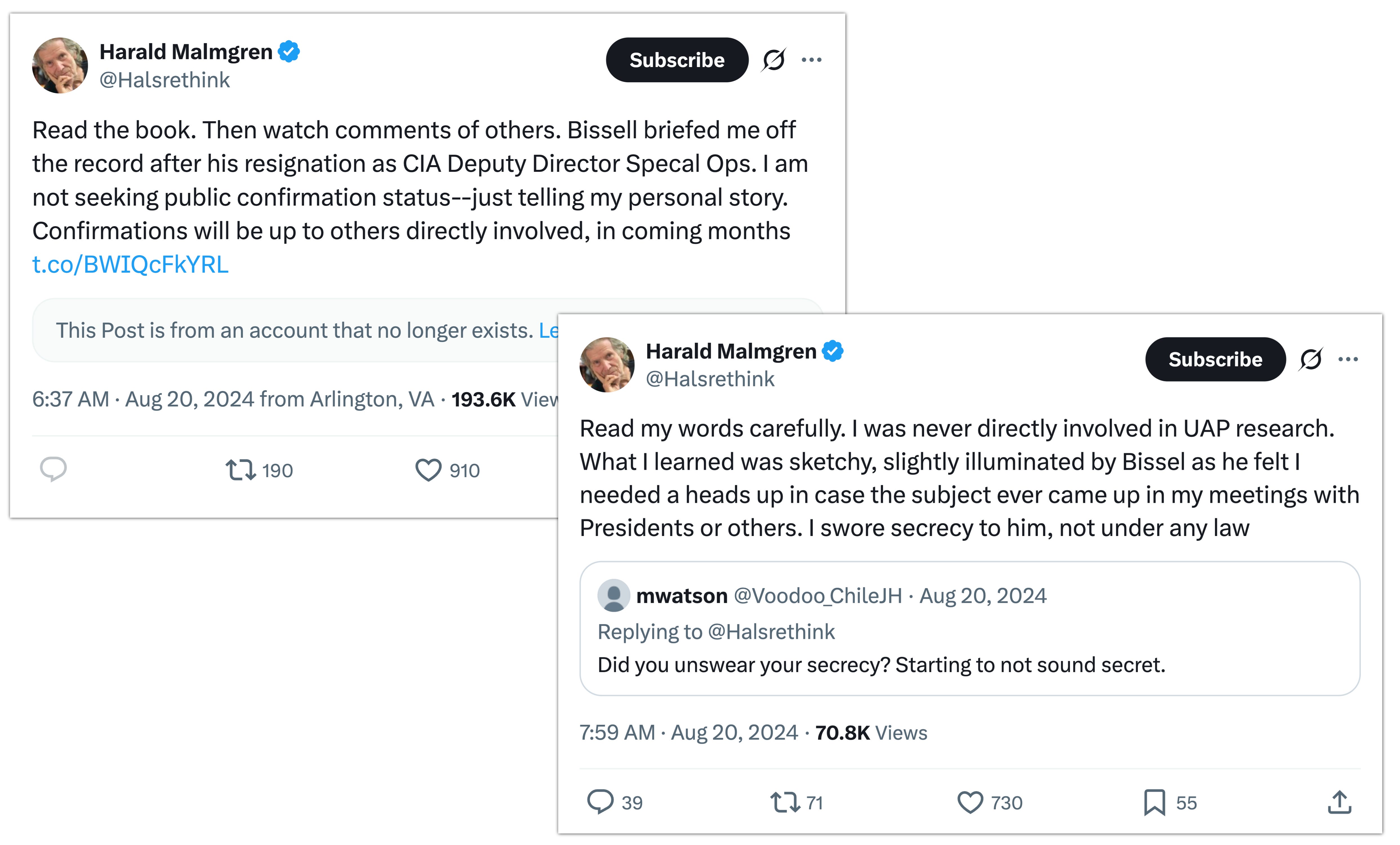
Not only does the timing hold up from Malmgren’s 1963 calendar to his April 2025 interview with Jesse Michels, but he also gets the timing correct in Tweets prior to that. To add further nuance, since Bissell was no longer the CIA Deputy Director formally,47 the January 1963 meeting with Bissell was not part of his official CIA duties and off the record, which is also part of Malmgren’s retelling, “I swore secrecy to him, not under any law.”48
Bissell would remain close at hand in Washington D.C. by first becoming Vice President of IDA the day after his accepted resignation from the CIA:
I joined the Institute for Defense Analyses (IDA) as executive vice president on March 1, 1962, immediately following my departure from the CIA. I viewed my new job at IDA, which bridged the academic and military worlds, and more generally the area of U.S. foreign policy, as providing an opportunity to stay in Washington and continue working on problems that would prove interesting. Four and a half months later, on July 12, 1962, I became president of IDA, succeeding Garrison Norton.49
At the same time Bissell was becoming president of IDA in July 1962, Malmgren was arriving from RAND. Then, in the fall of 1962, when Keesing, King, et al released their PACIFICA report, it was done so on IDA imprint because Bissell, “had worked out a series of agreements with the Pentagon and begun the implementation of new management policies. The agreements specified that tasks would be accepted and reports released only on the authority of the president of IDA and under the IDA imprint.”50 Thus we have the IDA branded report. Then in March 1963, Bissell would write to Malmgren to happily inform him of his salary increase along with Malmgren’s increasing role and grading with the Department of State.
In short, as work colleagues, Yale alums, and economic-focused academics who met regularly, Malmgren and Bissell would certainly have the opportunity for off the record conversations in 1963.
![By 24 March 1963, Malmgren would list Schelling (Yale, RAND, IDA), King (Q-cleared head of IDA International Studies Division), Caplan (Director of the Office of International Finance and Economic Analysis at the U.S. Department of State), Bissell (CIA, President of IDA), and Enthoven (Deputy Assistant to the Secretary of Defense [then McNamara] and fellow Whiz Kid) as work references, all of whom had, “definite knowledge of [Malmgren’s] qualifications and fitness.”](https://substackcdn.com/image/fetch/$s_!i3Lt!,f_auto,q_auto:good,fl_progressive:steep/https%3A%2F%2Fsubstack-post-media.s3.amazonaws.com%2Fpublic%2Fimages%2F48ab11c2-2642-4c9c-8155-de958b9705bd_2850x1594.jpeg "By 24 March 1963, Malmgren would list Schelling (Yale, RAND, IDA), King (Q-cleared head of IDA International Studies Division), Caplan (Director of the Office of International Finance and Economic Analysis at the U.S. Department of State), Bissell (CIA, President of IDA), and Enthoven (Deputy Assistant to the Secretary of Defense [then McNamara] and fellow Whiz Kid) as work references, all of whom had, “definite knowledge of [Malmgren’s] qualifications and fitness.”")
Malmgren in October 1962
Two historical events that make up much of the Malmgren interview with Michels, and which both happened in October of 1962, are the Cuban Missile Crisis and Operation Fishbowl culminating in the Bluegill Triple Prime test. Johnson disputes Malmgren having any involvement in either one; however, as Malmgren was present and working in the Weapons Systems Evaluation Group (WSEG) at the Pentagon via IDA’s Weapon Systems Evaluation Division, he would have an abundance of opportunity to be involved.
Bluegill Triple Prime
Starting with the latter first, a major focus of Malmgren’s work was on Anti-Ballistic Missile (ABM) defense and the related topics of the era: Air Defense of the North American Continent (ADNAC), Ballistic Missile Defense (BMD), and Intercept tests. Again, returning to Malmgren’s 1963 calendar, he was still busy with this work throughout the year as seen in this brief summer sample.
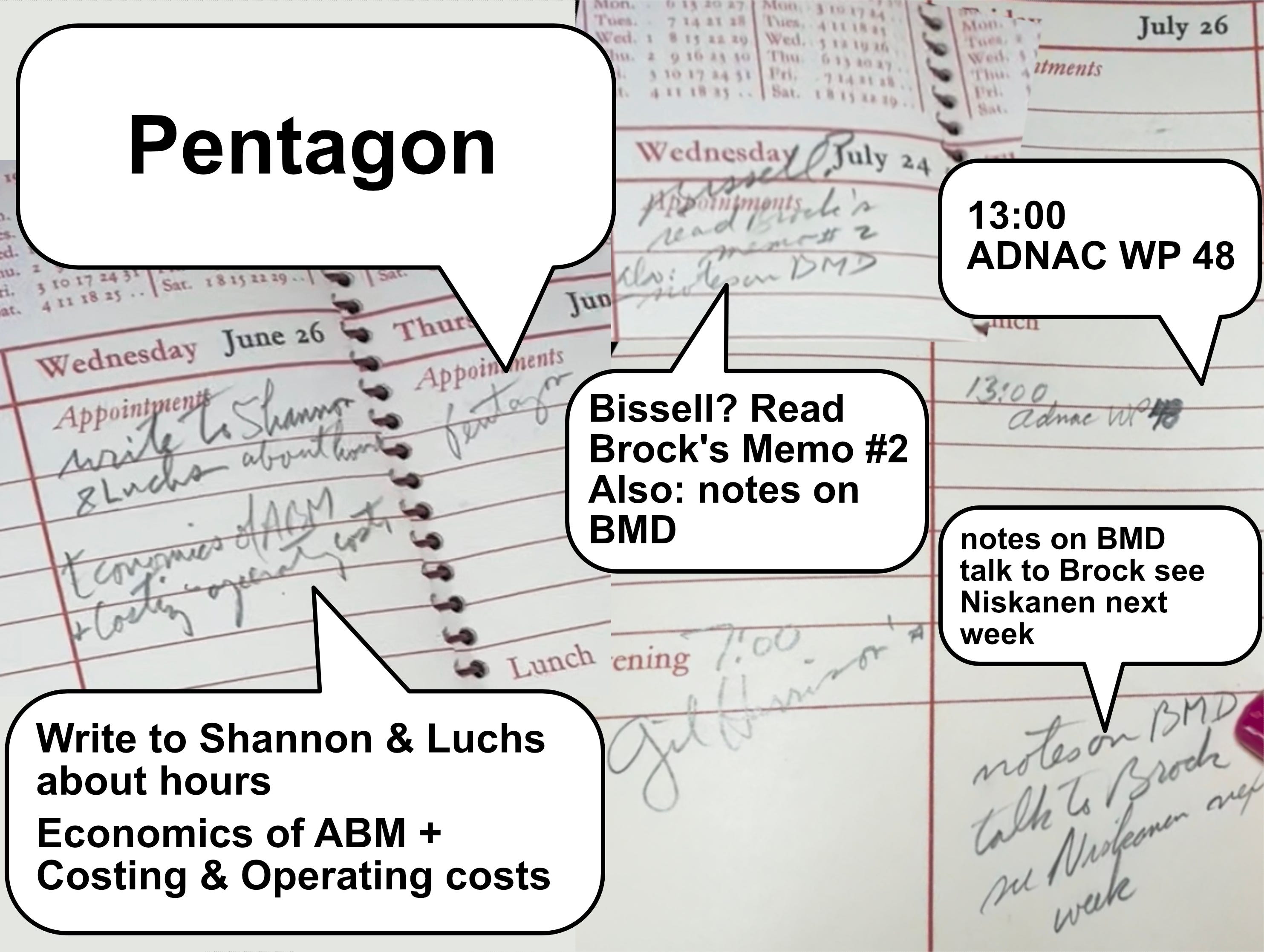
Also of note, all early ABM devices were nuclear warheads, “The [United States and Soviet Union] started developing anti-ballistic missile (ABM) systems in the 1960s to protect against ICBMs and SLBMs. Since they were not very accurate, the ABMs carried a nuclear weapon to destroy the enemy warhead.”51 So Malmgren, working directly in this area, would have the standing to be part of the analysis of Bluegill Triple Prime, delivering on his role relevant to ABM defense. Remember too that Bissell, now head of IDA, was applying his economics background to weapons development and testing, so when Malmgren notes his access due to his analysis on “Economics of ABM + Costing & Operating costs” this aligns with the business-orientated mandate of Bissell as he outlines in his biography:
I felt that what we were being paid to do was to bring an independent judgment on weapons. How good is an aircraft? Will it really achieve the promised range? How efficient is it as a weapon? We were hired not to give another military opinion but to exercise an independent judgment arrived at by competent scientists and technical people.52
Then as the liaison from IDA’s Weapons Systems Evaluation Division (WSED) to the Pentagon’s Weapons Systems Evaluation Group (WSEG),53 Malmgren was even more specifically directed to be a competent judge of weapons and weapons tests like the Operation Fishbowl series. This is directly opposite to how Johnson portrays him, “Malmgren was at the time a low-to-mid-level analyst-researcher with no direct involvement in such matters.” The facts clearly state otherwise.
Additionally, in what seems to be a recurring practice in Johnson’s writing, in his article on the Bluegill Triple Prime nuclear test he dedicates a large portion of research to his views, but his omissions are stark. Nowhere in the 13,000+ word article does he mention the retrograde separation of the rocket vehicle (RV) and the booster–namely the Thor retrorocket blast–which significantly slowed the booster to create an abundance of separation between it and the warhead.
Geoff Cruickshank–in his article “The Bluegill ‘Booster in Fireball’ Theory: A Flawed Argument Nuked By Basic Physics”–makes this point clear in his section ‘Flaw No.2: Retrograde Rockets’:54
As we can see from this image, (17), the Kingfish shot on 1 November 1962 had retrorocket firings at 180.593 and 181.701 seconds after launch. Using the above information stating that the Bluegill test would fire its retrorockets at a time 2 seconds after the other tests (Starfish, Checkmate, Kingfish and Tight Rope), I have used 182 and 184 seconds in my modelling data of the booster and RV trajectories.
To this end, actual flight data from the Bluegill Triple Prime tests gives the time the RV separated from the booster at 176.4 seconds after launch. (18) Using the Douglas Aircraft Company (DACO) data above, the two side-mounted, solid propellant retrograde (“retro”) rockets would fire in what is known as “ripple” mode – sequentially, one after the other. This reaction would work both opposite to the direction of travel and laterally, pushing the spent booster off the line of trajectory of the RV. These retrorocket firings are Doug’s Flaw No.2.
17. Project Officer’s Report - Project 9.4b Pod and Recovery Unit Fabrication https://apps.dtic.mil/sti/tr/pdf/ADA995471.pdf Pg. 90
18. Ibid., Pg. 92
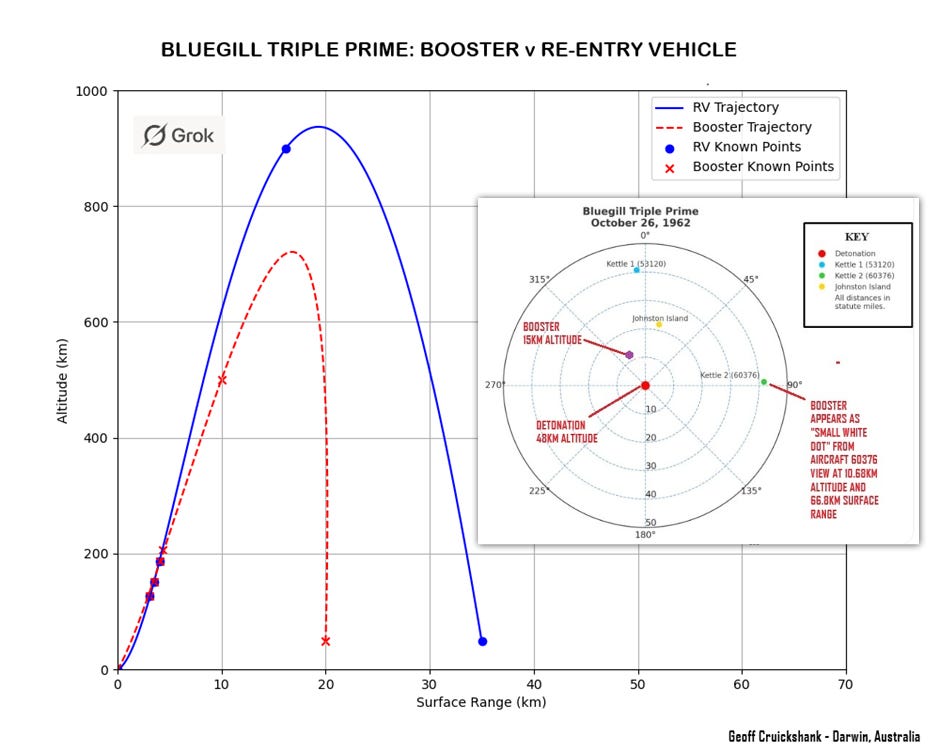
The use of ‘retro rockets’ is also made explicit in the November 1961 document, “Preliminary Plan for Operation Fishbowl” where it says, “After engine cut-off, latches securing the payload open and solid propellent Retro rockets on the Thor back it away from the payload.” Further, they specifically cite this as a way to reduce, “the possibility of the booster interfering with the diagnostic and debris investigation.”55
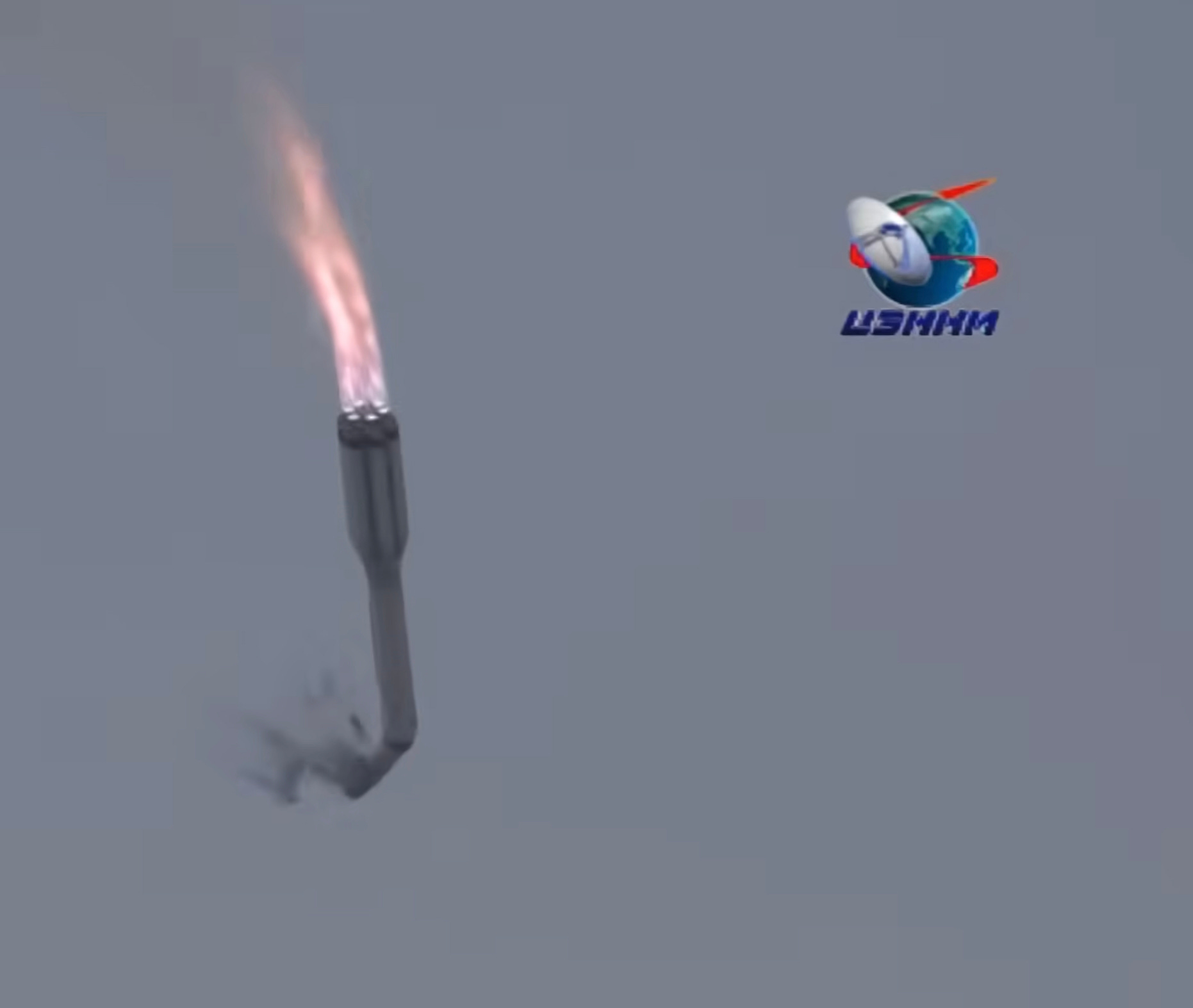
As seen in Cruickshank’s analysis, the planning of the test, and its results, there was a significant separation between the booster and the warhead at the time of the recorded detonation. To simplify this even further, rocket boosters are not designed to ride along with rocket vehicles. The Apollo missions didn’t end with the Saturn V rockets landing on the moon; rather, the diminutive lunar module. The space shuttle didn’t go into orbit with the Liquid Oxygen tank and SRB Motors attached. Launches that have boosters in proximity to–or exceeding–rocket vehicles tend to look like this:56
Since the object in the videos of the Bluegill Triple Prime detonation was not the booster, or the pods, it was unidentified. This was the conclusion at the time in 1962 as well since the UFO–colloquially called a tag along–was what instigated Malmgren to use his position within WSEG to get details on the unknown object. The inquiry also aligns with Malmgren’s U.S. Navy Top Secret clearance, as testimony from David Noble Whitecrow–completely unknown and unrelated to Malmgren–states that he knew, “a second-class diver in Pearl Harbor back in 1962, and his group was called away on a top-secret mission.” Cruickshank, in another study co-authored with Caren Gallaudet and Rear Admiral Tim Gallaudet - U.S. Navy (ret.), detail that the dive:
Chief’s reference to a “top secret mission” for a full complement of divers aligns with the possible contents of COMSERVPAC MSG 290214Z, which ordered the Fleet Ocean Tug USS Abnaki and the Harbor Tug USS Tuscumbia to deploy to the Johnston Island area with YFN-994 covered lighter and Barges 6456 and 6085 in tow.57
Caren Gallaudet (nee Ritter) was herself a U.S. Navy diver who, “graduated with honors as the only woman accepted into the Navy’s Diving and Salvage career path called Special Operations (now Explosive Ordnance Disposal) from USNA in 1991.”58 Her service provided her acute insight into the deck logs from the October 1962 recovery operations stating, “the deck logs of the Safeguard during the recovery operation are ‘very tight lipped’ about the dive operations it participated in with the Point Barrow between 28-30 October 1962.”59 Johnson makes no mention of the work of Navy divers in the recovery, nor Whitecrow’s corroborating account.
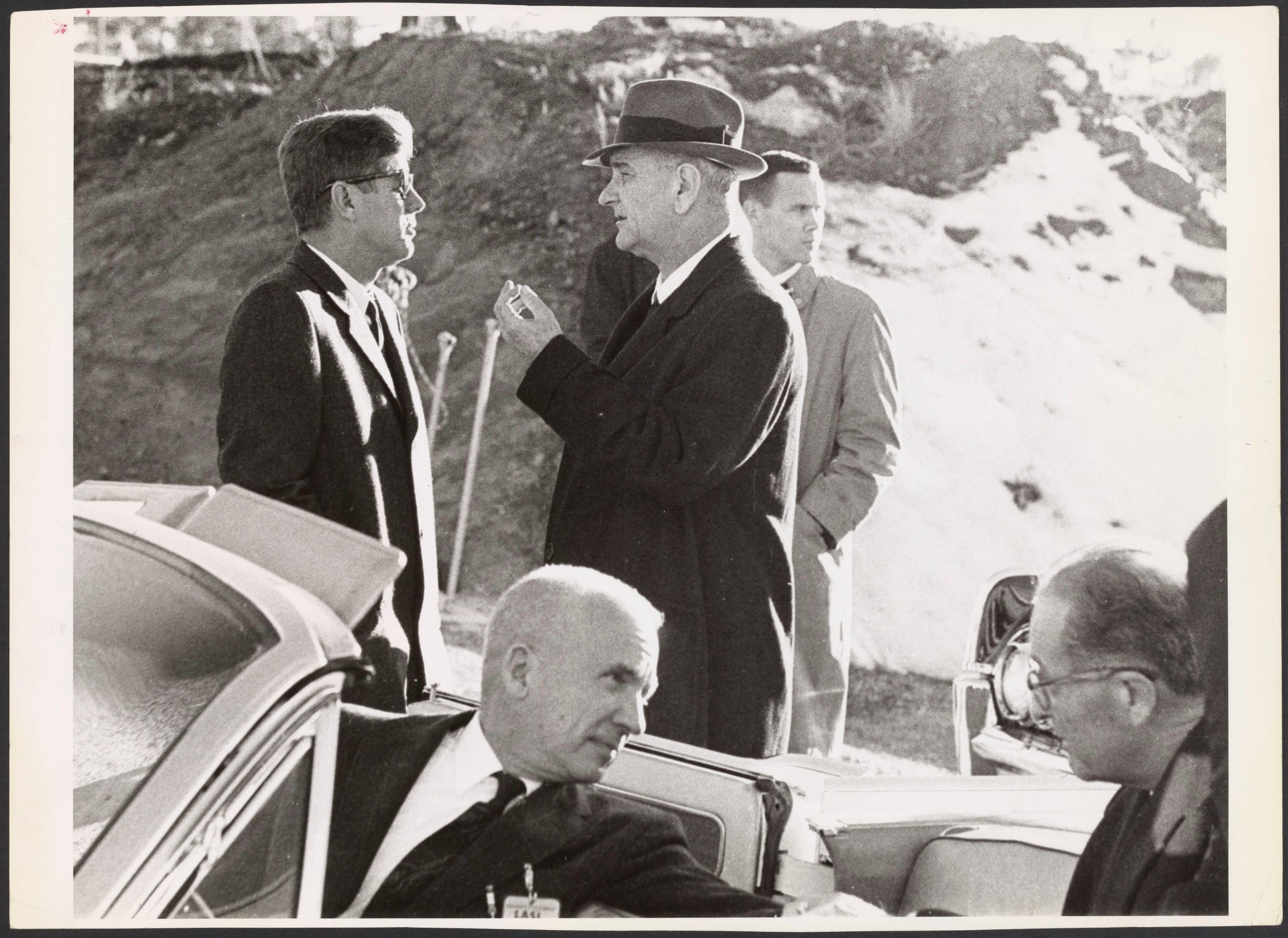
Reviewing the timeline, between 28 October 1962 and 23 November 1962 Malmgren would learn about the ‘tag along,’ culminating with his visit with Lawrence Gise at Los Alamos Scientific Laboratory two weeks prior60 to President John F. Kennedy and Vice President Lyndon B. Johnson jointly visiting61 on 7 December 1962.62 Of note, a president and vice president making any joint visit is an exceptionally rare activity. They take separate planes and cars to ensure continuity of government in case of a disaster. Further, their trip represented two of the three presidents to ever visit Los Alamos, with Bill Clinton being the other.
According to Malmgren, the visit was prompted by the extraordinary debris recovered from the Bluegill Triple Prime event:
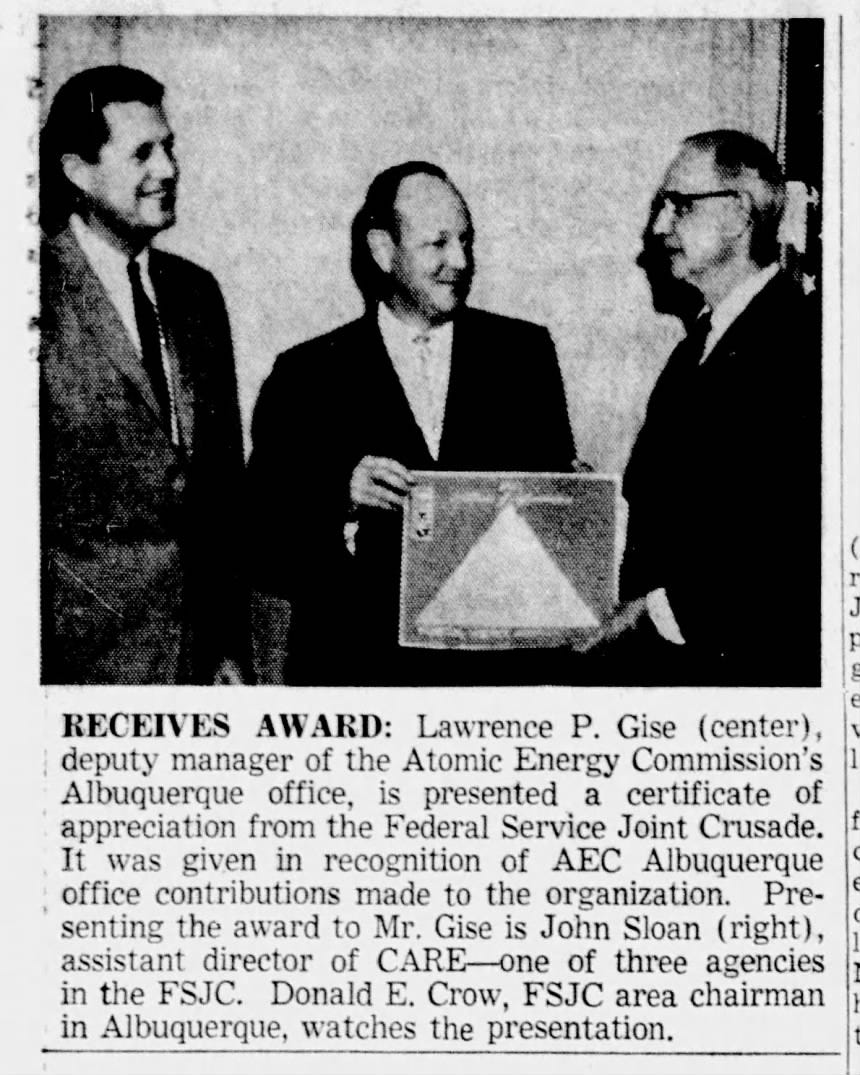
Michels: “When you came out two weeks before [Kennedy and Johnson] what did you find? What did they tell you?” Malmgren: “I met Lawrence Gise63 and he said, ‘I have this letter saying that I can brief you.’ I said, ‘Thank you, because I’m really–” He said, ‘Well test details are controlled by Naval Intelligence. It was interesting,’ he said, ‘They don’t share everything with the Navy Department. They are an autonomous entity. They are more secure than any other intelligence agency. Just be aware, the mighty CIA is not on their fully approved list to circulate.’ So I said, ‘Well what am I here to find out?’ He said, ‘Well..’ and he reached for some stuff sitting on his desk, ‘these are things that have come down.’ I’m looking at, sitting here on his desk, round rocks.” Michels: “So you’re looking at material, anomalous material?” Malmgren: “Yeah.” Michels: “Debris.” Malmgren: “Yeah.” Pippa Malmgren: “Debris or images?” Harald Malmgren: “Debris.”64
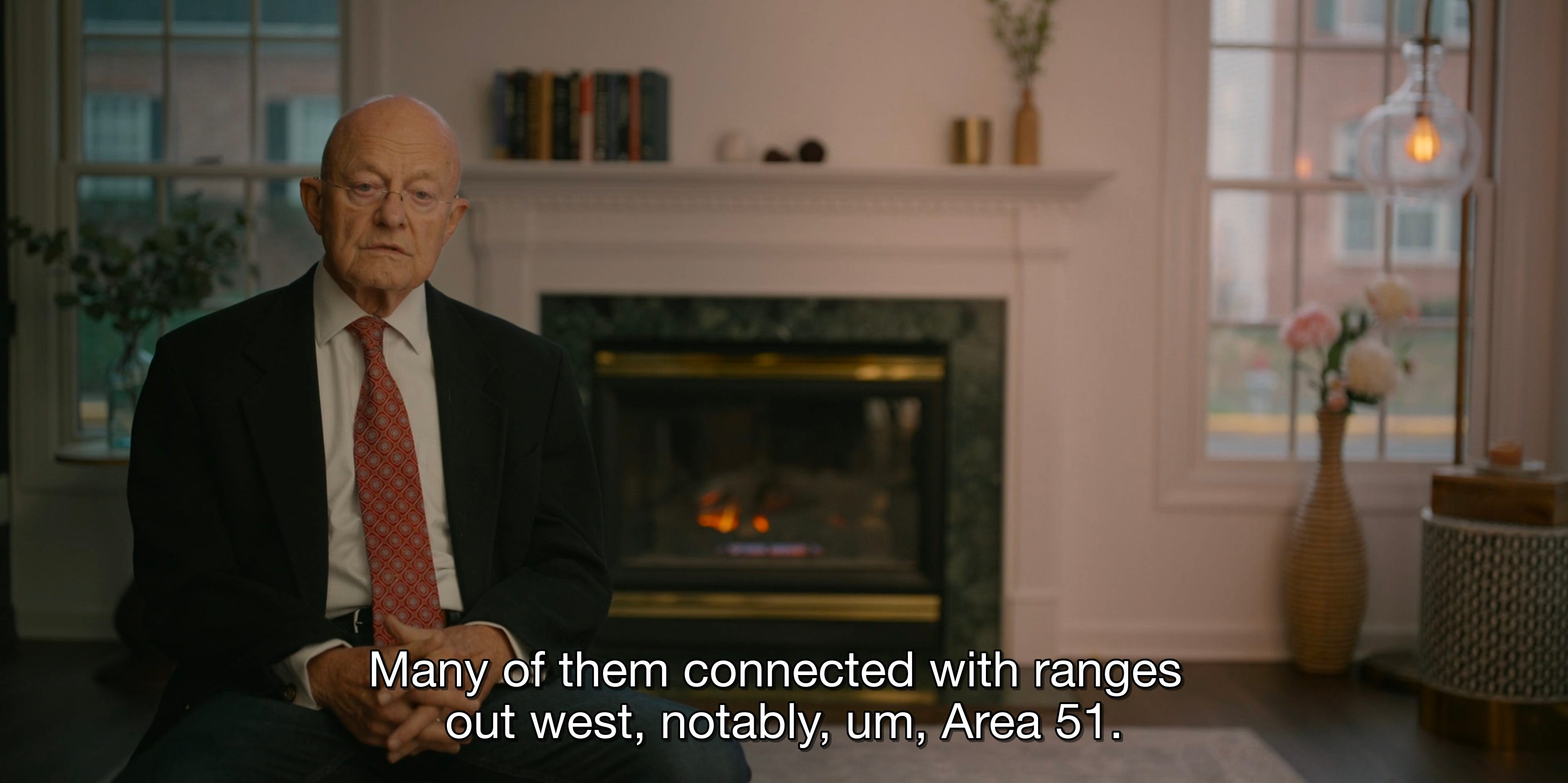
Then–as previously discussed–Bissell, aware of Malmgren’s progress, met with him to have the Malmgren-recounted off-the-record debrief on UAP/NHI in January 1963. From Malmgren’s diary, undisputed government records, and other facts of the timeline, his retelling of events is highly plausible. Following Malmgren’s death, the film Age of Disclosure added further corroborating details when James Clapper stated as chief of Air Force Intelligence he was part of an Air Force investigation into UAP in the same location deeply linked to, and setup by, Richard Bissell: Area 51.65
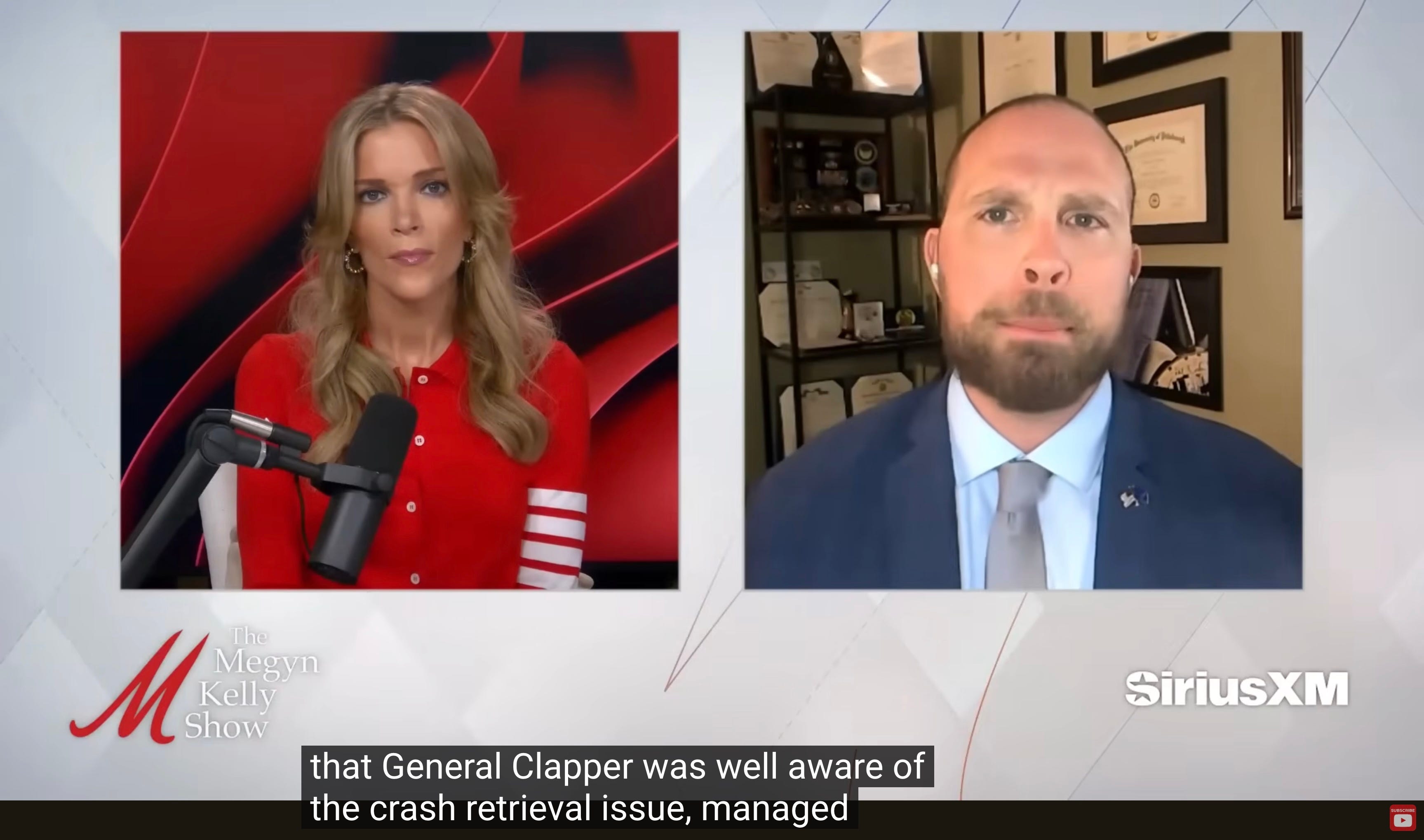
This was followed by David Grusch appearing on The Megyn Kelly Show on 8 January 2026, stating that, “General Clapper was well aware of the crash retrieval issue, managed the crash retrieval issue and when he was the DNI, USDI and DIA director, he placed people in critical roles to manage this issue..both publicly and...non-publicly. General Clapper, Stephanie Sullivan, other folks in the IC...are well aware of this issue, [and] were in rooms discussing this issue.”66
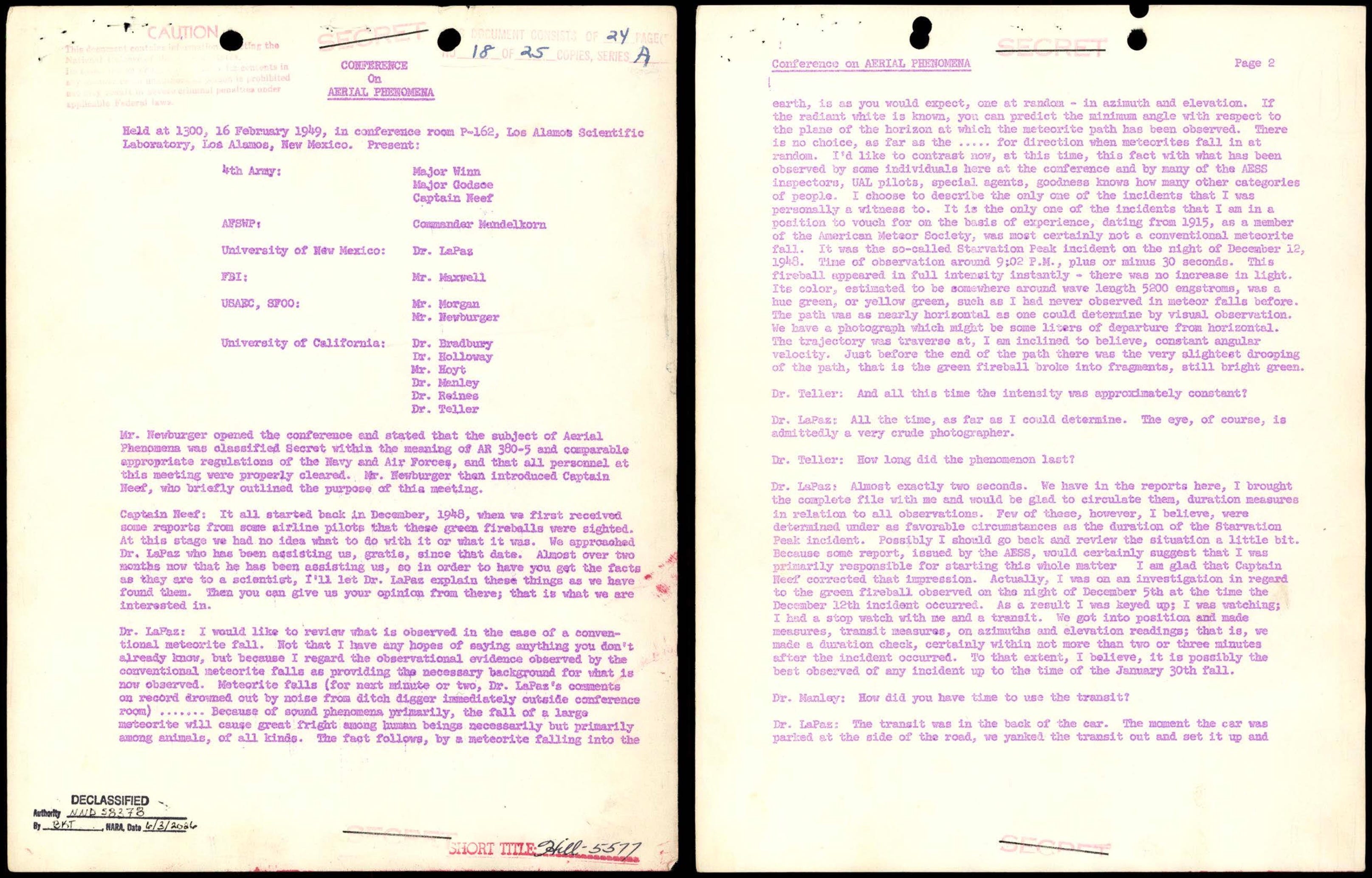
Then, announced in a May 2026 Press Release,67 the Department of War launched the Presidential Unsealing and Reporting System for UAP Encounters (PURSUE). Far from Malmgren’s portrayal by Johnson as a ‘fabulist’, his testimony fits within a continuum of the historical record that preceded him, his contemporaneous accounts, and history as it has played out after his death. To drive home that point, from the very files PURSUE has put forward, there is DOE-UAP-D004_Los-Alamos-Conference-on-Aerial-Phenomena_1949.pdf which details the 1949 deliberations of scientists, intelligence officials, and military personnel at Los Alamos Scientific Laboratory on the topic of “Aerial Phenomena.”68
Only in Johnson’s article–with its already identified omissions–is Malmgren seen as being “engaged in gross fabrications about his jobs, authorities, and associations.” Instead, when the historical record is searched and taken into account, Malmgren was precisely in the correct places at the correct times with the needed clearances to have taken part in the conversations he describes.
Cuban Missile Crisis
In what appears to be an attempt to discredit Malmgren, Johnson combines exaggerations of Malmgren’s testimony regarding his relationship with the Kennedys and McNamara, plus his record dump–from the wrong location–to make it seem as Malmgren was not involved. In the case of the Cuban Missile Crisis, Johnson cites records from EXCOMM and the White House, when Malmgren’s retold interactions were with the JCS at the Pentagon in the recently established Joint War Room:
The Joint War Room Annex, which had been established by the JCS in March 1952 as a means to coordinate the operations of all atomic-capable forces, was operated by the Air Force as an adjunct to the AFCP. It was not until after the crises of 1958 that the JCS would assume control of the Joint War Room Annex and, finally, in August 1959, would establish their own Joint War Room. In December I960, the AFCP finally gave up its Joint and national responsibilities.69
Due to the relationship of IDA with the JCS Weapons Systems Evaluation Group inside the Pentagon, this seems obvious, but it is further cemented by Malmgren’s diary and his testimony that, “suddenly the Cuban Missile Crisis unfolds, and I get a call, ‘Bob wants you to work directly with a small group in the war room.’ I said, ‘What’s the war room?’ ‘It’s where the generals meet and decide: go, no go. Because they have the weapons. The White House doesn’t have them.’”70
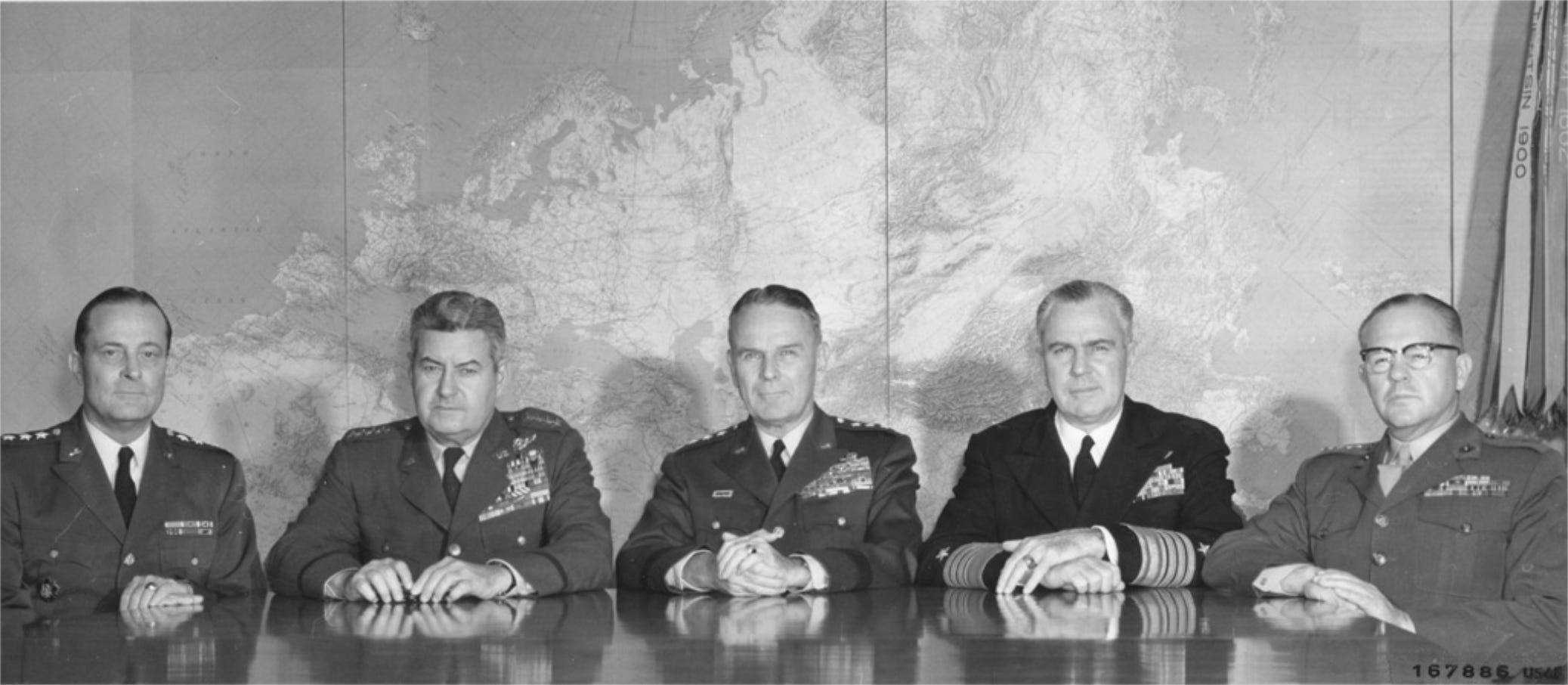
In other words, Malmgren was at the Pentagon, not the White House. His retelling of his ‘appointment’ as a liaison was likely about as formal as being declared a Whiz Kid. Factually, he was an IDA consultant, again with the overarching goal of being an adviser to the Office of the Secretary of Defense. Thus it makes sense that he could stand in and buy time for the SecDef within the Pentagon while McNamara and team were occupied at the White House.
For McGeorge Bundy, Malmgren’s year at Harvard was while Bundy was Dean of Students and active in the academic competition for people like Malmgren as a doctoral graduate. That Malmgren graduated from Yale with a senior year spent in the Scholars of the House adds further credence to the idea that Harvard would be inclined to offer him a Ph.D track based on producing published work. As unusual as this may seem, Harvard has similar odd instances of granting doctoral degrees. Take NRO legend James G. Baker’s example:
He received his PhD in 1942 from Harvard in rather an unusual fashion, which is worth retelling. During an Astronomy Department dinner, Dr. Harlow Shapley (the director) asked him to give a talk. According to the “Courier-Journal Magazine”, “Dr. Shapley stood up and proclaimed an on-the-spot departmental meeting and asked for a vote on recommending Baker for a Ph.D. on the basis of the ‘oral exam’ he had just finished. The vote was unanimous.”71
Likewise, Kennedy, a Harvard grad–and plausibly hearing recommendations from Bundy, McNamara, Schelling, Bissell and others as to Malmgren’s talent–could have gone along with Malmgren being their young, informal point man within JCS at the Pentagon during periods of the Cuban Missile Crisis when McNamara or his deputies were tied up at the White House. Malmgren doesn’t describe this role gloriously, “They’re not going to be eager to hear from this young squirt.” And likewise getting less than exalted instructions, “Don’t tell them what you think should happen. Ask a lot of questions.”72 Succinctly: stall.
Malmgren’s retelling certainly doesn’t sound like Johnson’s description that he “cast himself as a prime mover of events.”73 Rather Malmgren’s version tracks with his other retellings as being a go-between, or, at best, a safe pair of hands familiar to the more academically oriented Kennedy administration. This aligns with his later clarification that his “interaction with JFK and Bobby was very limited.” So while Malmgren would absolutely qualify as ‘senior’ based on his GS grading and ‘advisor’ in his role as an IDA consultant to the Secretary of Defense, he never portrayed himself as a Rasputin whispering in Kennedy’s ear. Reading Johnson you could be forgiven for thinking otherwise.
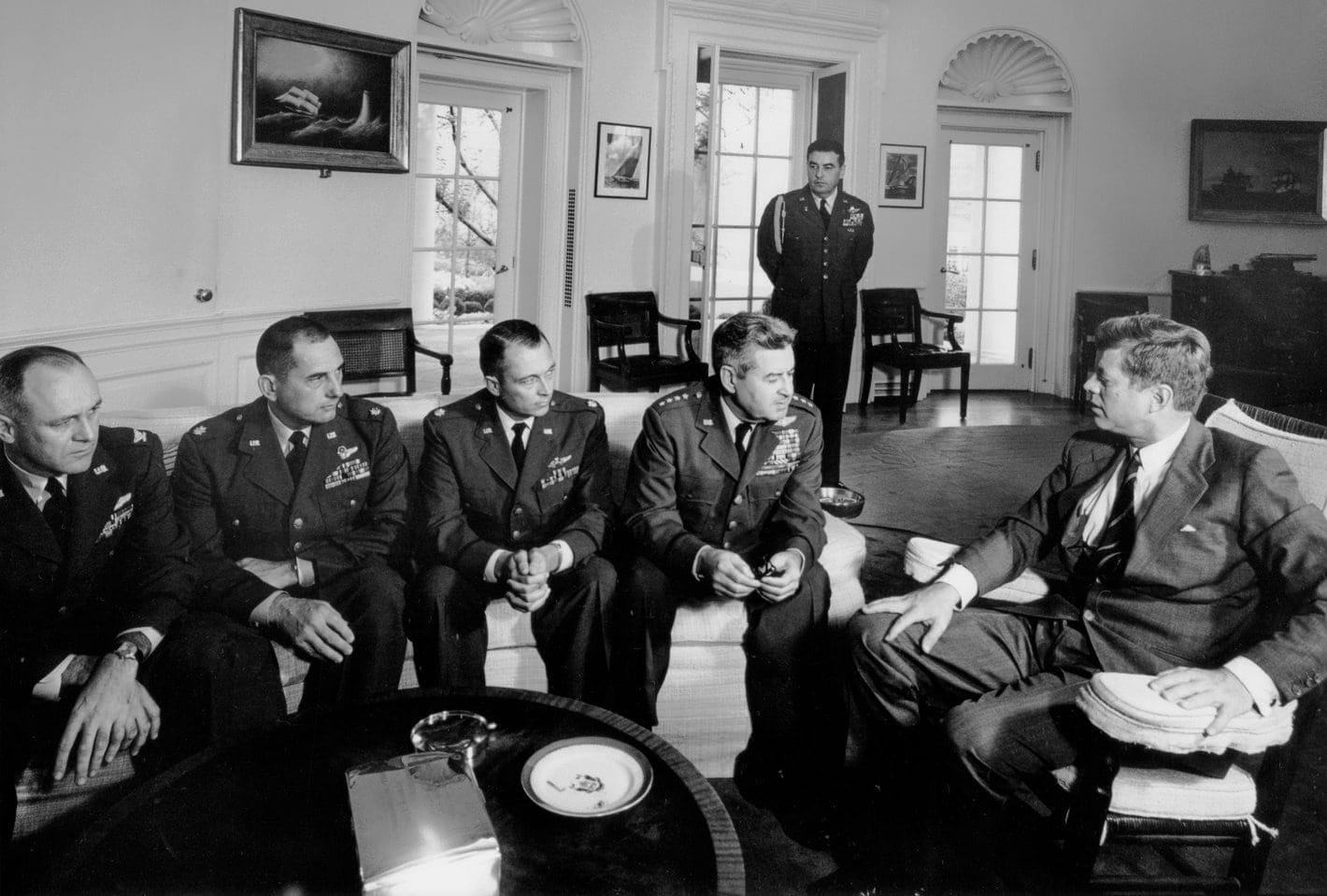
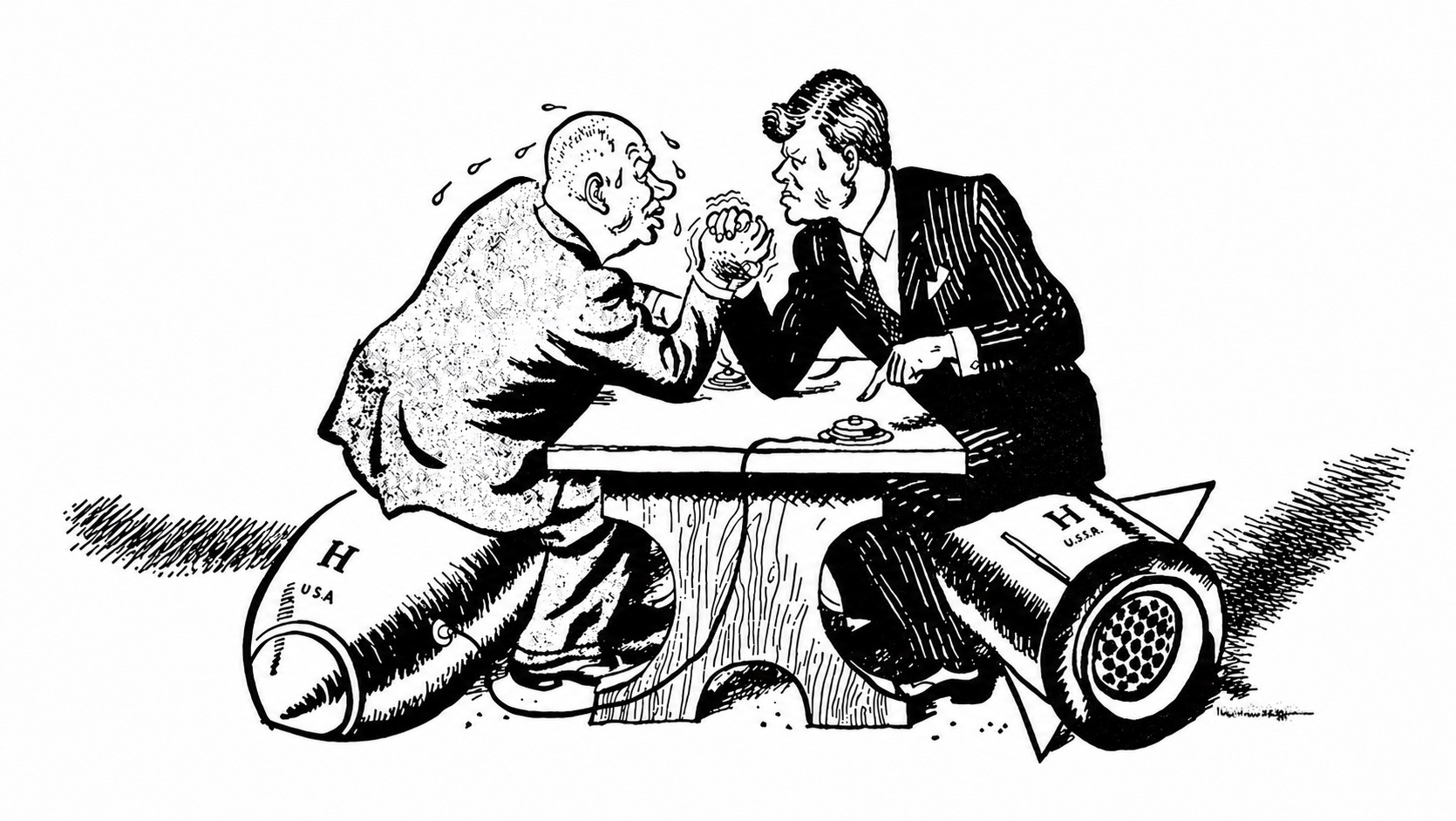
The rest of the Cuban Missile Crisis doesn’t need rehashing. If Malmgren found success in stalling, then he was on the right side of history with several others. Did he save the world? No more so than Vasily Arkhipov, Krushchev, JFK, McNamara, Dobrynin,74 Gen. Taylor, Bundy, the many boat captains who turned away from the blockade, and nameless others. Curtis LeMay never seemed to learn that lesson though, as McNamara recounted:
“After Khrushchev had agreed to remove the missiles, President Kennedy invited the Chiefs to the White House so that he could thank them for their support during the crisis, and there was one hell of a scene. LeMay came out saying, ‘We lost! We ought to just go in there today and knock ’em off!’”75
The Clearance Q
For the era (1962-1972) it is not surprising that Malmgren’s FBI file could miss the Q Clearance. Especially since his investigation at that time (1970) was not in relation to the Atomic Energy Commission or a Restricted Data handling role. In fact, by then the FBI were not the primary agency in charge of running Q Clearance investigations.76 That office was the Civil Service Commission.77 This is even an element of the FBI file itself. First, the FBI file cites an earlier Civil Service Commission investigation, “The files of the Bureau of Personnel Investigations, Civil Service Commission, indicate that during an investigation conducted by the Civil Service Commission concerning Dr. Malmgren in 1965, Frank H. Golay, Professor of Economics, Cornell University, Ithaca. New York, was interviewed.” Second, the other government agencies listed as searched for security information do not include the Atomic Energy Commission because by this time the FBI had a security and defense investigation mandate only.
Further, just prior to Malmgren’s hiring at IDA, the Kennedy Administration emphasized the use of the Civil Service Commission in the investigation of contractors:
On April 30, 1962 the White House issued a Report on Government Contracting for Research and Development, approved by the President, that set forth general policy guidelines for government contracting with private institutions and enterprises for scientific and technical work…the SecDef, the Administrator of NASA, the Chairman of the AEC, the Director of the National Science Foundation, the Chairman of the Civil Service Commission, and the Special Assistant to the President for Science and Technology…had been directed by the President to review the growing use of contractors to operate R&D facilities and programs, perform analytical studies and services, and provide technical supervision of weapons systems and other programs, with a view to recommending policies.78
On top of this, the Department of Energy–and Atomic Energy Commission before it–had historic problems in issuing security clearances, screening, records keeping, and timeliness related to its Q Clearance program. This is perhaps typified in the June 1999 report, “Science at its Best - Security at its Worst” which summarized, “At the birth of DOE, the brilliant scientific breakthroughs of the nuclear weapons laboratories came with a troubling record of security administration. Twenty years later, virtually every one of its original problems persists.”79
Looking more closely at the types of security issues AEC and DOE struggled with is even more revealing:80
DOE Inspector General reports in 1990 and 1991 found that one of the weapons laboratories had granted “Q” clearances (which provide access to U.S. government nuclear weapons data) to more than 2,000 employees who did not need access to classified information.(28) A 1992 report to the Secretary of Energy noted that “DOE grants clearances requested by its three major defense program sponsored labs based on lab policies to clear all employees regardless of whether actual access to classified interests is required for job performance.” (29)
28. DOE/IG/WR-B-91-08, “Review of Contractor’s Personnel Security Clearances at DOE Field Office, Albuquerque,” September 1991.
29. DOE, “Office of Safeguards and Security, Report to the Secretary: Status of Safeguards and Security,” February 1993
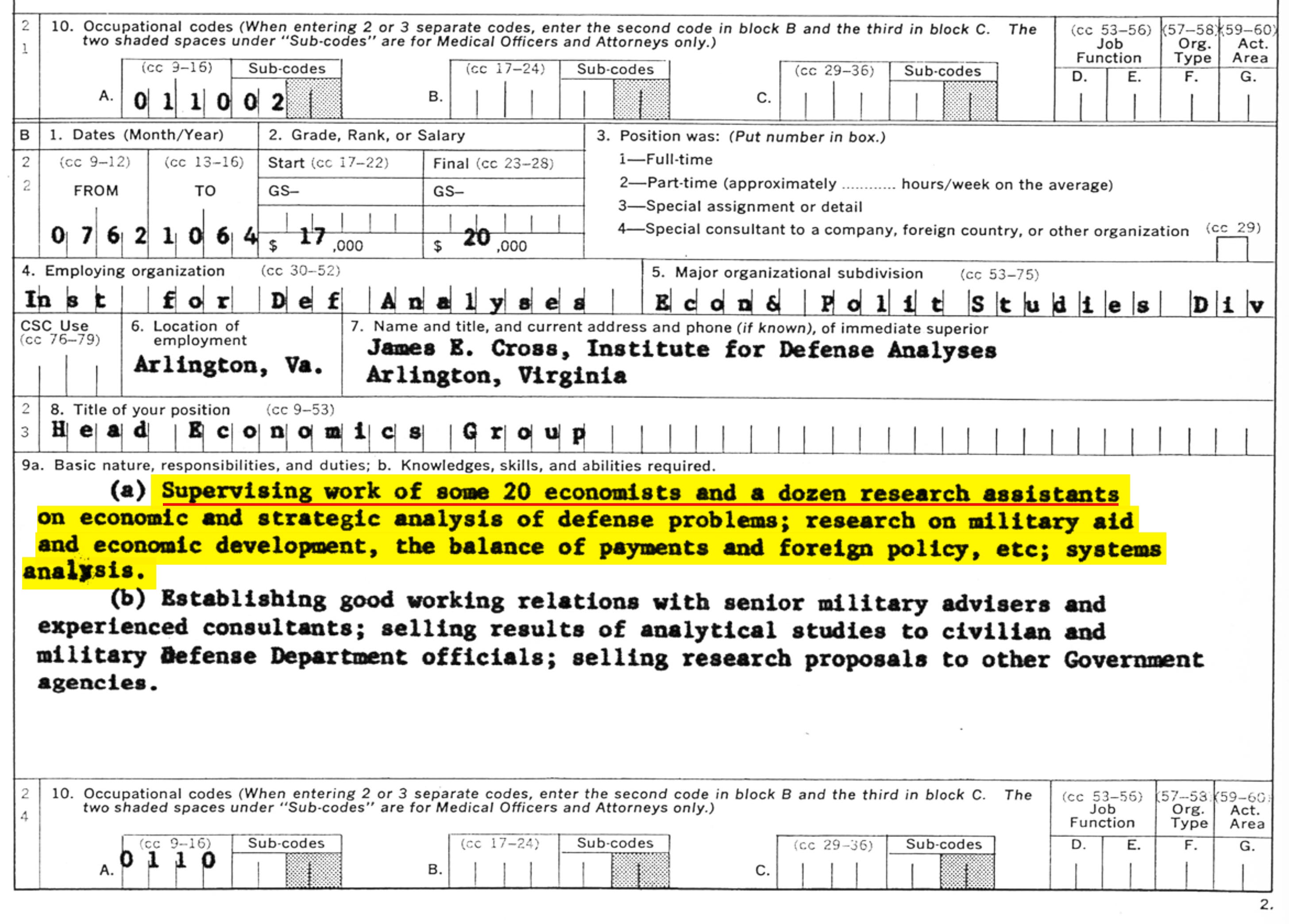
So when Malmgren says “they gave me a blanket Q clearance”81 the ‘blanket’ very well could have been applied as part of IDA broadly, or the WSED / WSEG compartment specifically. As seen prior, IDA Economics Group coworker Donald B. Keesing worked with Restricted Data while a Malmgren colleague–and personal reference–James E. King Jr. was likewise Q cleared. Recall that Malmgren became Head of the Economics Group in the latter half of 1963 so would then be Keesing’s boss. As head of the group he supervised 20 economists and 12 research assistants. This group produced Restricted Data research–proven with the example from Keesing–so a management role overseeing the Restricted Data research would necessitate a Q Clearance.
History offers another surprising instance of a managerial role conferring a Q Clearance:
[Ronald] Reagan’s tenure as governor also provided direct experience regarding classified material and security clearances, since his duties included oversight of Lawrence Livermore National Laboratory—a national resource for nuclear research—which required Reagan to hold a “Q” clearance granted by the Atomic Energy Commission.82
Reagan certainly wasn’t a scientist or engineer, and neither was Keesing, but both had Q clearances.
The elevated security status of WSED / WSEG–due to being focused heavily on nuclear weapons– also deserves recognition, by 1964:
…the Washington divisions of IDA were consolidated in quarters in a new IDA building at 400 Army-Navy Drive in Arlington, Va., directly across from the Pentagon. WSEG moved into the new building as well, joining WSED in occupying three separate floors of the building. WSEG and WSED staff members worked in co-mingled offices under WSEG security control, and also utilized a small suite of WSEG offices in the Pentagon for liaison and on-site study requirements. The remainder of IDA operated in separate office space in the new building under an IDA industrial security system.83
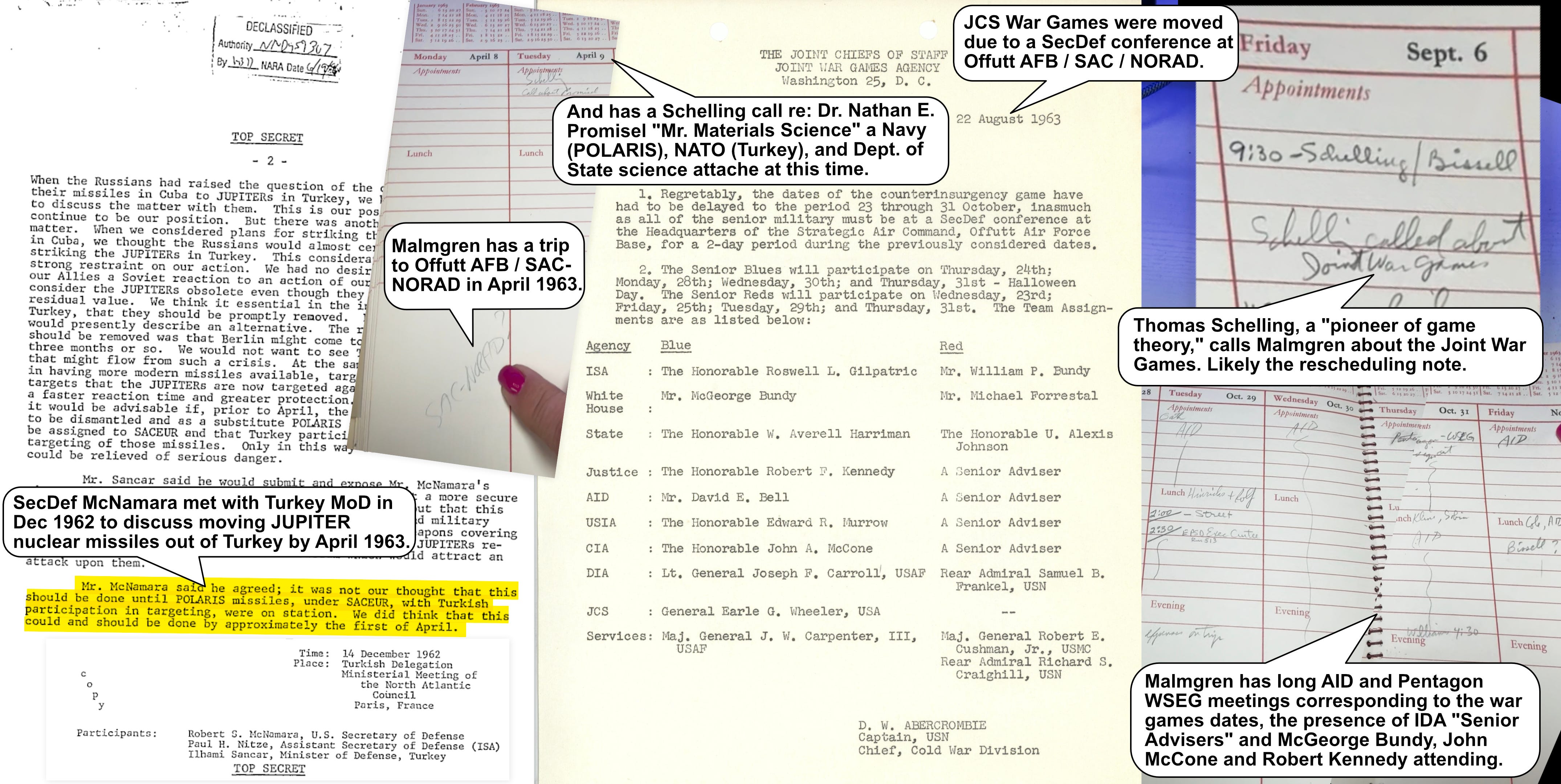
Next, take a close look at this sequence of events related to nuclear missiles and war planning, all highly indicative of Q cleared work. It begins with SecDef Robert McNamara meeting with İlhami Sancar, Minister of National Defense of Turkey to discuss the removal of the U.S. supplied and managed JUPITER nuclear missiles stationed in Turkey following the Cuban Missile Crisis. McNamara tells Sancar that the move will be “done by approximately the first of April.”84 Then, in a letter from Patricia Malmgren to her mother she writes Harald is leaving “next Monday for a three day trip to Omaha of all places!”85 This corresponds with Malmgren’s diary entry of “SAC/NORAD?” on Monday, 8 April 1963 with Strategic Air Command (SAC) being housed at Offutt Air Force Base in Omaha Nebraska. That trip is also in conjunction with a call to Thomas Schelling about “Promisel”, i.e. Dr. Nathan E. Promisel who was nicknamed “Mr. Materials Science” and had this CV at the time:
From 1940 to 1966, Nate was chief materials scientist and engineer for the Navy Department in Washington, D.C. From 1955 to 1964 he was the recipient of outstanding accomplishment awards from the Navy Department. From 1959 to 1971 he was member and chairman of the NATO (AGARD) Structures and Materials Panel. In 1962–1963 he was science attaché at the U.S. Embassy in London.86
Later in the year, the delay for Joint Chiefs of Staff and IDA managed 1963 Joint War Games was because “all the senior military must be at a SecDef conference at the Headquarters of the Strategic Air Command, Offutt Air Force Base, for a two day period for the previously considered dates.”87 This delay, noted in a 22 August 1963 JCS memorandum, was followed by a Schelling call to Malmgren about “Joint War Games” on 6 September 1963, likely telling him about rescheduling the event. Then at the time of the Joint War Games, Malmgren had all day bookings for AID at the Pentagon related to WSEG. Corresponding with Malmgren’s likely war games attendance were several noted “Senior Adviser” roles–i.e. IDA advisers–which would be part of the Red Team in the games. Also scheduled for attendance were McGeorge Bundy, John McCone, and Robert F. Kennedy. That Malmgren’s contemporaneous 1963 calendar entries align so closely with these now declassified Top Secret events is a defining factor for the accuracy of the diary and Malmgren’s own credibility and record keeping.
Again, thanks due to Johnson for getting federal files that so clearly display Malmgren’s Top Secret clearances, work with RAND, IDA, and connections to Bissell, Schelling, Enthoven, etc. But Malmgren’s Q Clearance investigation files would have come from 1962 and from the Civil Service Commission, not the FBI–especially since Malmgren’s records show zero loyalty or espionage concerns. The outline of an earlier investigation is in the FBI file reference to the 1965 Civil Service Commission work, but this would have come at a time when Malmgren was entering the Office of the Special Representative for Trade Negotiation, and not requiring a Q clearance investigation like when entering IDA and WSEG. Complicating matters is the integrated security features of IDA WSED and Pentagon WSEG personnel as well as the AEC and DOE’s historic troubles related to clearance management. Finally, oral Q clearances like the one for Mc Cord further cloud record searches.
In short, from the primary source material, Malmgren was obviously working on areas that were managed as Restricted Data: Anti-Ballistic Missile (ABM) defense, Air Defense of the North American Continent (ADNAC), Ballistic Missile Defense (BMD), Intercept, SAC, NORAD, etc. He was supervising Q-cleared and Restricted Data handling personnel. He was working inside the Pentagon alongside officials concerned with nuclear weapons within the Weapons Systems Evaluation Group. And he was writing papers for IDA concerned with the same.88 It would be more shocking–and a serious lapse–if somehow he was not Q-cleared.
Not So Boring Economists
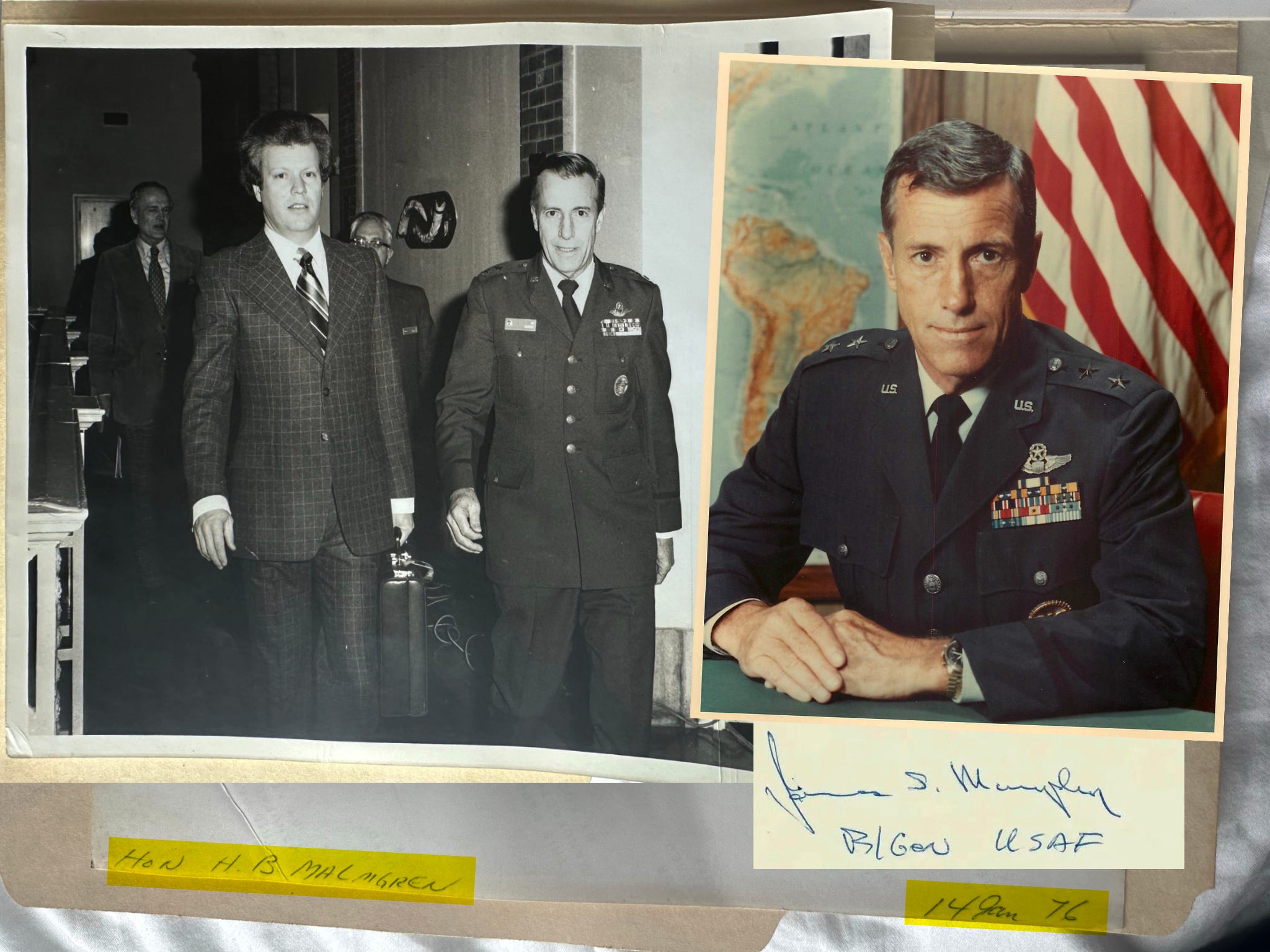
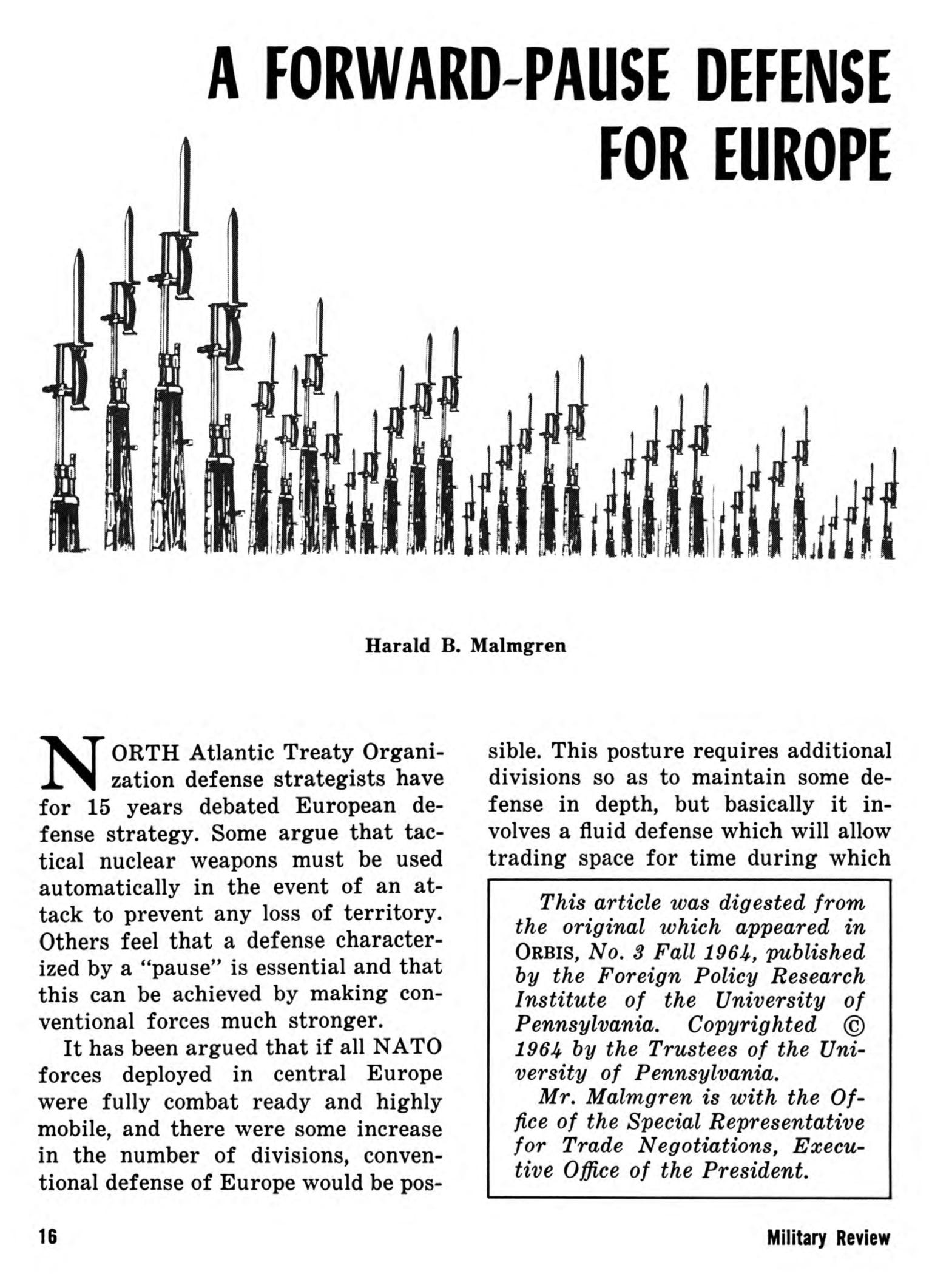
“Some years ago he began to make up an alternative, much more exciting version of his life” states Johnson near the close of his introduction to Malmgren, but from the record we know for the entirety of his government career from RAND in March 1962 onward, Malmgren operated with clearances and–save five months out of hundreds–a Top Secret clearance. He was in the Pentagon working for the WSEG during the Cuban Missile Crisis, the latter half of Operation Dominic, and nearly all of Operation Fishbowl. His bosses–Richard Bissell at IDA and Robert McNamara as Secretary of Defense–were likewise economists with compartments full of clandestinely covered work. Long time mentor Thomas Schelling, a pioneer of game theory, was another economist and future Nobel-prize winning one at that. But why? Why all the import, accolades, and excitement around economists? Two major reasons surface: they helped win the Cold War, and economics was a prime field for intelligence and covert operations.
The United States did not roll tanks over the Berlin Wall or–as LeMay would have preferred–carpet bombed eastward from there to break up the USSR. Rather, those walls crumbled from within. Facing continued economic pressure for decades in a race between nations, the USSR capitulated, unfit and unable to keep up with the growing disparity in the West from citizens’ standard of living to advancing military prowess. The tipping point came in the 1980s, as the Berlin Wall crumbled in 1989, elections swept Eastern Europe in 1990, and 1991 saw the dissolution of the USSR. The decades prior set those events in motion, and it began just as soon as World War II ended, if not earlier.
Fittingly, the economist at the nexus of this beginning–Harry Dexter White–also carved out molds of Cold War economist and spy, on both sides no less:
The Venona decrypts listed sources including the code names ‘Richard’, ‘Jurist’, and ‘Lawyer’ in many Soviet cables between 1944 and 1946. Richard, Jurist, and Lawyer are now known to be cover names for Harry Dexter White, confirming that he had indeed been known in the Soviet networks; had received instructions from Soviet Intelligence; had leaked US State and Treasury papers on foreign policy, military matters, and monetary proposals; had lobbied the Administration for concessional treatment of the Soviet Union; and had promoted and protected other sympathizers.89
Venona, a World War II program initiated by the Signals Intelligence Service and later run by the NSA,90 focused on decryption of intelligence messages transmitted by the Soviet Union. Harry Dexter White, who helped shape U.S. economic policy at the end of the war and establish the International Money Fund and World Bank was also a Soviet sympathizer, if not outright agent.91 Thus from the beginning of the Cold War, economics and spying were inextricably joined.
Coming in on the timeline after White were heavy weights like Bissell, John von Neumann, and Schelling who doggedly pursued economic victories within the CIA and other U.S. military industrial settings. Malmgren directly worked with two of these three and became part of the growing efforts in trade and development that expanded US gains globally in the 70s and 80s. Author of “Confessions of an Economic Hit Man,” John Perkins, fits into this timeline as well, beginning in 1963 and purportedly operating in conjunction with the NSA.92 Pippa Malmgren wrote of her father’s efforts in this era, “Drawing on the ideas of his academic mentor, Tom Schelling — who later won the Nobel Prize for his idea of game theory — Harald concluded that for each dollar spent on a hypothetical ABM system, it would cost the adversary roughly seven dollars to penetrate it.”93 Meanwhile RAND continued to focus and press on macroeconomics and systemic vulnerabilities, while IDA targeted the cost-exchange ratios of military technology.
With a framework in place, the Reagan-Bush Administration aggressively pushed these economic and military technology factors to a level of disparity that was too much for the Soviet Union to bear and its empire imploded with most of its satellites joining into western economies.
Malmgren progressed steadily in these times as well gaining in rank and grade within the Executive branch of the U.S. government, serving presidents Johnson, Nixon and Ford at what would soon after become the Senior Executive Service level, gaining the title and role of Ambassador, and then returning to the private sector to again teach and lobby as an international trade specialist.
A Diagnostic Shift
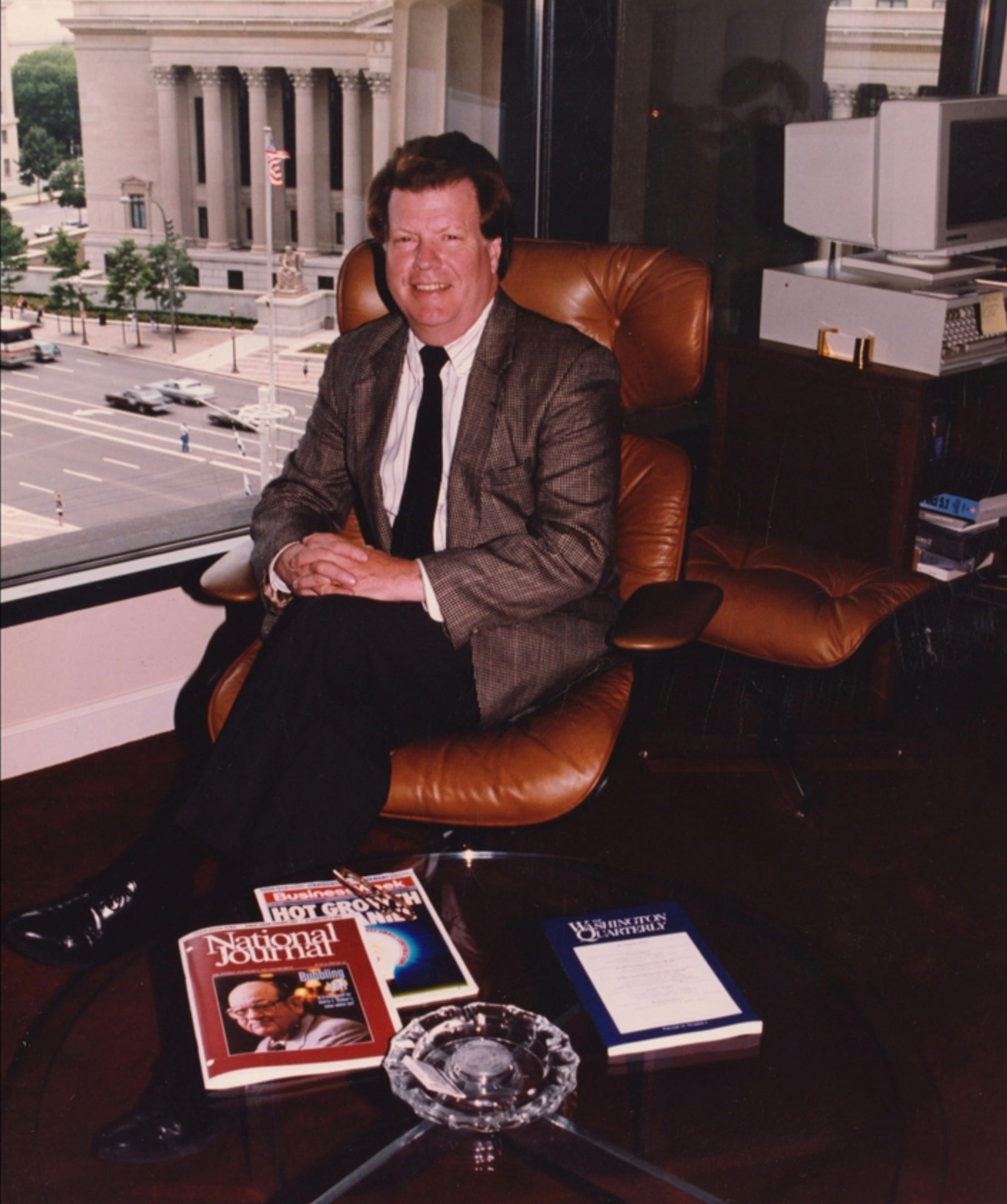
Perhaps one of Malmgren’s most consequential tweets is one that has not been knowingly acknowledged in other reviews of his life,94 namely his 13th year anniversary announcement on 26 July 2024 of his recovery from Stage IV throat cancer:
13 years ago I had just completed months of arduous, physically debilitating radiation and chemotherapy treatment of Stage IV cancer in my throat at Sloane Kettering in NY, evading death but with half my previous weight barely capable to walk, when my eldest daughter @DrPippaM persuaded me to exercise my brain with Twtter, now X, conversation with the world, providing my reflections on US and global change as therapy.95
Prior to the cancer battle, Malmgren had a deeper voice, markedly different to the one most were familiar with when seeing his interview with Jesse Michels on 23 April 2025. It began to degrade steadily following the therapy, but is still noticeably more robust in 2017 from his 21 April interview with Jacob Shapiro:
In that same year, on 16 December 2017, the New York Times published, “Glowing Auras and ‘Black Money’: The Pentagon’s Mysterious U.F.O. Program.”96 Malmgren would likely have some ideas as to the Black Money angle.
Still not venturing into the UAP/NHI fray publicly, he had another serious health scare in 2019, “Days after our 2019 London lunch my life again was put in question by aspirational pneumonia. Escaped again, your reminder now tells me time has come to leave behind me some of my exciting, busy life’s lessons.”97 This reminder in July 2023 came about six weeks after the initial whistleblower reveal of David Grusch on 11 June 2023.98 By 2024, Malmgren was regularly discussing UAP and his associated history on X. Luis Elizondo’s book, “Imminent” was released on 20 August that year99 and Harald B. Malmgren would be entering the last half year of his life.
Before his death100 on 13 February 2025 however, he would record an extended interview with Jesse Michels for his series American Alchemy, with the episode being released posthumously on 23 April 2025. At this stage in his life–a cancer survivor facing repeated battles with aspirational pneumonia–Malmgren most likely knew his time was limited. Did he seek aggrandizement and deception in his final moments as Douglas Dean Johnson alleges? Or faced with death, did Harald Malmgren organize his affairs and make his dying declaration? The records collected in this research, and the events that have followed from the Executive branch of the U.S. government, strongly indicate the latter.
The Counter Intelligence Campaign of Dogmatic Skeptics
On the day of the release of the Jesse Michels documentary and interview, Harald Malmgren and Pippa Malmgren’s Wikipedia pages were targeted for deletion by the same Wikipedia editor, “Chetsford”.
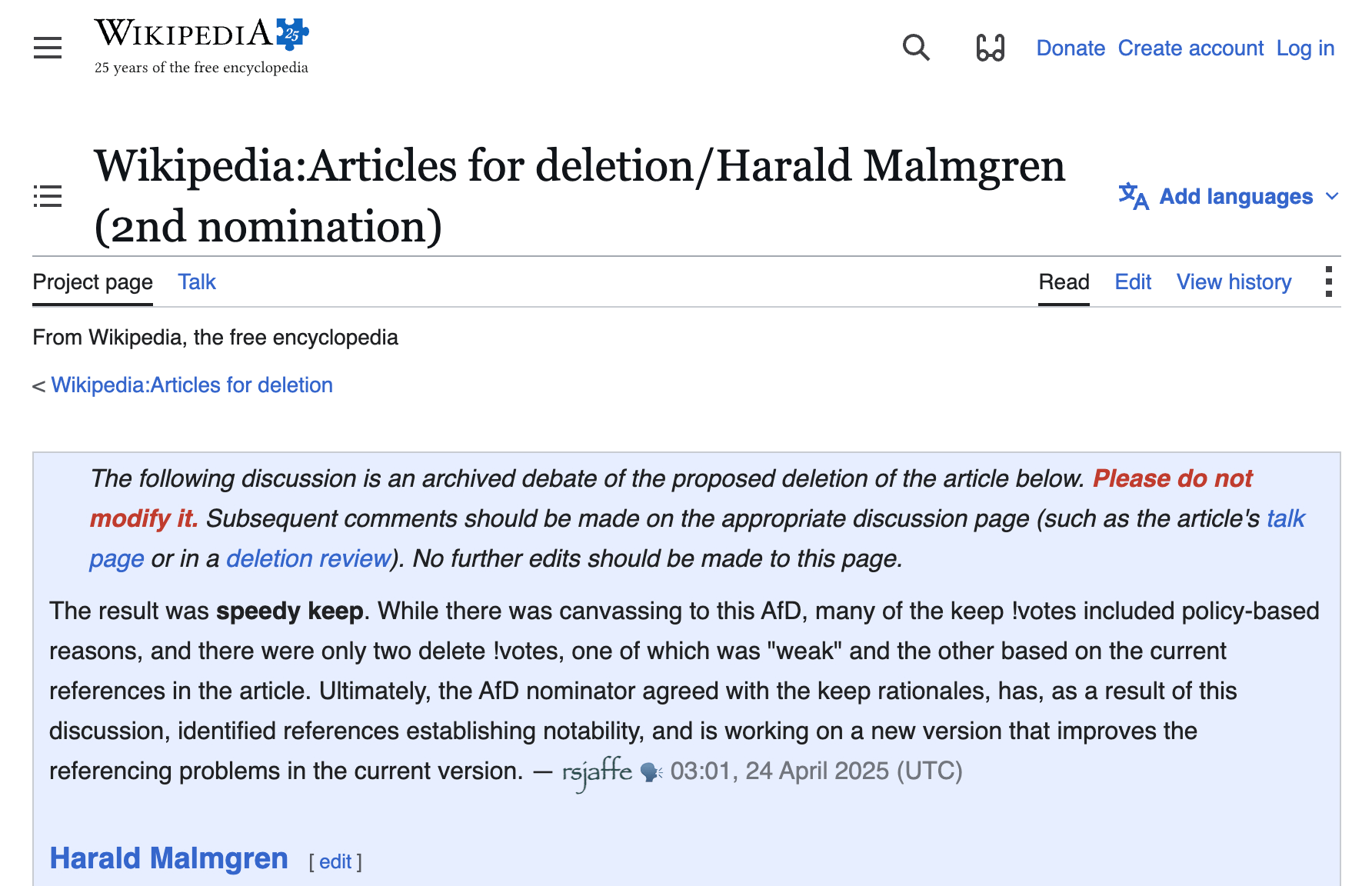
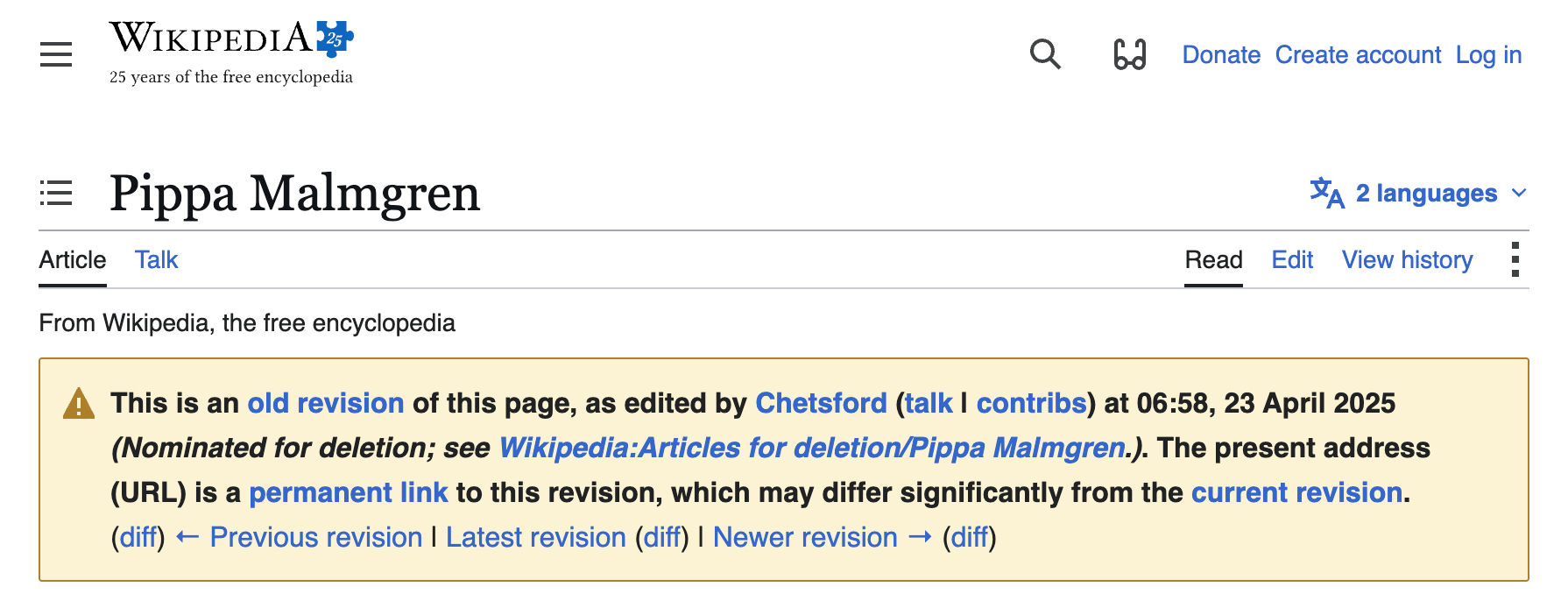
Both were preserved. The overt heavy-handedness of the targeting however brought Wikipedia Co-founder Jimmy Donal Wales into the conversation, stating from his ‘Jimbo Wales’ account on whether or not to Keep or Delete Harald Malmgren’s article:
Keep - the question of whether someone’s views are accurate or “whacky” really has no bearing on the question of notability. Similarly, the popularity that someone might have in “wild corners of the internet” has no bearing on the question of notability. Per Very Polite Person there’s plenty of sourcing out there and there’s no question that the article could be improved. Deletion seems out of the question.--Jimbo Wales (talk) 14:10, 23 April 2025 (UTC)101
Meanwhile, Johnson classified these actions as, “Wikipedia editors had removed some unsubstantiated claims from the encyclopedia’s previously weakly sourced profile of Malmgren” rather than the targeted deletion that was being attempted both on Harald and Pippa Malmgren’s Wikipedia pages immediately following the release of Michels’ video and after Harald Malmgren’s death. Johnson’s own Malmgren piece likewise came after Malmgren’s death, unable to correct the record. Johnson states, “When I started this project in January 2025, I planned to seek an interview from Harald Malmgren before completing this article. However, Malmgren died on February 13, 2025.” I have reached out to Johnson requesting records of any attempted outreach in his research–either to Harald before his death or Pippa following.
After his self-published article, Johnson wrote an op-ed for the Washington Examiner, restating his “journalistic investigation”, yet landing in the opinion section. Finally he promoted his work on the Mick West run Metabunk Forum. A familiar network to those who have studied the dogmatic skeptics: Metabunk, Wikipedia, and writing that definitively states what readers should think.
Picking up the Petty Pieces
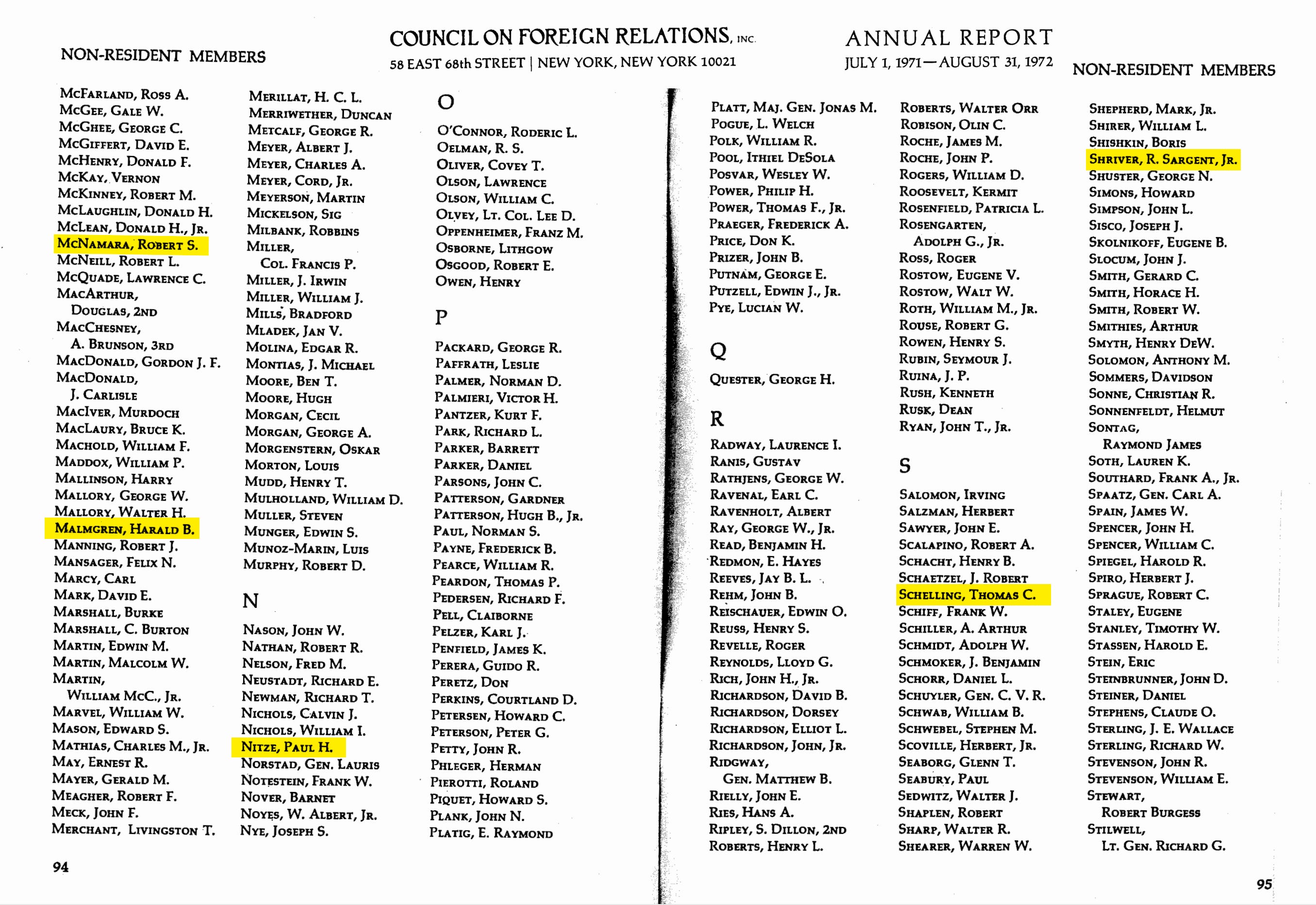
A few remaining items are left from Johnson’s deconstruction. First is the Kennedy circle connection that Malmgren claims was at a ‘go-between’ level with Sargent Shriver, right after Malmgren qualifies any interactions he had with JFK and Bobby as, ‘very limited’.102 Obviously not at the level of pen pals or close friends, but rather passing acquaintances, Malmgren’s claimed workplace connection to Shriver was highly qualified and certainly not a ‘close association’ as inflated by Johnson. Unsurprisingly they didn’t leave a record of writing to each other. Yet, they were not completely without a record of some group connection. From the Council On Foreign Relations’ Non-Resident Members listing, the following share pages 94 and 95: Robert S. McNamara, Harald B. Malmgrem, Paul H. Nitze (Assistant Secretary of Defense for International Security Affairs), Thomas C. Schelling, and R. Sargent Shriver.103 From the noted records, Malmgren and Shriver appear 15 times each, covering 15 years of CFR membership.
Next, the inferred Malmgren claim of a sub-4 minute mile. Inferred is the correct usage because in checking the video and transcript from which the statement surfaces, it is told second-hand by Jesse Michels and not a direct quote from Malmgren. Thankfully, Yale does have an archive of athletics that is available to search in person which should provide a black and white account–or at least some directional weighting–but really not much should be made of this claim. There is a chance that it was something misheard or miscommunicated in a phone call between Michels and Malmgren with the latter suffering aspirational pneumonia and having a severely impaired voice.
Third, the salaries and income tracked by Johnson are left without context of the larger financial picture. As a start, with full scholarships during his schooling, Malmgren had zero debts–as later confirmed in his FBI investigations. More importantly, the IDA starting salary of US $17,400 would place Malmgren in the top 5% of United States income earners in 1962.104
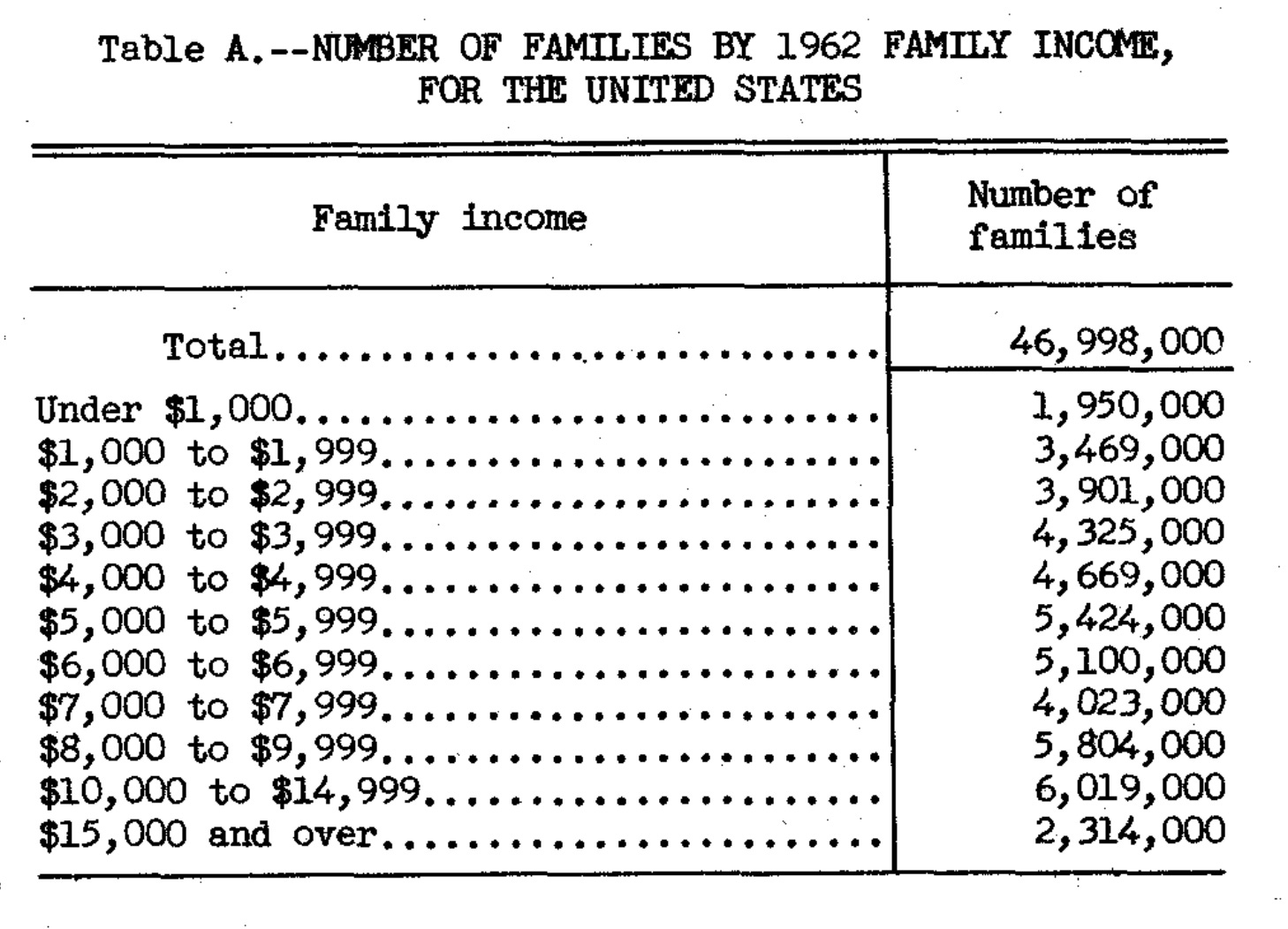
Heading to Washington with zero debts, he was in a position to purchase a suburban home for around $18,000. For cars, a new Ford Galaxie or Chevy Impala of that year would run between $2,600 to $3,000. Civil servants at the highest grade of GS-18 were earning between $18,500 and $20,000 then, so Malmgren’s salary likewise conferred senior status.105
Finally, prior to his RAND and IDA employment, the Evans Professor role was not the “designation of a bottom-tier teaching slot” as Johnson claims, but explicitly an elevated, jointly approved position. It appears Malmgren misremembered or misspoke the name of Gordon Evans as Galen Stone, but accurately described the structure and newness of the professorship he was given. The language, ‘start at the top’ appears to be how Cornell pitched the role.
Conclusion
Harald Malmgren was in the right places, at the right times, with the right background, right clearances, right colleagues, producing the right kind of work to make his retelling of private conversations highly plausible. Through inexplicable twists of logic, Johnson strives to portray the opposite, calling Malmgren’s history lies, fictions, and confabulations. However, Malmgren’s history ties into events beyond his control and aligns with accounts completely separate from his involvement. Since his death, the release of NHI/UAP data held by the U.S. Government has only become more formalized, while other documentaries and DOPSR reviewed works have added to, not disproved, Malmgren’s account. He placed his account in the hands of Senate Intelligence, as recounted by longtime staffer Kirk McConnell, and being privy to classified documentation not yet released to the public, they too found Malmgren to be plausible.106
Malmgren undisputedly earned and rightly held the titles of: Ph.D., Ambassador, Senior Executive, and International Trade Consultant while operating at the highest levels of government at the forefront of the world’s stage. His work is recorded in the records of Congress, Presidential files, and numerous books. From this position, he chose to make a dying declaration that aliens are real, they’re here, and we’ve shot at them with nukes. He is perhaps the most highly ranked and longest serving member of what is now considered the Senior Executive Service, to make such claims. And at a time when more files come to light, more declassifications expire, and an empire built for the mid-century struggles with the present one, Harald Malmgren again appears to be on the right side of history.
In that light, watch–or rewatch–Jesse Michels’ exceptionally well-produced biography with the confidence of knowing the legitimacy of Harald Malmgren’s background. History has already proven that Michels’ work was so well done as to trigger a speedy and aggressive backlash. Yet the people that tried to erase Malmgren following his dying declaration failed, and the government records that corroborate his accounts have only continued to increase.
Appreciations
This deeper look into Harald Malmgren would not have been possible without the help and support of all the people that communicated with me in the process of researching and writing this paper, including: Pippa Malmgren, Geoff Cruickshank, David Burkett, Rob Heatherly, Rob Jones, Matt Ford, Pavel Ibarra, and many unnamed others.
Last, and most importantly, my heartfelt thanks to you, the reader.
It is my hope that this, and coming work, adds to the marvel of our wider universe of knowledge–the scope and scale of which should fill our days with many wonders and abundant curiosity, placing onerous secrets and dogmatic skepticism in a very distant and small perspective.
Any mistakes, errors, or omissions are the fault of this author.
Comments, criticisms and receipts are greatly appreciated.
The overall aim of this writing is that it’s done in a way that makes us all better for life ahead. An effort that Harald Malmgren championed.
May he rest in peace.

Corrections
27 August 2026 - The author incorrectly identified Major General James S. Murphy and Major General John W. Carpenter in an earlier version of this article. Confirmation of the misidentification was received on 27 August 2026 and corrected.
“Department of War Releases Unidentified Anomalous Phenomena Files in Historic Transparency Effort” Department of War, 8 May 2026 https://www.war.gov/News/Releases/Release/Article/4480582/department-of-war-releases-unidentified-anomalous-phenomena-files-in-historic-t/
“Presidential Advisor: “I Directly Handled UFO Material” (Ft. Harald Malmgren).” 2025. American Alchemy, created by Jesse Michels, season 2025, episode 72, Jesse Michels Media, 23 April 2025. YouTube.
“Class of 1953.” Rensselaer Polytechnic Institute, retrieved 13 July 2026, listed in ‘Lost Class of 1953 Alumni’. https://www.alumni.rpi.edu/s/1225/RH/index-4col.aspx?sid=1225&gid=1&pgid=6942
Goldfrank, Walter L. “The Scholars of the House Program at Yale: Praise From the Faculty, Student Criticism.” The Harvard Crimson [Cambridge], 22 November 1958, https://www.thecrimson.com/article/1958/11/22/the-scholars-of-the-house-program/. [According to Sewall, the Scholars of the House program is part of the present tendency in American education to encourage and foster independence and initiative in college students. The program is based on the theory that, for those students with exceptional ability and maturity, “nothing short of a maximum challenge will evoke a maximum response.” The responsibilities of a Scholar of the House are “not for the average, or even the above-average student who has no precisely defined or dynamic interest,” Sewall says. “The program has been designed as both a challenge and a symbol: a challenge to those personally and intellectually equipped to respond, and a symbol, to all the rest, of self-induced scholarly and creative work going on independent of the larger undergraduate framework of compulsions and restraints.”]
Malmgren, Harold B.: Investment, Allocation, Technology, and Economic Development, 1957 https://archives.yale.edu/repositories/12/archival_objects/811916
Hartwig, Daniel, editor. “Guide to the Scholars of the House Program, Yale University, Records.” Yale University Library Manuscripts and Archives, vol. RU 143, no. 1950-1987, 2008, p. 24. Guide to the Scholars of the House Program, Yale University, Records, https://as13dev-new.library.yale.edu/2612.pdf.
Malmgren, Harald B. “Curriculum Vitae“ retrieved 28 July 2026. https://independent.academia.edu/HaraldMalmgren/CurriculumVitae
Ibid.
University, Oxford. 1961. “1961-1962 - Vol 92”. University of Oxford. https://doi.org/10.25446/oxford.25352344
Malmgren, Harald B., and University of Oxford. Social Sciences Division. Information, Expectations, and the Nature of the Firm. 1961. Thesis (D.Phil.)--University of Oxford, 1961. https://solo.bodleian.ox.ac.uk/permalink/44OXF_INST/rl48sd/alma990154230170107026
Lise Arena. Oxford’s Contributions to Industrial Economics from the 1920s to the 1980s. The Palgrave Companion to Oxford Economics, pp.75-100, 2021, ⟨10.1007/978-3-030-58471-9_3⟩. ⟨hal-03290294⟩ https://hal.science/hal-03290294/document
Office of the Dean. Letter to Harald Malmgren. Cornell University, 24 October 1961.
Formation of the Justine M. Evans Memorial Fund. Proceedings of the Board of Trustees of Cornell University - Including the Minutes of Certain Standing Committees July 1, 1959 - June 30, I960. p. 3754 https://ecommons.cornell.edu/entities/publication/84ba3853-e855-419f-b55c-0402b77ba9ea
Ibid. p.3754 “The Fund had been given by Gordon M, Evans, Class of 1906, the income thereof to be used to promote interest in and a knowledge of Economics among engineering students.” [Note: Malmgren explicitly held a uniquely named professorial position “Evans Professor” that required a joint recommendation from two different schools (Engineering and Economics at Art and Sciences) within Cornell University. The role was developed the year prior to his arrival. All elements–apart from the name, Gordon Evans vs Galen Stone–hold to the story as retold.]
Hanley, John T. Jr. (2017) “Changing DoD’s Analysis Paradigm” Naval War College Review: Vol. 70 : No. 1 , Article 5. Available at: https://digital-commons.usnwc.edu/nwc-review/vol70/iss1/5 [Note: During World War II, the United States and the United Kingdom instituted operations evaluation groups, consisting of scientists, to quantify the outcomes of military practices and seek improvements. These groups observed operations, collected data, and created models of military operations analogous to the models they used in scientific endeavors. Following World War II, the U.S. government established federal contract research centers to continue this practice in peacetime. The Navy transformed its Operations Research Group into an Operations Evaluation Group that became the Center for Naval Analyses. The Air Force established RAND. The Army established its Operations Research Office at Johns Hopkins University, which became the Research Analysis Corporation. The Joint Chiefs of Staff (JCS) founded a Weapons Systems Evaluation Group that became the Institute for Defense Analyses. Initially these organizations provided mechanisms for contracting university professors; eventually, they developed permanent staffs.]
Malmgren, Pippa “About Dr. Pippa Malmgren” https://www.pippamalmgren.com/
Johnson, Douglas Dean “Harald Malmgren saves the world: a fantasy set during the Cuban Missile Crisis” and “Harald Malmgren: real-world history vs. grandiose fantasy” Mirador. 2025.
“The Senior Executive Service: Overview and Recent Developments.” Congress.gov, Library of Congress, 18 August 2026, https://www.congress.gov/crs-product/R48932. [Note: “The Senior Executive Service (SES) was established in the Civil Service Reform Act (CSRA) of 1978 as a centralized personnel system of government managers. The vast majority of members of the SES are career appointees who generally comprise the highest levels of leadership within federal agencies, often reporting directly to the Senate-confirmed agency leadership.”]
“Senior Executive Service: Overview & History” U.S. Office of Personnel Management. Accessed 18 August 2026. https://www.opm.gov/policy-data-oversight/senior-executive-service/overview-history/ [Note: The SES includes most managerial, supervisory, and policy positions classified above General Schedule (GS) grade 15 or equivalent positions in the Executive Branch of the Federal Government.”]
Stillman, Richard J. “The Pentagon’s Whiz Kids” United States Naval Institute. April 1966. Proceedings. Vol. 92/4/758. [Note: This article by Stillman was awarded First Honorable Mention Prize Essay 1966.] https://www.usni.org/magazines/proceedings/1966/april/pentagons-whiz-kids-first-honorable-mention-prize-essay-1966
Ibid.
Lewis, Charles. “America’s Frontline Trade Officials” Bloomsbury Academic. 1994 ISBN 0819199214
Harter, John J. Oral History Interview by Charles Stuart Kennedy. READER. 1997. United Nations - Geneva. General Agreement on Tariffs and Trade Team Member Geneva (1966-1970)
President’s Calendar - Robert McNamara. Daily schedules - Daily schedules 23, Folder ID: 1773181, ISAD(G) Reference Code: WB IBRD/IDA 03 EXC-10-4544S, Series: Daily schedules. Sub-Fonds: Records of President Robert S. McNamara, World Bank Group Archives, Washington, D.C., United States.
24 “Alain C. Enthoven — Publications” RAND Corporation https://www.rand.org/pubs/authors/e/enthoven_alain_c.html
“K. V. Smith — Publications” RAND Corporation https://www.rand.org/pubs/authors/s/smith_k_v.html
Johnson, Douglas Dean “Harald Malmgren: real-world history vs. grandiose fantasy” Mirador. 2025.
Hanley, John T. Jr. (2017) “Changing DoD’s Analysis Paradigm, “Naval War College Review: Vol. 70 : No. 1 , Article 5. Available at: https://digital-commons.usnwc.edu/nwc-review/vol70/iss1/5
Gonzalez, Eloisa Ruano “Joseph J. Loftus: Ex-CIA agent was devoted to his family” Orlando Sentinel. 13 November 2010. “In 1949, the CIA recruited him, his son said. The agency was relatively new at the time. ‘The U.S. government was looking for college graduates that had brains. And dad was a smart man,’ his son said.” https://www.orlandosentinel.com/2010/11/13/joseph-j-loftus-ex-cia-agent-was-devoted-to-his-family/
Schutte, John M. “Casting Net Assessment: Andrew W. Marshall and the Epistemic Community of the Cold War” School of Advanced Air and Space Studies. February 2015. “Due to his work on targeting issues, Marshall held a Q clearance—a prerequisite for access ‘behind the glass curtain’ quarantining the Physics Department from the rest of RAND.” https://apps.dtic.mil/sti/tr/pdf/ADA618922.pdf
“Honoring the Legacy of Andrew W. Marshall | AWMF History” Andrew W. Marshall Foundation. 2022. Section: Andrew W. Marshall (1921 - 2019) “His career spanned seven decades, including 25 years at the RAND Corporation before becoming Director of Net Assessment in the Office of the Secretary of Defense.” https://www.andrewwmarshallfoundation.org/about/history/
Conan, Neil “’Dangerous Man’ Daniel Ellsberg Reflects” National Public Radio. 18 February 2010. “Mr. ELLSBERG: You know, it’s - I should correct one thing there. Henry had -Kissinger - had had top secret clearance for many years, as I had in RAND. What I was really telling him was what I have - I’d had a dozen clearances higher than top secret, what are called compartmented information, when I was in the Pentagon.” https://www.npr.org/2010/02/18/123854242/dangerous-man-daniel-ellsberg-reflects
Perkovich, George “Daniel Ellsberg (1931-2023)” Arms Control Association. July/August 2023. “In late 1949, Harry Ellsberg had resigned his lucrative job as a lead structural engineer at a firm that helped build the Hanford plutonium-production plant in Washington state. Yet, Dan never knew why until a conversation in 1978 when his father told him he left the job ‘because they wanted me to help build the H-bomb [and] I didn’t want to make an H-bomb.’ Dan protests that this cannot be correct because President Harry Truman’s decision to proceed with the H-bomb was not made until January 1950, and the whole subject was ‘supersecret.’ His father explained that ‘somebody had to design [the necessary plutonium-production] plant if they were going to go ahead. I was the logical person. I had a Q clearance.’” https://www.armscontrol.org/act/2023-07/arms-control-today/daniel-ellsberg-1931-2023
Thomas C. Schelling – Biographical. NobelPrize.org. Nobel Prize Outreach 2026. Fri. 14 Aug 2026. “At RAND I continued my theoretical work, and went to Washington with a small contingent attached to the staff preparing for a prospective Geneva Convention on Measures to Safeguard Against Surprise Attack. I did not go to Geneva ; I did, however, produce two papers. One, “Surprise Attack and Disarmament,” explored the concept that the problem of nuclear surprise attack was the problem of the advantage, in case of war, of being the side to start it.” https://www.nobelprize.org/prizes/economic-sciences/2005/schelling/biographical/
Friedman, Saul. “The Rand Corporation and Our Policy Makers.” The Atlantic. September 1963. “One of Rand’s distinguished alumni, Harvard professor Thomas C. Schelling, an economist turned strategist, calls Rand the perfect place for an intellectual prima donna. 'University professors go to Rand because the salaries are good, the climate is ideal, there is much prestige in the job, and they can think and write without the nuisance of having to teach.' Some go there for another reason, one which is beginning to influence many aspiring scholars — the desire to take part in power and policy making. 'Rand is an ivory tower that is part of the real world,' says Schelling. 'You’re part of a researching community, but you know your work is going to have an effect on things that are happening in the world.'” www.theatlantic.com/magazine/archive/1963/09/the-rand-corporation-and-our-policy-makers/658922/
McFadden, Robert D. “James R. Schlesinger, Willful Aide to Three Presidents, Is Dead at 85” The New York Times. 27 March 2014 “Over the next decade he became chairman of the Atomic Energy Commission, director of Central Intelligence, a cabinet officer for three presidents (two of whom fired him), a thorn to congressional leaders and a controversial national public figure.” https://www.nytimes.com/2014/03/28/us/politics/james-r-schlesinger-cold-war-hard-liner-dies-at-85.html
Thomas Fraise, “The Magicians of Nuclear Strategy: Ritualized Knowledge Production and the Origins of Strategic Nuclear Thought”, Global Studies Quarterly, Volume 6, Issue 1, January 2026, ksag015, https://doi.org/10.1093/isagsq/ksag015
Johnson, Douglas Dean “Ex-ambassador’s astonishing UFO tales of 1962 wither under scrutiny” Washington Examiner. 20 May 2025
INVESTIGATIONS. Washington Examiner. https://www.washingtonexaminer.com/section/news/investigations/
Harald Malmgren FBI File. 161-HQ-7038-1, NW 89007 Docld: 34687837. Federal Bureau of Investigations. Screened by NARA (RF) 05-09-2025 FOIA #89007 p.11
Central Intelligence Agency, "Subject: MC CORD, James Walter Jr." 7 August 1962. Document ID: 104-10124-10007, National Archives, https://www.archives.gov/files/research/jfk/releases/2022/104-10124-10007.pdf
Central Intelligence Agency, "Subject: MORALES, David Sanchez" 22 March 1965. Document ID: 104-10121-10285, National Archives, https://www.archives.gov/files/research/jfk/releases/2022/104-10121-10285.pdf
ISCAP Appeal No.: 2012-034. Document No.: 5. Custodial Agency: Harry S. Truman Presidential Library and Museum. Date of ISCAP Decision: September 20, 2013. Title and Date: From Hillenkoetter, April 19, 1948. Pages: 1. Classification: Top Secret - Codeword. ISCAP Declassification Decision: Affirmed the classification of the document in its entirety. Classification Category: E.O. 13526 §3.3(h)(2) as 50X1. Agency tracking number: Truman NLT 2005-003 document 8. Contact: Harry S. Truman Library 500 W. US Hwy 24 Independence, MO 64050-1798 https://www.archives.gov/declassification/iscap/pdf/2012-034-5
Harald B. Malmgren, Diary, 1963, Harald Malmgren Papers, Family of Harald Malmgren, Washington D.C.
“Presidential Advisor: “I Directly Handled UFO Material” (Ft. Harald Malmgren).” 2025. American Alchemy, created by Jesse Michels, season 2025, episode 72, Jesse Michels Media, 23 April 2025. YouTube.
Harald B. Malmgren, Diary, 30 January 1963, Harald Malmgren Papers, Family of Harald Malmgren, Washington D.C.
Binder, David “Richard M. Bissell, 84, Is Dead; Helped Plan Bay of Pigs Invasion” New York Times. 8 February 1994. https://www.nytimes.com/1994/02/08/obituaries/richard-m-bissell-84-is-dead-helped-plan-bay-of-pigs-invasion.html
Malmgren, Harald (@Halsrethink). “Read the book. Then watch comments of others. Bissell briefed me off the record after his resignation as CIA Deputy Director Specal Ops. I am not seeking public confirmation status--just telling my personal story. Confirmations will be up to others directly involved, in coming months“ X, August 20, 2024.

And: Malmgren, Harald (@Halsrethink). “Read my words carefully. I was never directly involved in UAP research. What I learned was sketchy, slightly illuminated by Bissel as he felt I needed a heads up in case the subject ever came up in my meetings with Presidents or others. I swore secrecy to him, not under any law“ X, August 20, 2024.

Bissell, Richard M. “Reflections of a Cold Warrior - from Yalta to the Bay of Pigs” Yale University Press 1996. With Jonathan E. Lewis and Frances T. Pudlo.
Ibid. p.229
“A Brief History of Anti-Ballistic Missile Systems” National Air and Space Museum. Smithsonian. 5 June 2017 https://airandspace.si.edu/stories/editorial/brief-history-anti-ballistic-missile-systems
Bissell, Richard M. “Reflections of a Cold Warrior - from Yalta to the Bay of Pigs” Yale University Press 1996. With Jonathan E. Lewis and Frances T. Pudlo. p.229
Ibid. p.226
Cruickshank, Geoff “The Bluegill ‘Booster in Fireball’ Theory: A Flawed Argument Nuked By Basic Physics” 30 May 2025 https://www.linkedin.com/pulse/bluegill-booster-fireball-theory-flawed-argument-geoff-cruickshank-5wujc/
Preliminary Plan for Operation Fishbowl, November 1961 https://apps.dtic.mil/sti/pdfs/ADA469481.pdf pp.41 & 47
“Rocket Crash Compilation - Space Rocket Launch Fails & Explosions” Cosmosapiens. 5 March 2023. YouTube.
Cruickshank, Geoff; Gallaudet, Caren; Gallaudet, Tim. “Bluegill Triple Prime: The Recovery Operation” 23 June 2025 https://www.linkedin.com/posts/geoff-cruickshank_bluegill-triple-prime-the-recovery-effort-activity-7343049910272802816-CIHt/
Miele, Stephanie, “Women Navy Diver Veteran’s Roundtable Discussion - Celebrating the 50th Anniversary of Women in Navy Diving” Technical Diving International (TDI) / Scuba Diving International (SDI). 11 November 2025. https://www.tdisdi.com/women-divers-of-the-navy-roundtable/
Cruickshank, Geoff; Gallaudet, Caren; Gallaudet, Tim. “Bluegill Triple Prime: The Recovery Operation” 23 June 2025 https://www.linkedin.com/posts/geoff-cruickshank_bluegill-triple-prime-the-recovery-effort-activity-7343049910272802816-CIHt/
“Presidential Advisor: “I Directly Handled UFO Material” (Ft. Harald Malmgren).” 2025. American Alchemy, created by Jesse Michels, season 2025, episode 72, Jesse Michels Media, 23 April 2025. YouTube. [Michels: “When you came out two weeks before [Kennedy and Johnson] what did you find? What did they tell you?” Malmgren: “I met Lawrence Gise and he said, ‘I have this letter saying that I can brief you.’ I said, ‘Thank you, because I’m really–” He said, ‘Well test details are controlled by Naval Intelligence. It was interesting,’ he said, ‘They don’t share everything with the Navy Department. They are an autonomous entity. They are more secure than any other intelligence agency. Just be aware, the mighty CIA is not on their fully approved list to circulate.’ So I said, ‘Well what am I here to find out?’ He said, ‘Well..’ and he reached for some stuff sitting on his desk, ‘these are things that have come down.’ I’m looking at, sitting here on his desk, round rocks.” Michels: “So you’re looking at material, anomalous material?” Malmgren: “Yeah.” Michels: “Debris.” Malmgren: “Yeah.” Pippa Malmgren: “Debris or images?” Harald Malmgren: “Debris.”]
"100 exciting minutes: President John F. Kennedy's visit to Los Alamos, New Mexico", Dwight Ink Collection, Iowa State University Library Digital Collections. https://digitalcollections.lib.iastate.edu/ink/items/inkb1f32i1.html
Regan, William B. “President John F. Kennedy and Lyndon B. Johnson Visit Los Alamos Scientific Laboratory,” December 7, 1962. Records of the Lawrence Berkeley National Laboratory - Nuclear Division, Box 6. Science History Institute. Philadelphia. https://digital.sciencehistory.org/works/2ve0bgo
“Receives Award” The Albuquerque Tribune. (Albuquerque, NM) 9 October 1962. https://www.newspapers.com/article/the-albuquerque-tribune-gise-presented-w/108267480/
“Presidential Advisor: “I Directly Handled UFO Material” (Ft. Harald Malmgren).” 2025. American Alchemy, created by Jesse Michels, season 2025, episode 72, Jesse Michels Media, 23 April 2025. YouTube.
Farah, Dan. Age of Disclosure. United States: Amazon Prime, November 2025. https://www.amazon.com/Age-Disclosure-Dan-Farah/dp/B0FMF29BBJ
“How the CIA and BOTH Parties Have Covered Up Truth About UAPs, with UFO Whistleblower David Grusch” 2026. Megyn Kelly, created by Megyn Kelly, 8 January 2026. YouTube.
“Department of War Releases Unidentified Anomalous Phenomena Files in Historic Transparency Effort” Department of War, 8 May 2026 https://www.war.gov/News/Releases/Release/Article/4480582/department-of-war-releases-unidentified-anomalous-phenomena-files-in-historic-t/
“Conference on Aerial Phenomena” United States Atomic Energy Commission. 16 February 1949. Transcript produced on 22 March 1949 https://www.war.gov/medialink/ufo/071026/release_04/documents/DOE-UAP-D004_Los-Alamos-Conference-on-Aerial-Phenomena_1949.pdf
Wainstein, L. (June 1975). The Evolution of U.S. Strategic Command and Control and Warning: Part One (1945-1953) (Report). Vol. Study S-467. Institute for Defense Analyses. pp. 1–138. https://www.si.edu/media/NASM/NASM-Doc2-strategiccommandandcontrol---evolutionofocr.pdf
“Presidential Advisor: “I Directly Handled UFO Material” (Ft. Harald Malmgren).” 2025. American Alchemy, created by Jesse Michels, season 2025, episode 72, Jesse Michels Media, 23 April 2025. YouTube.
Baker, Neal Kenton “Obituary: James Gilbert Baker, 1914-2005” Bulletin of the American Astronomical Society ; Vol. 37, no. 4, p. 1545-1546. New York, American Institute of Physics, 2005. https://ui.adsabs.harvard.edu/abs/2005BAAS...37.1545B/abstract
“Presidential Advisor: “I Directly Handled UFO Material” (Ft. Harald Malmgren).” 2025. American Alchemy, created by Jesse Michels, season 2025, episode 72, Jesse Michels Media, 23 April 2025. YouTube.
Johnson, Douglas Dean “Harald Malmgren saves the world: a fantasy set during the Cuban Missile Crisis” Mirador. 2025.
Steele, Jonathan “Anatoly Dobrynin obituary” Guardian News & Media Limited. 16 April 2010 https://www.theguardian.com/world/2010/apr/16/anatoly-dobrynin-obituary
Rhodes, Richard “The General and World War III” The New Yorker. 12 June 1995. Condé Nast. https://www.newyorker.com/magazine/1995/06/19/the-general-and-world-war-iii
Harold P. Green, Information Control and Atomic Power Development, 21 Law and Contemporary Problems 91-112 (Winter 1956) https://scholarship.law.duke.edu/cgi/viewcontent.cgi?article=2665&context=lcp [Note: Access to Secret and Top Secret Restricted Data requires a "Q" clearance, based upon a full background investigation by the Civil Service Commission or the Federal Bureau of Investigation. Investigation is ordinarily conducted by the Civil Service Commission. The FBI conducts the investigation only with respect to positions designated by a majority of the members of the Commission as being of a "high degree of importance or sensitivity" or if the Civil Service Commission investigation develops derogatory information bearing upon loyalty considerations. §145(c)-(e), 68 STAT. 943, 42 U.S.C.A. §265(c)-(e) (Supp. 1954).]
Relyea, Harold C. “Information, Secrecy, and Atomic Energy” NYU REVIEW OF LAW AND SOCIAL CHANGE [Vol. X:265 1980-1981] https://socialchangenyu.com/wp-content/uploads/2017/12/Harold-C.-Relyea_RLSC_10.2.pdf [Note: The 1954 Act continued the personnel security practices of the 1946 Act. It required any persons having access to Restricted Data, whether by government employment or by contract, license, or other arrangement with the Atomic Energy Commission, to undergo a Civil Service Commission investigation regarding their character, associations, and loyalty.”
Ponturo, John. “Analytical Support for the Joint Chiefs of Staff: The WSEG Experience, 1948-1976” Institute for Defense Analyses - International and Social Studies Division. July 1979 pp. 210-211
“Science at its Best - Security at its Worst. A Report on Security Problems at the U.S. Department of Energy” President’s Foreign Intelligence Advisory Board (PFIAB). June 1999 https://www.energy.gov/documents/pfiab-doepdf
Ibid. p. 20
“Presidential Advisor: “I Directly Handled UFO Material” (Ft. Harald Malmgren).” 2025. American Alchemy, created by Jesse Michels, season 2025, episode 72, Jesse Michels Media, 23 April 2025. YouTube.
Dujmovic, Nick. “Ronald Reagan ~ Intelligence and the End of the Cold War” CIA Center for the Study of Intelligence. 2 November 2011. The Ronald Reagan Presidential Library https://www.cia.gov/static/Ronald-Reagan-Cold-War.pd
Ponturo, John. “Analytical Support for the Joint Chiefs of Staff: The WSEG Experience, 1948-1976” Institute for Defense Analyses - International and Social Studies Division. July 1979 pp. 239-240
RG 59, Records of the Deputy Assistant Secretary for Politico-Military Affairs, Subject Files, 1961-1963. Box 2. Memoranda (5 of 5). National Security Archive. https://nsarchive.gwu.edu/document/19686-national-security-archive-doc-13-memorandum
Pippa Malmgren email regarding Patricia Malmgren correspondence to her mother from April 1963.
Rath, Bhakta. “Dr. Nathan E. Promisel” National Academy of Engineering. Washington D.C. 2024 https://www.nae.edu/19579/19581/20412/28713/Dr-Nathan-E-Promisel
Papers of John F. Kennedy. Presidential Papers. National Security Files (JFKNSF) Joint War Games Agency: General, 1963: April-September (JFKNSF-282-006) https://www.jfklibrary.org/asset-viewer/archives/jfknsf-282-006#?image_identifier=JFKNSF-282-006-p0086
Williams, Harry and Malmgren, Harald. “Internal Note N-44 ~ The Strategy of Controlled Response” Institute for Defense Analyses ISD/Economics Group. 9 May 1963
Bollard, Alan “Economists in the Cold War” Oxford University Press. 2023.
“VENONA” National Security Agency https://www.nsa.gov/serve-from-netstorage/news-features/declassified-documents/venona/index.html
Boughton, James M. “The Messy Legacy of Harry Dexter White” International Monetary Fund. June 2024. https://www.imf.org/-/media/files/publications/fandd/article/2024/06/boughton.pdf
Perkins, John “Confessions of an Economic Hit Man” Berret-Koehler Publishers, Inc. 2004
Laird, Robbin “Looking Back: The Perspective of Dr. Harald Malmgren” Defense.Info. 7 May 2024 https://defense.info/interview-of-the-week/looking-back-the-perspective-of-dr-harald-malmgren/
Searches for reference to this tweet were made in August 2026.
Malmgren, Harald (@Halsrethink). X, July 26, 2024.

Helene Cooper, Ralph Blumenthal and Leslie Kean. “Glowing Auras and ‘Black Money’: The Pentagon’s Mysterious U.F.O. Program” The New York Times. 16 December 2017. https://www.nytimes.com/2017/12/16/us/politics/pentagon-program-ufo-harry-reid.html

Andy Gipson, Miguel Sancho, Zoë Lake, Dana Leavitt, Ross Coulthart “We are not alone: The UFO whistleblower speaks” NewsNation. 11 June 2023. Nexstar Media Inc. https://www.newsnationnow.com/space/ufo/we-are-not-alone-the-ufo-whistleblower-speaks/
Rowe, Jeff “Book Review: Former Pentagon insider says U.S. unwilling to release all its UFO info” The Associated Press. 20 August 2024. https://apnews.com/article/imminent-ufos-luis-elizondo-book-review-2d55255f6c8ce730a62040c9529258a0
Malmgren, Pippa. “Dr. Harald Malmgren Passed” Second Line of Defense. 24 February 2025. https://sldinfo.com/2025/02/dr-harald-malmgren-passed/
“Presidential Advisor: “I Directly Handled UFO Material” (Ft. Harald Malmgren).” 2025. American Alchemy, created by Jesse Michels, season 2025, episode 72, Jesse Michels Media, 23 April 2025. YouTube.
“Annual Report July 1, 1971 - August 31, 1972” Council on Foreign Relations, Inc. New York. https://isgp-studies.com/org/cfr/membership-lists/cfr-membership-roster-1965-1986-photocopies.pdf
“Income of families and persons in the United States: 1962” U.S. Department of Commerce. Washington D.C. Series P-60, No. 41. October 21, 1963
“How much did things cost in 1963 - USA?” RetroWow https://www.retrowow.co.uk/social_history/60s/cost_1963_usa.php
“Tesla's Technology is Still Classified!" (Ft. Senate Staffer Kirk McConnell)” 2025. American Alchemy, created by Jesse Michels, season 2025, episode 69, Jesse Michels Media, 3 April 2025. YouTube.
Incredible work Ryan.
Hal was one of my mentors in strategy and geopolitics in the period between 2016 and 2025. He shared many memories from meetings with key geopolitical figures during the first Cold War, trade negotiations and topics of geostrategy in our strictly personal conversations. I was able to meet him during his last visit to London. I‘m glad that he is finally getting the attention he deserved prior to his passing. I am a real person and a conversation with him is mentioned in the footnote 97.